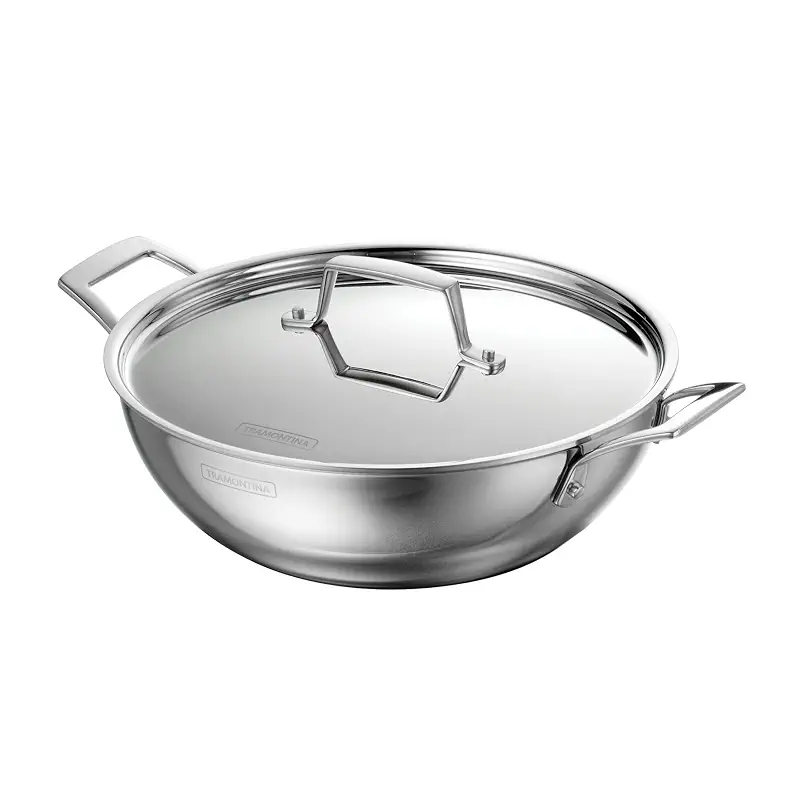
Ideal for: Home cooks seeking a premium, induction-compatible kadai for family meals and mixed cuisines.
The Tramontina Utsava strikes a strong balance between build quality and everyday performance. Its tri-ply clad stainless steel construction ensures even heating across the bottom, something many home cooks struggle with when moving between gas and induction cooktops. The 4-quart capacity handles family meals and batch cooking without forcing you to work in stages, and the internal measurement markings save time when following recipes.
Owners consistently praise the durability and how quickly it heats once you've got the flame right. The handle design keeps your hands relatively safe during longer cooking sessions, and the fact that it's oven-safe up to 500°F opens up finishing techniques (like browning the top of a curry or braise) that smaller kadais can't manage. The rosewood-style handles feel premium, though they do warm up under sustained high heat, so using oven mitts is still wise.
Where the Tramontina edges out the Hawkins models is in its refined polish and the confidence it gives newer cooks. If you're buying your first serious kadai and want something that works equally well for ramen, risotto, soups, and traditional curries, this is the smartest pick. The trade-off is weight (it's noticeably heavier than aluminum alternatives) but that mass is what delivers the even cooking most cooks are actually after.
Pros
Tri-ply clad ensures even heat distribution across all cooktops
4-quart capacity fits family meals and batch cooking easily
Oven-safe to 500°F for finishing dishes in the oven
Cons
Heavier than aluminum woks, requires more effort to move
Handles warm up during long cooking sessions on high heat
Key features
Tri-ply stainless steel construction with induction-compatible base
4-quart capacity with internal quart and liter markings
Oven-safe to 500°F with NSF certification
Mirror-polished exterior and satin interior finish
Included lid and precision-cast stainless steel handles
#2 Pick
Best for Small Households
Hawkins
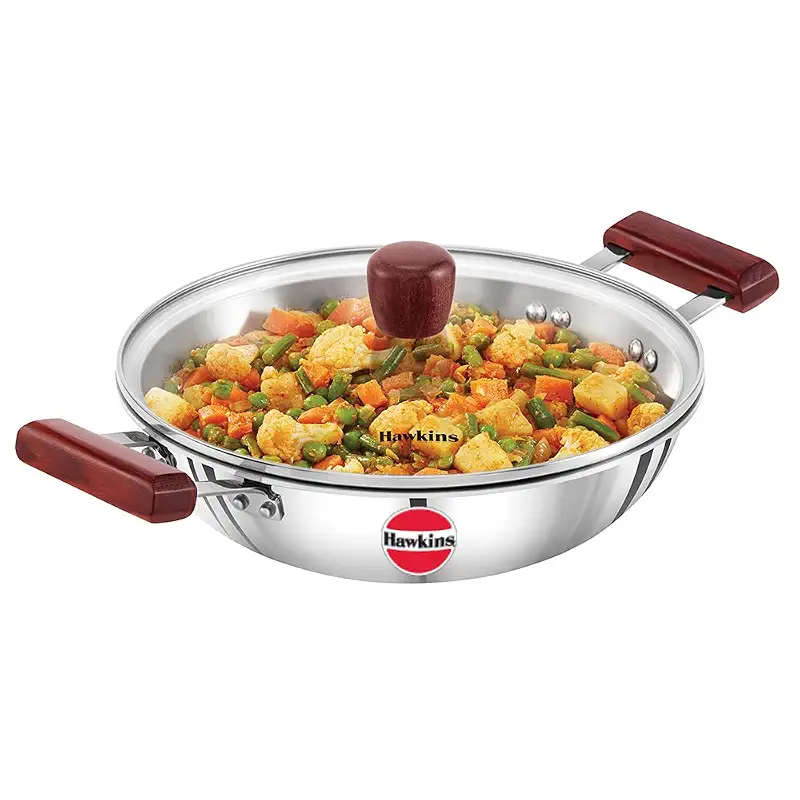
Hawkins 2.5 Litre Deep Fry Pan, Triply Stainless Steel Kadai with Glass Lid, Flat Bottom Induction Kadhai, Silver (SSD25G)
4.5(2,771)
Compact 2.5-liter tri-ply kadai perfect for cooking for one or two, with easy cleanup and reliable heat.
Ideal for: Solo cooks and couples seeking a compact, low-maintenance tri-ply kadai for daily curries and stir-fries.
The Hawkins 2.5-liter model is purpose-built for modest servings without the bulk of a family-sized vessel. At this capacity, you're looking at cooking for two people comfortably, or one person with leftovers to freeze. The tri-ply construction (the same material that makes larger kadais perform so well) means you're not sacrificing heat distribution just because the pot is smaller. Reviews consistently note that food doesn't stick or burn as readily as it would in a regular stainless steel pan, which is the real advantage of tri-ply construction.
The glass lid lets you monitor your curry or stir-fry without lifting it, saving heat and time. Rosewood handles are a nice touch, though like most tri-ply cookware, they conduct some warmth during extended cooking. The no-drip flange is genuinely useful when ladling: it prevents the mess that comes with pouring hot liquid from a rimmed pot. This kadai is dishwasher-safe, though hand-washing extends its life significantly.
Compared to the Tramontina, this Hawkins prioritizes footprint over capacity, making it ideal if counter or storage space is tight. It's also lighter to handle, which matters for people who prefer to move their cookware rather than work around it. The only real limitation is that if your household grows or you start cooking for guests, you'll outgrow it quickly.
Pros
Compact 2.5-liter size perfect for one or two servings
Tri-ply construction prevents sticking and burning
Glass lid allows monitoring without heat loss
Cons
Smaller capacity limits batch cooking and family meals
Glass lid handle can become loose with regular use
Key features
2.5-liter capacity with tri-ply stainless steel construction
Flat bottom suitable for induction, electric, and gas cooktops
Rosewood handles fixed with eight stainless steel rivets
No-drip ezee-pour flange for safe ladling and serving
Dishwasher-safe with food-grade AISI 304 stainless steel
#3 Pick
Best for Large Families
Hawkins
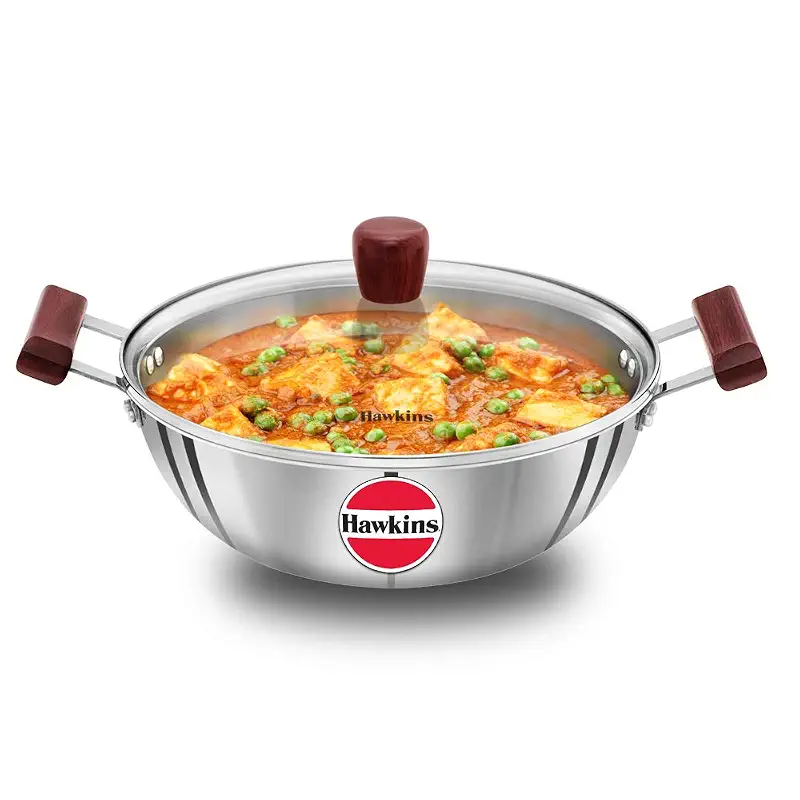
Hawkins 4 Litre Deep Kadhai, Triply Stainless Steel Kadai with Glass Lid, Flat Bottom Induction Kadhai, Big Kadai, Silver (SSK40G)
4.6(1,331)
Heavy-duty 4-liter deep kadai with superior heat retention and durability for serious home cooks.
Ideal for: Large families and serious home cooks who prepare substantial curries, stews, and deep-fried items regularly.
The Hawkins 4-liter deep kadai is built for people who cook in volume. The extra depth prevents spills when stirring vigorous curries, and the 4-liter capacity means you can sear meat, build a sauce, and finish a dish in one vessel without crowding. At 3mm thick tri-ply stainless steel, this is noticeably heavier than the smaller Hawkins model: which actually works in your favor, because that mass keeps heat steady even when you're adding cold ingredients or cooking at high temperatures.
Owners describe it as nearly impossible to burn food in, a quality that matters when you're managing a busy kitchen with multiple dishes. The wooden handles stay relatively cool compared to all-metal alternatives, and the glass lid is genuinely solid: reviewers note it doesn't feel flimsy. This kadai also performs beautifully on induction, though it heats more gradually than on gas. That slower ramp is actually an advantage for controlled simmering of curries; the steady, even heat means fewer burnt-on bottoms and more even flavor development.
If you're comparing this to the Tramontina Utsava, the Hawkins edges slightly ahead for pure cooking volume and depth. The trade-off is that the Tramontina's polish and lighter weight might feel more refined. But if you're feeding a family of five or more regularly, or you batch-cook for the week, the Hawkins' no-nonsense engineering and proven track record win out.
Pros
Extra-deep 4-liter capacity ideal for large family meals and batch cooking
Ideal for: Premium-minded cooks who prioritize durability, induction compatibility, and the extra depth for curries and frying.
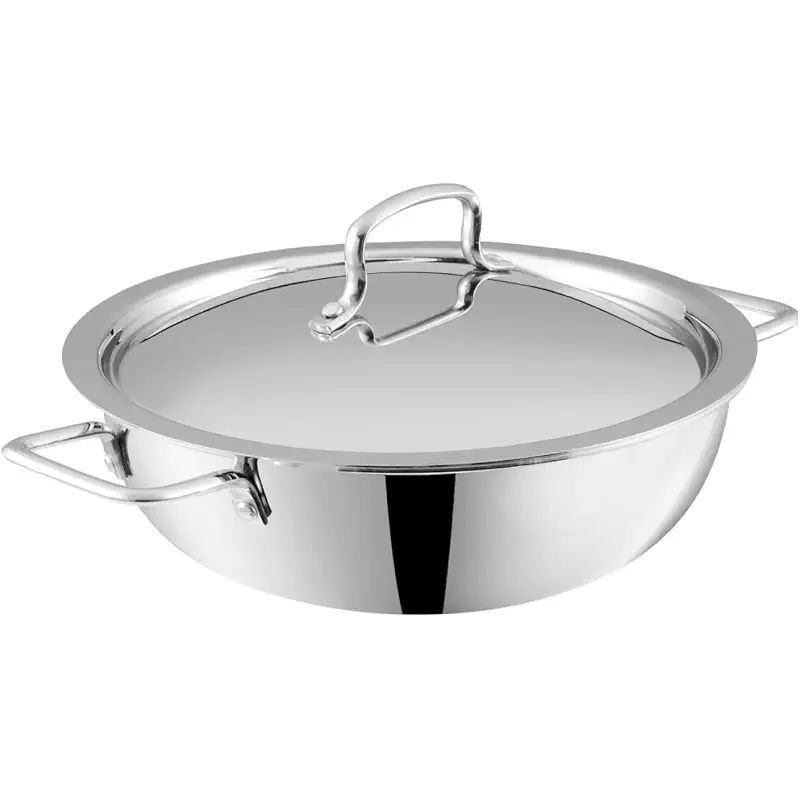
The Vinod Platinum Triply stands out for its attention to detail in both materials and design. The 34cm diameter and extra-deep profile give you more cooking surface and capacity without the weight penalty you'd take with a 4-quart stainless pot. The tri-ply construction here follows the same principle as the Hawkins and Tramontina, but Vinod emphasizes the magnetic stainless steel outer layer, which means solid induction compatibility if that's your cooktop.
What distinguishes this model is the stainless steel lid rather than glass. This matters more than it sounds: glass lids collect moisture and can fog up, making it harder to see your food; metal lids conduct heat better and are more durable in the dishwasher. The steam vent built into the lid is a thoughtful touch for controlled simmering. The heat-resistant stainless handles (not wood) are lower-maintenance and feel more industrial, which appeals to cooks who want minimal fuss.
Compared to the Hawkins 4-liter or Tramontina Utsava, the Vinod prices slightly higher and comes with fewer buyer reviews to draw from. That said, Vinod is a respected Indian cookware brand with decades of manufacturing experience, and the extra depth of this model gives you a slight edge if you're primarily doing curry work or frying. The stainless steel lid also lasts longer than glass without the replacement hassle.
Pros
Extra-deep 34cm profile prevents spilling during vigorous cooking
Stainless steel lid is more durable and fog-resistant than glass
Tri-ply construction with full induction compatibility
Cons
Limited buyer reviews relative to established brands like Hawkins
Premium positioning may not justify the cost for occasional cooks
Key features
Extra-deep 34cm diameter with tri-ply stainless steel body
Food-grade 18/8 stainless steel inner surface for healthy cooking
Aluminum core layer for even heat distribution and reduced burning
Stainless steel lid with steam release vent for controlled simmering
Heat-resistant stainless steel handles and induction-friendly base
#5 Pick
Best for Cast Iron Enthusiasts
Lodge
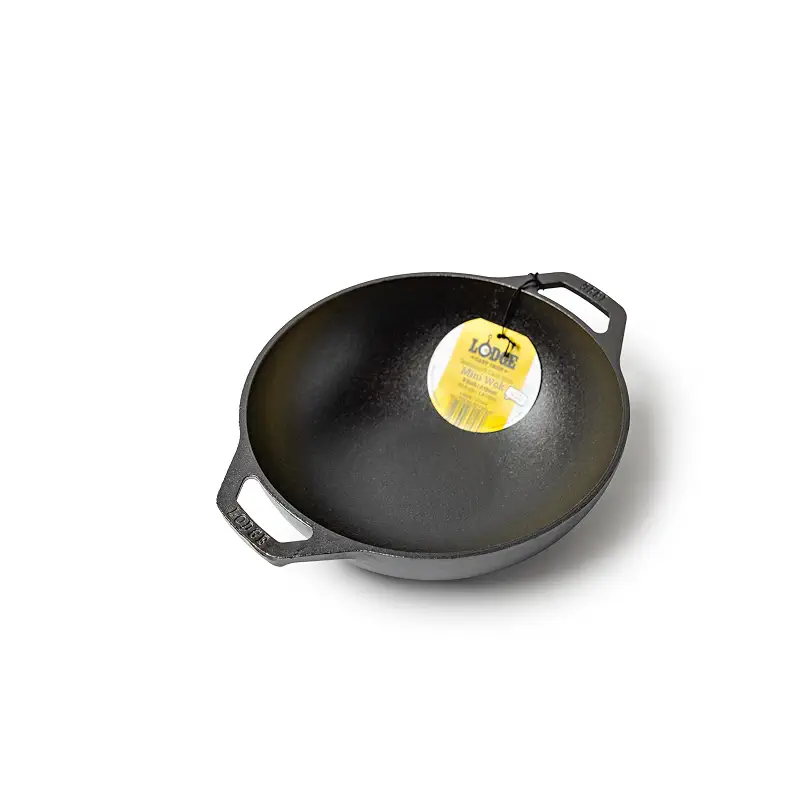
Lodge Pre-Seasoned Cast Iron Stir Fry Mini Wok, PFAS-Free, 9 Inches | PFAS-Free Cast Iron Wok for Stir Fry, Searing & Everyday Cooking, Oven & Stovetop Safe, Non-Toxic & Durable
4.6(6,079)
Compact 9-inch cast iron wok perfect for stir-fry and high-heat cooking, with a lifetime durability promise.
Ideal for: Cast iron devotees and high-heat cooks who prioritize seasoning development and are willing to hand-wash their cookware.
The Lodge cast iron mini wok represents a fundamentally different approach to kadai cooking. Instead of stainless steel tri-ply, you get pre-seasoned cast iron that builds its own non-stick surface over time. This matters because cast iron retains heat longer and more intensely than any stainless option, which is why professional wok cooking in restaurants relies on cast iron. For stir-fry, high-heat searing, and the kind of aggressive cooking that benefits from a screaming-hot pan, Lodge delivers.
The 9-inch size keeps it manageable for everyday use: it's compact enough for two people and still substantial enough for a side dish or appetizer for a small gathering. Cast iron requires a different maintenance mindset than stainless steel. You'll hand-wash only, wipe dry immediately, and season with a light oil coat after each use. Once you develop that habit, cleanup is actually faster than stainless, and the seasoning improves your non-stick surface permanently. Buyers rave about how nothing sticks once you learn the rhythm of preheating and oil management.
Where cast iron differs from the stainless steel kadais is intent. The Tramontina, Hawkins, and Vinod models are built for simmering curries and soups. Lodge is optimized for fast, high-heat cooking. If you're torn between stainless steel kadai vs cast iron, the answer is your cooking style: cast iron excels at stir-fry and quick searing; stainless steel kadai shines for slow-cooked curries. Lodge is made in the USA, which resonates with cooks who value manufacturing heritage.
Pros
Pre-seasoned cast iron improves non-stick quality with every use
Exceptional heat retention ideal for stir-fry and searing
Made in the USA with lifetime durability promise
Cons
Requires hand-washing and regular seasoning maintenance after use
Much smaller than traditional kadais, unsuitable for family curry cooking
Key features
9-inch compact wok with traditional cast iron construction
Pre-seasoned with 100% vegetable oil, ready to use immediately
Dual loop handles for secure grip and easy transport
PFAS-free and made with only iron and vegetable oil
Oven and stovetop safe, works on all cooktop types including induction
How to Choose the Right Kadai for Your Kitchen
Four trade-offs that actually matter when matching a kadai to your kitchen.
Capacity and Serving Size
Kadai size should match your typical cooking volume. A 2.5-liter model suits one or two people and saves counter space. A 4-quart (approximately 3.8 liters) fits a family of four to five comfortably and allows batch cooking for freezing. If you regularly host or cook for six or more, look for the 4-liter deep models. Capacity also affects cooking speed: a smaller pot heats faster, while a larger one retains heat better when you add cold ingredients.
Material: Stainless Steel vs. Cast Iron
Stainless steel kadais with tri-ply construction are ideal for simmering curries, soups, and slow-cooked dishes. They heat evenly, resist staining, and require minimal maintenance. Cast iron excels at high-heat stir-frying and searing, develops a natural non-stick surface, and lasts generations, but requires hand-washing and regular seasoning. Your choice hinges on whether you prioritize stainless steel kadai vs cast iron for everyday curry work or occasional wok-style cooking. Most households find tri-ply stainless steel more versatile for the range of Indian cooking they do.
Cooktop Compatibility
If you cook on induction, confirm the kadai has a magnetic, flat bottom. Tri-ply stainless steel models (Tramontina, Hawkins, Vinod) all work on induction, though they heat more gradually than on gas. Cast iron also works on induction but requires preheating. Gas and electric cooktops work with any kadai. Some older homes still have coil burners; tri-ply kadais work fine, though a cast iron wok is slightly more forgiving of uneven heat distribution. Unlike choosing a best korean rice cooker based on rice type, kadai selection is more about cooking method and family size.
Lid Type and Heat Control
Glass lids let you monitor cooking without lifting, but they fog and collect condensation, making it harder to see your food. Stainless steel lids conduct heat better, fog less, and last longer in the dishwasher, though you can't peek without opening. For simmering curries, either works. For high-heat stir-frying, a stainless lid is preferable. Many kadais come with lids included; if buying separate, ensure the fit is snug to avoid heat loss and spattering.
Handle Design and Safety
Wooden or rosewood handles insulate heat better and feel more comfortable for extended cooking, but they require hand-washing and can split if exposed to dishwasher heat. Stainless steel handles conduct more warmth but are nearly indestructible. Loop or curved handles on the sides (traditional kadai style) are safer than long protruding handles when you're carrying a heavy, hot pot. Test the handle balance if possible: an off-center handle makes the kadai harder to pour from without spilling.
Frequently asked
Quick answers to the questions readers ask most.
What is tri-ply stainless steel construction, and why does it matter?
Tri-ply means three layers: food-grade stainless steel on the cooking surface, aluminum in the middle for heat conduction, and magnetic stainless steel on the bottom for induction. This prevents hot spots, reduces sticking, and allows even cooking compared to single-layer pans. The aluminum core spreads heat quickly and evenly, which is essential for curries where uneven heat causes burning on the bottom.
Can I use a kadai on an induction cooktop?
Yes, if it has a flat, magnetic bottom. All stainless steel tri-ply kadais in this guide work on induction. Cast iron also works on induction. Avoid aluminum or copper-bottomed kadais on induction, as they won't heat. Check the product description or test with a magnet: if it sticks to the bottom, induction is compatible.
How do I prevent food from sticking to a stainless steel kadai?
Preheat the kadai for two to three minutes before adding oil, then wait until the oil shimmers before adding food. Avoid moving food too early; let it develop a crust first, then it will release naturally. Use adequate oil or ghee: stainless steel isn't naturally non-stick like cast iron or Teflon. Deglaze with water or broth if food is stuck; it will lift easily after a minute.
Is a cast iron wok better than a stainless steel kadai?
Not universally better: it depends on your cooking. Cast iron excels for stir-fry, high-heat searing, and rapid cooking because it retains intense heat. Stainless steel tri-ply is superior for simmering curries, soups, and slow-cooked dishes where even heat and minimal maintenance matter more. Most home cooks benefit from owning both, but if you choose one, stainless steel kadai handles a wider range of Indian cooking.
How do I clean and maintain a stainless steel kadai?
Wash by hand with warm soapy water and a soft cloth or sponge immediately after cooking. For stuck-on food, fill with water, boil for a few minutes, then scrub. Avoid steel wool, which scratches the finish. For stubborn spots, use Bar Keepers Friend or baking soda paste. Dry thoroughly with a towel and store dry. Some tri-ply kadais are dishwasher-safe, but hand-washing extends their life significantly.