Kitchen & Dining · Cookware
Best Japanese Knife Sets Under $200 for Home Cooks
Find the best Japanese knife sets under $200. Compare 5 top-rated options with Damascus, stainless steel, and professional-grade blades for home kitchens.
Affiliate disclosure: As an Amazon Associate I earn from qualifying purchases.
At a glance
1
Best Overall: Storage-Smart DesignSyokami
2
Best Value: Versatile 5-Piece SetBrewin
3
Premium Aesthetic: Damascus CladdingEmojoy
4
Best for Serious Home Cooks: 5-Piece PowerhouseSanmeiho
5
Premium Japanese Craftsmanship: VG10 DamascusAtumuryou
Detailed reviews
The Syokami set hits a sweet spot for families juggling counter space and safety. The seven-piece lineup covers nearly every cutting task, from the 8-inch chef's knife down to a 3.8-inch paring blade, so you're rarely reaching for a substitute. The hand-sanded 15-degree edge and high-carbon stainless steel (56+ Rockwell) keep these knives sharp through weeks of regular use, and buyers consistently report that sharpness feels revelatory after years with dull hardware-store knives.
The foldable acacia block is genuinely clever for small kitchens and rentals. It collapses into a drawer to protect kids and pets, and the magnetic slots hold each knife securely during transport. Where this set diverges from the Sanmeiho option is storage philosophy: the Syokami trades permanent counter presence for flexibility. One buyer noted the block's easel can feel unstable on countertops if knocked, which matters if you prefer your knife block as a permanent display piece.
If you prioritize a set that vanishes when not needed yet remains approachable for daily cooking, the Syokami excels. The lifetime warranty and gift packaging also make this a natural choice for someone buying on behalf of another cook.
Pros
- Foldable design stores flat in drawers
- Magnetic slots hold knives securely in place
- Seven-piece set covers all everyday prep tasks
Cons
- Easel-stand balance can be unstable on countertops
- Not ideal for cooks who want knives on permanent display
Key features (4)
- 7-piece Damascus-pattern set with 56+ Rockwell hardness
- Foldable acacia wood block with magnetic knife slots
- Hand-sanded 15-degree edge on all blades
- Includes 8-inch chef, Santoku, slicing, bread, utility, and paring knives
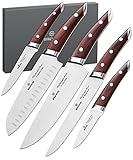
Brewin's Chefilosophi set has earned exceptional buyer trust. The combination of 56+ Rockwell hardness, full-tang construction, and three-point handle reinforcement delivers durability that belies the budget price. The red pakkawood handles are both functional and visually distinctive, and the ergonomic balance reduces hand fatigue during longer prep sessions. Buyers appreciate that these knives come sharp enough to demand respect, yet the German 1.4116 stainless steel is forgiving enough for home cooks who don't hone obsessively.
Compared to the Damascus-pattern aesthetics of the Emojoy set, the Brewin prioritizes function and longevity over visual drama. The five-piece lineup (two 8-inch knives, Santoku, utility, and paring) covers most home cooking without redundancy. One review noted the steel's ease of resharpening, which matters for cooks planning to keep these knives for years. The full-tang design also means no weak points at the bolster, a common failure zone in cheaper sets.
If you want a set that performs like professional equipment without the commitment to specialty maintenance, this is the clearest choice. The value proposition has attracted enough serious home cooks that resale demand remains strong.
Pros
- German stainless steel holds edge well over time
- Full-tang construction with reinforced handle anchors
- Excellent balance reduces hand fatigue
Cons
- Requires hand-washing and careful honing maintenance
- German steel is softer than Damascus alternatives, dulls faster
Key features (4)
- 5-piece set with 56+ Rockwell German 1.4116 stainless steel
- Full-tang blades with red pakkawood ergonomic handles
- Includes two 8-inch, 7-inch Santoku, 5-inch utility, and 3.5-inch paring
- Professional-grade construction at entry-level price
The Emojoy set appeals to cooks who view their knives as kitchen jewelry. The 67-layer Damascus cladding, combined with a 58 Rockwell hardness core and hand-forging by experienced blacksmiths, creates blades that are genuinely beautiful to look at while delivering the performance home cooks need. The laser-controlled 15-degree edge arrives razor-sharp, and the organic CALABRIAN olive wood handle feels warm and comfortable in hand. At just three pieces (8-inch chef, 7-inch Santoku, 3.5-inch paring), the set is minimal but sufficient for 90 percent of household cutting.
The key trade-off is blade count: unlike the five-piece Sanmeiho set, you're without a dedicated fillet knife or utility blade, which some cooks will feel as a gap. One buyer reported early rust-spotting after a month, which is rare but suggests olive wood requires conscientious drying. The Damascus aesthetic also means these knives invite display, so counter real estate becomes part of the cost.
If you cook primarily with vegetables and occasional proteins, and you value owning something that looks as good as it cuts, the Emojoy justifies its position. The wooden gift box also elevates this as a gift for someone who already owns basics.
Pros
- 67-layer Damascus cladding is visually striking
- Hand-forged with 58 Rockwell hardness core
- Comfortable olive wood handle with organic ergonomic shape
Cons
- Only three knives limits versatility compared to larger sets
- Olive wood requires careful drying; rust-spotting reported rarely
Key features (4)
- 67-layer Damascus forged blades with 0.98% carbon core
- Hand-forged by experienced blacksmiths in Japan
- CALABRIAN olive wood handles with half-bolster design
- 3-piece set: 8-inch chef, 7-inch Santoku, 3.5-inch paring
The Sanmeiho set represents a step up in hardness and precision for cooks ready to treat their knives with intention. The 10Cr15CoMoV high-carbon Japanese steel heat-treated to 63 Rockwell is notably harder than the Brewin's 56+ Rockwell, which means these blades hold their edge longer between sharpenings. The hand-sharpened 12-degree angle is more aggressive than industry standard, demanding lighter pressure and cleaner technique, but rewards that discipline with effortless, paper-thin cuts.
The five-piece lineup (8-inch chef, 7-inch Santoku, 7-inch fillet, 6-inch utility, 3.75-inch paring) includes a dedicated fillet blade absent from the three-piece Emojoy, making this the most versatile option for omnivorous home cooks. Pakkawood handles provide excellent weight distribution and durability, though one buyer correctly noted these knives should never see a dishwasher. A German-language review highlighted that the 12-degree angle requires respectful handling and a proper honing stone, so this set suits cooks willing to learn knife care fundamentals, not someone seeking set-and-forget reliability.
Where this diverges from the Atumuryou option is simplicity: Sanmeiho focuses on performance without Damascus drama, appealing to cooks who want precision tools, not conversation pieces.
Pros
- 63 Rockwell hardness holds edges exceptionally long
- 12-degree angle delivers paper-thin, precise cuts
- Five-piece set includes dedicated fillet blade
Cons
- Aggressive edge angle requires proper honing technique
- Harder steel is more brittle; improper use risks chipping
Key features (4)
- Japanese 10Cr15CoMoV steel heat-treated to 63 HRC
- Hand-sharpened to precision 12-degree blade angle
- 5-piece set with chef, Santoku, fillet, utility, and paring
- Ergonomic pakkawood handles with balanced weight distribution
The Atumuryou set bridges visual luxury and functional excellence in a way that justifies its premium positioning within this price band. The 67-layer Damascus cladding over a Japanese steel core (62 Rockwell) and 12-degree hand-sharpened edge deliver both aesthetic drama and cutting performance. The ocean-blue resin stabilized-wood handles are genuinely one-of-a-kind, with full-tang construction and ergonomic dimpling at the hilt. Buyers consistently report that sharpness rivals knives costing three times as much, and the hand-forged quality control feels evident in how the blade balances and responds in hand.
The three-piece lineup (8-inch chef, 7-inch Santoku, 3.5-inch paring) is identical in count to the Emojoy, though steel is Japanese and generally considered slightly superior in edge retention to the Emojoy's 0.98% carbon core. The Atumuryou's cushioned velvet packaging and gift-box presentation reflect the maker's care, making this a natural choice for someone buying a special knife as a milestone gift. One potential drawback: the stabilized-wood handles, while beautiful, require hand-washing and should not spend time in water; they're meant to be respected, not grabbed carelessly.
If you want the Emojoy's three-knife minimalism but with superior Japanese steel and visibly higher craftsmanship, this is your choice. The 62 Rockwell hardness also splits the difference between mid-range and ultra-hard blades, making it forgiving enough for home cooks yet serious enough for culinary enthusiasts.
Pros
- Japanese steel holds edges better than comparable alternatives
- Hand-forged 67-layer Damascus with visible, unique patterns
- One-of-a-kind ocean-blue resin handles with ergonomic grip dimples
Cons
- Only three knives limits versatility for varied cooking tasks
- Stabilized-wood handles require careful hand-washing and drying
Key features (4)
- Japanese steel core with 67-layer Damascus cladding
- Hand-forged and hand-sharpened to 12-degree angle per side
- Stabilized wood with ocean-blue resin handles, full-tang construction
- 3-piece set: 8-inch chef, 7-inch Santoku, 3.5-inch paring
How to Choose a Japanese Knife Set
Steel Type and Hardness Matter More Than You Think
Japanese knives typically use either stainless steel, carbon steel, or Damascus (layered) construction. Hardness, measured in Rockwell (HRC), ranges from 56 to 63+ in this price range. Higher hardness means longer edge retention but also increased brittleness; a 63 HRC blade holds a sharper edge longer than a 56 HRC, but demands more careful handling. Understanding japanese knife steel types guide helps clarify trade-offs between German stainless (softer, forgiving) and Japanese high-carbon (harder, less forgiving). For most home cooks, 56-58 HRC balances edge-holding and durability.
Knife Count vs. Blade Variety
A three-piece set (chef, Santoku, paring) handles 85 percent of home cooking and minimizes storage hassle. A five-piece set adds a utility knife and fillet blade, expanding options for boning, filleting, and prep work. Seven-piece sets begin including specialty blades like bread knives and slicing knives. Consider how you actually cook: vegetable-focused home cooks thrive with three knives, while omnivorous cooks benefit from a fillet or slicing blade. Avoid buying larger sets simply because they exist; unused knives gather dust and complicate maintenance.
Storage and Display Trade-offs
Magnetic knife blocks, foldable designs, and traditional slots each solve different problems. A foldable magnetic block stores flat in drawers, protecting children and maximizing counter space but sacrificing easy daily access. A countertop block is always ready but occupies real estate. Consider your household's priorities: rental kitchens and small apartments favor foldable designs, while cooks with dedicated kitchen counter often prefer permanent display. The best storage system is the one you'll actually use daily without frustration.
Handle Material Affects Comfort and Care
Pakkawood (laminated wood composite) is durable, visually appealing, and dishwasher-resistant. Natural wood (olive, stabilized wood with resin) looks premium and feels warm in hand but demands careful hand-washing and drying to prevent splitting or staining. Synthetic handles are rare at this price point but offer maximum durability. Your choice depends on whether you view knife maintenance as part of the ritual (natural wood fans) or an obstacle to daily use (pakkawood preference). Japanese knife maintenance basics covers cleaning and sharpening essentials for any handle type.
Edge Angle and Sharpening Frequency
Japanese knives typically arrive sharpened to 12-15 degrees per side, which is more acute than German knives (20 degrees). This means Japanese blades cut more cleanly but require honing every few uses and professional sharpening annually. A 15-degree edge is friendlier for home cooks; a 12-degree edge rewards disciplined technique and regular maintenance. Budget for a honing steel (under $20) if you plan to keep these knives sharp between professional sharpenings. The sharper the angle, the more frequently you'll sharpen: a real consideration before committing.
Our picks at a glance
1
Best Overall: Storage-Smart DesignSyokami
2
Best Value: Versatile 5-Piece SetBrewin
3
Premium Aesthetic: Damascus CladdingEmojoy
4
Best for Serious Home Cooks: 5-Piece PowerhouseSanmeiho
5
Premium Japanese Craftsmanship: VG10 DamascusAtumuryou
Frequently asked
Can I put Japanese knives in the dishwasher?
No. Hand-wash all Japanese knives immediately after use with lukewarm water and mild soap, then dry thoroughly. Dishwashers expose blades to extreme heat and harsh detergents, dulling edges and damaging handles. If a knife spends hours wet, the steel can develop rust spotting and the wood can swell or split. Hand-washing takes 30 seconds per knife and keeps them performing for years.
How often should I sharpen Japanese knives?
Most home cooks sharpen annually with a professional or honing stone, but frequency depends on use. A family that cooks daily might sharpen every 6 months; a casual cook every 18 months. Between sharpenings, use a honing steel once weekly to realign the edge. Honing keeps the blade aligned without removing metal; sharpening removes metal to restore the edge. A 15-degree angle is easier for home cooks to maintain than a 12-degree, making that a practical consideration.
What's the difference between Damascus and solid-steel blades?
Damascus knives feature visible layered patterns created by forging different steel types together. The aesthetic appeal is genuine, and the layering can enhance durability and corrosion resistance. Solid-steel blades (high-carbon or stainless) prioritize function without visible ornamentation. Both approaches produce sharp, durable knives; the choice is whether you value the visual drama and hand-forged character of Damascus or prefer straightforward performance. Damascus blades typically require the same maintenance as solid steel.
Is a 56 Rockwell hardness better than 63?
Higher hardness holds an edge longer, but also chips more easily with rough handling. A 56 HRC blade is forgiving: softer, more durable against accidents. A 63 HRC blade is harder, sharpens to a finer edge, and keeps that edge longer, but demands more careful use and technique. For home cooks who sometimes bang knives around, 56-58 HRC offers a practical balance. For disciplined cooks willing to respect their tools, 62-63 HRC delivers edge retention that justifies the trade-off.
Should I buy a set or individual knives?
A set offers better value and ensures coherent design and quality control across all blades. A three- to five-piece set covers nearly all home cooking needs at one purchase. Buying individual knives later is sensible only when you've identified a genuine gap (a fillet knife, for example) or want a specialty blade for specific cooking. Most home cooks never need more than five knives; a complete set acquired upfront is simpler and more economical than piecemeal building.