Kitchen & Dining · Espresso
Best Heat Exchange Espresso Machine for Home Baristas
Find the best heat exchange espresso machine for your kitchen. Compare top models, learn what matters, and discover which fits your brewing style.
Affiliate disclosure: As an Amazon Associate I earn from qualifying purchases.
At a glance
1
Best OverallRocket Espresso Milano
2
Best Updated DesignRocket Espresso Milano
3
Best Premium Italian AestheticDiletta
4
Best for Speed and Temperature PrecisionRocket Espresso Milano
5
Best Entry Point with Built-in GrinderBreville
Detailed reviews
The Rocket Appartamento Nera sets itself apart through an unapologetic mechanical philosophy. It has no digital widgets or electronic creep: just a heat exchanger boiler, mechanical controls, and an E61 group head that owners consistently report lasting decades with proper care. That durability matters because espresso gear represents a commitment, not a gadget.
What buyers highlight is the machine's responsiveness to technique. The mechanical dial controls and simple pressure regulation force you to develop intuition about brew time, temperature profiling, and milk texture. Early reviews show initial frustration (shots pull thin, milk won't stretch, crema disappears) but owners who push through report genuine competence within weeks. The learning curve is real, though it's the kind that sticks with you. Many mention pressure runs high out of the box (around 13 bar instead of the ideal 9), but the design is straightforward enough that adjusting it yourself is feasible and cheap.
Maintenance is non-negotiable here. Weekly backflushing with detergent, monthly tank cleaning, quarterly descaling: this isn't a "set it and forget it" appliance. The tradeoff is that if you follow the regimen, owners report machines running flawlessly for a decade or more. One long-term review after 2+ years of daily use noted that a single pressure-stat upgrade transformed the machine from solid to exceptional. That serviceability, that ability to tinker and improve for next to nothing, resonates deeply with owners who view espresso as a craft.
Pros
- Mechanical simplicity enables long-term repairability and DIY upgrades
- Heat exchanger design enables simultaneous brew and steam without dual-boiler cost
- Compact footprint suits tight kitchen counters without sacrificing thermal mass
Cons
- Steep learning curve; early shots often pull thin or bitter before technique locks in
- Factory pressure setting runs high; manual adjustment required for optimal results
Key features (4)
- 1.8-liter heat exchange boiler for simultaneous brewing and milk steaming
- E61 heated group head maintains stable brew temperatures during extraction
- Mechanical controls with manual pressure regulation for total user command
- Compact chassis designed for space-restricted kitchens and small counters
The Appartamento 2.0 takes the architecture that proved itself over years of ownership and layers in refinements that address minor friction points. The deeper drip tray cuts down on emptying frequency. The extended steam and hot water valves reduce reaching and awkward angles during milk work. The RGB indicator light replaces guesswork about machine readiness: small luxuries that compound over daily use.
Where it converges with the original Nera is the heat exchanger core and the manual control philosophy. If you've read the Nera analysis, the learning demands and maintenance commitment are identical. The 2.0 is not a dumbed-down version; it's the same demanding machine with better ergonomics. The updated control board brings more refined pressure management, which could spare you the fine-tuning that first-gen owners sometimes pursue.
Compared to the Giotto FAST R further down this list, the Appartamento 2.0 trades electronic temperature control for mechanical purity: fewer things to fail, more direct feedback between your actions and the cup. That choice will appeal to different people depending on philosophy. If you value tinkering and long-term ownership, the 2.0 honors that. If you want a machine that dials in automatically and lets you focus on milk technique, the Giotto's PID control is worth the step up.
Pros
- Deeper drip tray and extended valve reach improve daily usability
- RGB indicator removes guesswork about machine warm-up status
- Updated control board enables more stable pressure regulation out of the box
Cons
- No customer reviews available; buyer confidence rests on brand reputation alone
- Manual controls still demand technique and patience; not a step toward automation
Key features (4)
- 1.8-liter heat exchange boiler with consistent thermal stability
- E61 group head design with improved pressure consistency via updated board
- Available in polished stainless, black powdercoat, or copper side panel finishes
- Handcrafted in Milan with Rocket's three-year parts-and-labor warranty
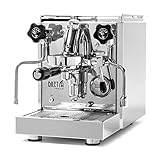
The Diletta Bello arrests attention the moment you see it. All-stainless construction, elegant proportions, handmade-in-Milan provenance: it arrives as a design object, not just an appliance. The heat exchanger boiler and E61 group head promise the same simultaneous brew-and-froth capability as its Rocket counterparts, and the optional eco timer adds a convenience absent from the Appartamento Nera.
But buyer feedback reveals significant reliability cracks. Two separate reviews report water leaks from underneath the machine appearing within weeks of ownership, persisting even after parts replacement. One owner describes a two-month repair turnaround that left them without an espresso machine during the warranty period. Another reports the group head leaking hot coffee and spray onto the counter, creating a safety hazard. These aren't isolated outlier complaints; they form a pattern.
Thermal stability is another friction point. The Bello demands a 30-minute warm-up before the first shot pulls properly, and even then, early shots register weak pressure on the gauge. Compared to the Rocket Appartamento, which owners learn to manage quickly, this machine feels sluggish and unreliable. For the premium price (and the aesthetic appeal), the expectation would be that durability and consistency match the design. They don't. If you prioritize looks above everything and are prepared to wrestle with repair logistics, the stainless-steel finish is genuinely beautiful. If you want the heat exchanger capability to actually work reliably, the Rocket machines (despite less flashy styling) deliver more consistent ownership experience.
Pros
- All-stainless-steel construction with sculptural appeal stands out visually
- Heat exchanger enables simultaneous brew and steam from a single thermal mass
- Optional 60-minute eco timer prevents accidental overheating when left idle
Cons
- Water leaks from beneath machine reported within weeks; warranty repairs slow and inconvenient
- Extended warm-up time and weak pressure suggest thermal management issues affecting consistency
Key features (4)
- All-stainless-steel body, boiler, and frame for premium durability appearance
- E61 heat exchange group head for thermal stability and simultaneous steam capability
- Manual brew and steam controls demand active barista technique and attention
- Available in polished stainless, black, or white powdercoat finish options
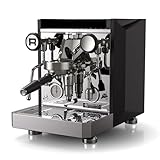
The Giotto FAST R represents the opposite philosophy from the Appartamento Nera. Instead of mechanical regulators and thermal intuition, you get PID temperature control that holds the brew water within a narrow band without fussing. The rotary pump and larger heating elements promise 15-minute heat-up versus the standard 20–30 minutes, and that convenience compounds if you're pulling multiple drinks daily or making shots back-to-back.
The hidden controls (tucked behind the drip tray) preserve the visual simplicity while enabling fine-grained electronic management. A shot timer tracks your extraction and helps lock in consistency. For someone who views espresso as a destination rather than a ritual, these features compress the learning phase significantly. You dial in your grind and dose, trust the PID to manage temperature, and focus on milk technique: a more modern take on "just make good coffee."
The trade-off is mechanical. Electronic controls fail; mechanical controls endure. The Giotto's complexity means repair requires specialist knowledge, and if the PID board or solenoids fail after the warranty period, you're facing a repair bill or replacement. The Rocket machines, by contrast, invite owner tinkering and simple part swaps. Compared to the Nera, you're paying a significant step up for speed and automation rather than for expanded capability. If your priority is consistency and efficiency, and you trust that Rocket's build quality will outlast your warranty period, the Giotto FAST R is the pragmatic choice. If you prize the ownership experience itself (the learning, the tinkering, the decade-long relationship with a machine) the mechanical Appartamento likely suits you better.
Pros
- PID temperature control maintains precise brew-water temperature without manual adjustment
- 15-minute heat-up time and rotary pump enable quick successive shots
- Shot timer and hidden controls reduce learning curve while preserving elegant aesthetics
Cons
- Electronic components reduce long-term repairability compared to mechanical machines
- Significantly higher cost than the mechanical Appartamento for incremental brewing gains
Key features (4)
- 1.8-liter heat exchanger boiler with integrated PID temperature management system
- Rotary pump and enlarged heating elements achieve 15-minute brew-ready warm-up
- Asymmetric Giotto side panels and modern beveled case design
- Shot timer and hidden electronic controls streamline operation and monitoring
The Breville Barista Express occupies a fundamentally different category from the heat exchangers above, yet it deserves consideration because many first-time buyers choose it over traditional espresso machines. The built-in conical burr grinder, integrated tamper, and PID temperature control compress multiple purchases and decision-making into one box. For someone entering espresso cold, that consolidation reduces friction and cost.
Long-term owners report years of reliable daily use. The grinder works, the PID manages temperature, and the steam wand (while not as powerful as a heat exchanger or dual boiler) steams milk adequately for lattes and cappuccinos. The included accessories (tamper, portafilter, milk jug, cleaning tablets) get you started without buying separately.
But the limitations matter for serious espresso work. It's a single-boiler machine, meaning you brew, wait for the boiler to cool, then steam milk: a workflow bottleneck if you're making multiple drinks. The steam power is slower than heat exchangers, so microfoam takes 60–70 seconds instead of seconds. The small water reservoir needs frequent refilling. Most critically, the built-in grinder, though serviceable, heats beans during grinding and lacks the adjustability of dedicated burr grinders that espresso demands. For occasional lattes or espresso on weekends, it's outstanding value. For daily craft espresso work, the heat exchangers above offer more satisfying long-term paths. If your morning routine also includes brewing a best turkish coffee maker alongside espresso for guests, the Breville's compact footprint won't crowd your counter, but know that neither the heat exchanger machines nor the Breville are optimized for that dual-appliance scenario.
Pros
- Integrated conical burr grinder eliminates the need for a separate grinder
- Digital PID temperature control auto-manages brew water without manual fussing
- Years of owner reports indicate solid long-term reliability
Cons
- Single boiler requires workflow delay between brewing espresso and steaming milk
- Integrated grinder generates heat and lacks fine adjustability compared to standalone burr grinders
Key features (4)
- Integrated conical burr grinder with adjustable dose and manual override settings
- Digital PID temperature control for consistent brew-water temperature
- 54mm stainless-steel portafilter with single and double-wall filter baskets
- Powerful steam wand with low-pressure pre-infusion for balanced flavor extraction
How to Choose the Right Heat Exchange Espresso Machine
Heat Exchanger vs. Dual Boiler: Know the Trade-off
Heat exchangers use one large boiler with a water loop running through the group head. That design lets you brew and steam simultaneously: a dual-boiler capability at single-boiler pricing. The payoff is thermal cycling: the boiler can drift slightly outside ideal brew temperature if you've been steaming heavily. Dual boilers (not represented here) eliminate that drift, but they're bulkier, more expensive, and demand more electrical load. For most home baristas, heat exchanger vs. dual boiler comparison shows that heat exchangers handle daily use beautifully. The Rocket Appartamento Nera's two-plus years of owner data prove the point repeatedly.
Mechanical Controls vs. Electronic Temperature Management
The Appartamento Nera relies on mechanical pressure regulators and your intuition about brew time and temperature. The Giotto FAST R adds PID electronic control that holds temperature within tight tolerances automatically. Mechanical machines have fewer failure points and invite owner tinkering; electronic machines handle variation for you but are harder to repair yourself. Neither is objectively superior: it depends whether you want the espresso machine to be a tool you master or a tool that masters espresso for you. Budget and long-term ownership plans should drive this choice.
Warm-up Time and Group Head Stability
A heated group head (like the E61 in the Rockets and Diletta) keeps water circulating so brew temperature stays consistent between shots. Standard group heads require longer stabilization. The Breville Barista Express and some entry machines skip this refinement to reduce cost. Warm-up time ranges from 15 minutes (Giotto FAST R's rotary pump) to 30 minutes (mechanical Appartemento Nera). If you're an impatient morning-coffee person, fast heat-up matters. If brewing is ritual, the wait is part of the experience.
Build Durability and Repairability
Heat exchanger espresso descaling steps and routine maintenance reveal a machine's true design philosophy. The Rocket machines feature simple mechanical architecture that invites owner maintenance and YouTube-enabled repairs. Electronic machines like the Giotto or the Breville require specialist service if key components fail. Stainless-steel construction (Diletta Bello) looks premium but doesn't guarantee reliability: several owners report thermal or leak issues. Longevity favors simplicity and serviceability over flashy materials.
Counter Space and Kitchen Aesthetics
Heat exchangers are typically more compact than dual boilers. The Appartamento Nera's small footprint suits tight kitchens. The Diletta Bello's all-stainless finish appeals to minimalist aesthetics but is the bulkiest machine here. The Breville Barista Express is mid-size and fits standard counters. The Giotto FAST R leans modern with its beveled panels. None of these choices is wrong: only consider whether the machine will live happily in your space and match your kitchen's visual language.
Our picks at a glance
1
Best OverallRocket Espresso Milano
2
Best Updated DesignRocket Espresso Milano
3
Best Premium Italian AestheticDiletta
4
Best for Speed and Temperature PrecisionRocket Espresso Milano
5
Best Entry Point with Built-in GrinderBreville
Frequently asked
Can I use regular tap water in a heat exchange espresso machine, or do I need filtered water?
Tap water deposits mineral scale inside boilers and group heads, shortening machine lifespan and degrading shot consistency. Most owners use filtered water or install a water filter. The Breville Barista Express includes a filter cartridge; heat exchangers like the Rocket benefit from a simple pitcher filter or under-sink setup. Descaling every few months (with filtered water as routine) keeps machines healthy for years.
How long does it take to pull a good espresso shot on a heat exchange machine?
After warm-up, the actual extraction takes 25–30 seconds from the moment you engage the pump. The Giotto FAST R's 15-minute heat-up is fastest; mechanical Appartemento Nera machines typically need 20–30 minutes. Add time for grind adjustment, tamping, and milk steaming. A complete cappuccino cycle is roughly 5–10 minutes once you're familiar with your machine and beans.
Do I need a separate grinder if I buy a heat exchange espresso machine?
For serious espresso work, yes. The Breville Barista Express includes a grinder, so you don't need a separate one. Heat exchange machines like the Rocket Appartamento assume you'll pair them with a quality burr grinder ($150–400 range). Grind consistency is the biggest lever for espresso quality, cheapening the grinder undercuts the machine's potential. Most owners find a dedicated grinder ($200–300) pays dividends in shot consistency.
What maintenance routine should I follow to keep a heat exchanger machine healthy?
Daily: wipe down the steam wand and purge the group head. Weekly: backflush with cleaning detergent and brush the group head. Monthly: clean the water tank and replace the filter. Quarterly or biannually: run a descaling cycle. These steps take 5–10 minutes and are essential. Skip them and scale buildup, internal corrosion, and performance drift will shorten machine life dramatically. Filtered water reduces descaling frequency significantly.
Will a heat exchange espresso machine make the same quality espresso as a more expensive dual boiler or lever machine?
Yes, in the hands of a skilled barista. A heat exchanger machine's boiler and group head design deliver excellent thermal stability for $1,500–3,000. Dual boilers and lever machines cost $4,000–9,000 and offer marginally better performance: mostly consistency under high-volume use or extreme temperature precision. For home daily use, the heat exchanger's quality ceiling is high enough. The difference between machines becomes less important than technique, grinder quality, and bean freshness.