Kitchen & Dining · Drinkware
Best Glass Tea Cups: Top Picks for Daily Sipping
Find the best glass tea cups for your kitchen. Compare borosilicate options, sizes, and styles to match your tea-drinking habits.
Affiliate disclosure: As an Amazon Associate I earn from qualifying purchases.
At a glance
2
Best for Specialty SippingTeabloom
4
Best European ImportVolarium
5
Best Large-Capacity OptionMfacoy
Detailed reviews
The Gurudar set hits the middle ground that most tea drinkers want: big enough for a real sitting session, small enough to finish while the brew is still hot. At 12 ounces, these are noticeably larger than the Teabloom or Volarium options, which appeals to anyone who wants to steep and sip without constant refills. Buyers consistently praise the smooth rim (no uncomfortable lip), the thin-but-sturdy glass that doesn't feel fragile, and the fact that tea stains wash away without scrubbing. The set includes a rubber mat for steeping and coaster duty, a thoughtful touch that justifies the two-cup format rather than pushing you toward an oversized set.
Borosilicate glass handles temperature swings well, and reviews confirm these cups stand up to boiling water without cracking. The main trade-off is that thin glass means you need to be gentle; these aren't indestructible. Owners also note the cups run larger than "traditional" tea-cup sizing, so if you prefer dainty, small-batch steeping, the Teabloom's 7-ounce format might suit you better.
For daily drinkers who want a glass cup that looks graceful without demanding special handling, this is the safe first choice. The two-cup count also makes it realistic as a gift or starter set without overwhelming your cabinet.
Pros
- 12-ounce capacity ideal for leisurely tea sessions
- Smooth rim lip reduces discomfort while sipping
- Tea residue washes clean without scrubbing effort
Cons
- Thin glass requires careful handling and avoids thermal shock
- Cups run larger than traditional tea-cup proportions
Key features (4)
- Borosilicate glass resists cracking from temperature changes
- 12-ounce capacity suits extended steeping and sipping
- Microwave and dishwasher safe for daily convenience
- Set of two with rubber mat for steeping and coaster use
Teabloom's philosophy is simple: smaller cup, slower ritual, better tea. At 7 ounces, these demand you pour once and commit to the steep, which shifts the mindset from casual refilling to intentional tasting. Reviewers who love these cups describe them as "civilized": perfect for single-origin teas or ceremonial styles where volume isn't the point. The handles are substantial enough that even double-finger grips feel secure, and the rim is clean and drip-free, a detail many buyers highlight.
Compared to the Godinger or Mfacoy options, which lean toward coffee-mug proportions, Teabloom embraces the tea-cup tradition of smaller, focused servings. Where the Gurudar prioritizes quantity, this prioritizes quality and presence. However, "very small" is the consistent caveat in reviews: this is not a casual gulper's cup. If you're used to 16-ounce mugs, you'll want to recalibrate your expectations.
These also shine for serving tea to guests in a more formal setting, or for anyone teaching etiquette or sharing tea with children. The delicate-but-sturdy build wins over people who want glass to feel special without being fragile. If you're comparing options that also work for espresso or small-volume coffee presentation, best cups for latte art prioritize transparency and handle comfort in much the same way.
Pros
- 7-ounce size encourages mindful, slow steeping ritual
- Substantial handle prevents finger burns on cup sides
- Premium borosilicate with lead-free and cadmium-free certification
Cons
- Notably small capacity demands frequent refilling for long sessions
- Minimal volume unsuitable for casual or high-volume drinkers
Key features (4)
- Compact 7-ounce capacity for focused tea appreciation
- Lead-free and cadmium-free borosilicate glass construction
- Sleek modern design with comfortable handle ergonomics
- Microwave and dishwasher safe with versatile beverage use
Godinger's reputation rests on handcrafted quality since 1973, and it shows in the details: smooth seams (a rarity at this price), a thick base that stabilizes the cup on any surface, and an overall feel that outweighs the modest 10-ounce capacity. For buyers comparing sets like the Volarium or Mfacoy, the Godinger offers what feels like a step up in manufacturing care without a proportional price jump. The four-cup format means you can share or keep backups without the commitment of a six-pack.
The 10-ounce size sits comfortably between Teabloom's dainty 7 ounces and Gurudar's generous 12: it's a true middle ground. Owners note the cups are sturdy but not clunky, and the comfortable handle suits people with arthritic hands or anyone who appreciates a practical grip. Unlike the Mfacoy, where some buyers report wobbly bases or visible seams on the handle, Godinger reviewers consistently praise even, stable bottoms and seamless construction.
If you want Italian heritage and visible craftsmanship without oversizing the cups, this is the pragmatic pick. The four-cup set also makes more sense than a two-cup starter or six-cup commitment for many households.
Pros
- No visible seams on mug exterior or handle for smooth feel
- Thick base provides stable, wobble-free placement
- Handcrafted Italian design balances elegance and durability
Cons
- 10-ounce capacity smaller than premium options like Gurudar
- Glass thickness trades some delicacy for sturdiness
Key features (4)
- Handcrafted in Italy with lead-free borosilicate glass
- 10-ounce capacity strikes balance between sipping and serving
- Thick base and smooth handle for comfortable daily use
- Set of four, microwave and dishwasher safe
Volarium positions these cups as a European café import, and the positioning rings true: reviewers mention spotting similar designs across European coffee houses and tea rooms. At 7.5 ounces, they're slightly larger than Teabloom but significantly smaller than Gurudar, striking a balance for people who want tea-focused but not ceremonial sipping. Made in Europe is a stated selling point for buyers avoiding Chinese manufacturing, and the company's reputation for responsive customer service (same-day replacement offers in reviews) adds confidence.
These cups excel for Turkish tea culture or anyone accustomed to European café customs. The handle is generous, the glass is clear and true, and the stackability is practical for small kitchens. One consistent note: visible seams on the handles bother some owners, and thermal-shock sensitivity (sudden temperature changes can crack glass) is a real consideration that separates Volarium from borosilicate-focused brands. Compared to the Godinger, which emphasizes seamless construction, Volarium prioritizes European heritage and Turkish/café aesthetics over manufacturing perfection.
If European sourcing, café-style aesthetics, and responsive customer service matter to you, Volarium delivers. Just avoid iced water followed immediately by boiling water in the same cup.
Pros
- Manufactured in Europe with stated conscious sourcing commitment
- 7.5-ounce sweet spot between ceremonial and practical brewing
- Responsive company customer service with rapid replacement service
Cons
- Visible seam on handle from glass molding process
- Standard glass more sensitive to thermal shock than borosilicate
Key features (4)
- Set of six 7.5-ounce cups made in Europe
- Lead-free glass with microwave and dishwasher safe rating
- Comfortable handle and crystal-clear body for visual appeal
- Ideal for Turkish tea, café-style service, or boutique brewing
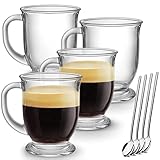
Mfacoy targets the coffee-mug demographic with a 15-ounce capacity: nearly double Teabloom's size. The set of four arrives with stainless-steel spoons, and the wide base design attempts to prevent wobbling during daily use. For people who brew cappuccinos, lattes, or hot chocolate and want visible layers or generous servings, this capacity makes sense. Borosilicate glass and the full suite of safety certifications (BPA-free, lead-free, food-grade) match what you'd expect at this tier.
However, reviews surface a critical quality inconsistency: the "wide base design" advertised to prevent wobbling doesn't perform reliably. One detailed review documents slight gaps between the base and table surface, making cups rock side-to-side. Additionally, visible seams on the handle interior and ripples in the upper glass are noted as consistent but less refined than Godinger's seamless approach. Where Godinger delivers careful craftsmanship at a lower price, Mfacoy emphasizes capacity and included spoons but with less attention to finishing details. If you're comparing this to the Godinger or Teabloom on build quality, Godinger wins. Mfacoy wins on pure volume and set size.
Choose these if maximum capacity and quantity (four cups with spoons) matter most, and you're willing to accept minor surface irregularities. They're also practical for gifting to friend cup ideas gatherings or any occasion where a full service set adds to the presentation.
Pros
- 15-ounce capacity accommodates espresso drinks and layered beverages
- Set of four with complimentary spoons for immediate use
- Borosilicate glass with BPA-free, lead-free certifications
Cons
- Advertised stable base may wobble on some cups due to manufacturing variance
- Visible seams and ripples in glass reduce perceived craftsmanship
Key features (4)
- Large 15-ounce capacity for coffee, latte, and hot-chocolate servings
- Set of four with stainless-steel spoons included
- Borosilicate glass, microwave and dishwasher safe
- Wide base design intended for stable placement on tables
How to Choose Glass Tea Cups
Capacity: Small Ritual vs. Large Session
Glass tea cups range from 7 ounces (Teabloom, Volarium) to 15 ounces (Mfacoy), and this single metric shapes your entire experience. Small cups (7-7.5 oz) force intentionality: you steep once and sip slowly, ideal for single-origin teas or ceremony. Medium cups (10-12 oz) split the difference: the Godinger and Gurudar appeal to people who want real volume without oversizing. Large cups (15 oz) suit coffee drinkers or anyone who hates refilling mid-morning. Consider how you actually drink: Do you linger over one slow cup, or do you want to fill it once and forget about it for an hour?
Glass Type and Durability
Borosilicate glass (Gurudar, Teabloom, Godinger, Mfacoy) resists thermal shock: sudden temperature swings won't crack it. Standard glass (Volarium) is cheaper but demands care: don't pour boiling water into a cold cup. Both are dishwasher and microwave safe. Thickness matters too. Thin glass feels elegant but demands gentle handling; thick glass feels sturdy but less refined. Reviewing borosilicate glass benefits helps clarify why professional-grade glass commands higher prices. All five options here use lead-free, food-safe materials, so safety isn't a differentiator.
Seams, Rims, and Craftsmanship Details
The difference between a pleasant drinking experience and an annoying one often lives in details reviewers highlight. Smooth rims and invisible seams matter: they prevent lip discomfort and feel more refined in hand. Godinger wins here with seamless construction. Mfacoy and Volarium have visible seams on handles and sides. A thick, stable base (Godinger, Gurudar) prevents wobbling, though some Mfacoy units ship with uneven bottoms. Handle size affects grip comfort: larger handles (Teabloom, Volarium, Mfacoy) suit arthritic hands or anyone who values security; slender handles (Gurudar) feel more delicate.
Set Size and Long-Term Value
You'll see two-cup sets (Gurudar, Teabloom), four-cup sets (Godinger, Mfacoy), and six-cup sets (Volarium). Two cups make sense if you're the only tea drinker or want a backup; four cups work for small households; six cups suit entertaining or families. Don't let marketing push you into a six-pack if you only need two. Resale and breakage matter too: buying a set of four means one breakage is recoverable; a set of two leaves you solo. Consider also whether a glass tea cup care guide aligns with your lifestyle: these cups benefit from hand-washing and gradual temperature changes, not rushed daily dishwasher cycles.
Our picks at a glance
2
Best for Specialty SippingTeabloom
4
Best European ImportVolarium
5
Best Large-Capacity OptionMfacoy
Frequently asked
Are glass tea cups safe for boiling water?
Borosilicate glass cups (Gurudar, Teabloom, Godinger, Mfacoy) are engineered to handle boiling water without cracking. Standard glass (Volarium) can crack if exposed to sudden temperature shock, pouring boiling water into a cold cup. The safest approach: rinse the cup with warm water first, then add boiling water. Borosilicate is more forgiving, but all glass benefits from gradual temperature transitions.
Do glass tea cups retain heat better than ceramic?
Both materials retain heat similarly, but glass offers one advantage: you can see the brew color and watch it cool. Ceramic insulates slightly better, while glass transfers temperature faster, so you'll feel the warmth in your hand sooner. Thin-walled glass like Gurudar and Teabloom conduct heat more readily than thick-walled options like Godinger.
Will tea stains build up on glass cups?
No. Glass doesn't absorb tannins the way ceramic does, so stains sit on the surface and wash away with routine cleaning. Gurudar buyers specifically praise this: no scrubbing required. A gentle hand-wash with warm soapy water removes residue instantly. Dishwasher-safe options work too, though hand-washing extends the life of delicate seams.
What's the difference between 7-ounce and 12-ounce cups?
A 7-ounce cup (Teabloom, Volarium) holds a traditional tea service portion: brewed once, sipped slowly over 15-20 minutes. A 12-ounce cup (Gurudar) lets you steep and refill without pouring again, ideal for a 30-60 minute session. Choose based on your habits: if you linger, go small; if you settle in for a long afternoon, go larger.
Are glass cups with handles better than handleless cups?
Handles eliminate the need to grip the hot glass body, making them safer and more comfortable for everyday use. All five options here include handles. Handleless designs exist but demand careful hand positioning and are riskier with boiling water. For daily tea drinking, handles are the practical choice.