Kitchen & Dining · Gadgets
Best French Fry Cutter for Sweet Potatoes | Top Picks
Find the best french fry cutter for sweet potatoes. Compare manual cutters, commercial-grade options, and budget picks to cut perfect fries at home.
Affiliate disclosure: As an Amazon Associate I earn from qualifying purchases.
At a glance
2
Best Commercial-GradeVevor
3
Best Compact DesignPrepworks
4
Best for Heavy-Duty DurabilityCiao Stilista
5
Best Budget-Friendly Multi-ToolPrep Naturals
Detailed reviews
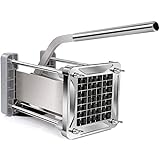
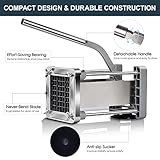
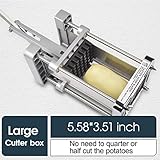
The Sopito cutter earns consistent praise for consistent results across potato types. Owners report it cuts through russet, gold, red, and sweet potatoes without hesitation, and the suction-cup base holds firm on most countertops. The lever mechanism requires surprisingly little force: important for anyone with hand or joint concerns, or simply for reducing fatigue during large batches. The 1/2-inch blade is the standard fry size, and while the tool accepts interchangeable blades, most users find the included size covers their needs.
One practical detail from the manual stands out: for sweet potatoes specifically, a 1-3 minute microwave softens them just enough to cut more smoothly without affecting texture once cooked. This small step prevents the tool from getting stuck mid-press. Assembly involves a handful of bolts and screws; some owners report tightening these periodically as they can loosen slightly with heavy use, but this is not a defect: just normal maintenance for a lever tool.
Cleanup is straightforward with a stiff brush to clear the grid. Storage improves dramatically when you unscrew the handle and tuck it separately in a cabinet. Compared to the Vevor commercial model, this prioritizes compact footprint and home-kitchen simplicity over swappable blade variety.
Pros
- Holds potatoes securely with reliable suction base
- Cuts sweet potatoes cleanly with minor softening prep
- Lever requires minimal hand strength or effort
Cons
- Bolts may loosen with heavy use and need occasional tightening
- Handle and base take cabinet space when stored assembled
Key features (4)
- Stainless steel construction with 1/2-inch blade standard
- Ergonomic lever design reduces hand and wrist strain
- Removable handle allows compact vertical storage
- Works on russet, gold, red, and sweet potato varieties
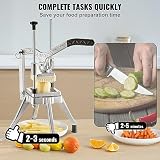
The Vevor commercial chopper stands apart for sheer blade flexibility. It ships with 1/2-inch, 3/8-inch, 1/4-inch, and a wedge-slicer attachment, plus spare blades, giving you options for thick steak fries, thinner matchsticks, or hash-brown consistency all in one unit. Owners who prep carrots, apples, and potatoes in bulk rave about how fast it moves through volume; one reviewer processed 50 pounds of carrots in under an hour with family help.
Sweet potatoes require more attention here than with the Sopito model. Reviewers note that raw sweet potatoes are significantly harder to cut than russets, and some suggest halving them first or cutting them into quarters and inserting them point-side down (like an inverted cone) to let the weight do more of the work. Once you find the right technique, it performs well, but the learning curve is steeper. The tool is also substantial: heavier and larger than compact home cutters, which appeals to serious meal-preppers but frustrates those with limited storage.
Blade swaps are straightforward but require attention to detail: there's a right way and a wrong way to seat them, and the metal edges are razor-sharp during the change. Vevor includes an instruction booklet and YouTube videos help, but this is not a grab-and-go-blindfolded tool. Where the Sopito favors simplicity, Vevor trades ease for versatility.
Pros
- Four distinct blade sizes plus spare blades for versatility
- Powerful lever system handles dense vegetables efficiently
- Heavy stainless steel and aluminum construction built for years
Cons
- Blade swaps require careful attention and carry cut risk
- Sweet potatoes need advance cutting or angled insertion technique
Key features (4)
- Four interchangeable blades: 1/2, 3/8, 1/4 inch and wedge-slicer
- Heavy-duty stainless steel and aluminum construction
- Non-slip rubber feet and ergonomic pull-down lever
- Suitable for restaurants and high-capacity home batch prep
The Prepworks tower design compresses functionality into an elegant package that won't dominate your kitchen real estate. The clear container catches cut fries as they drop, which keeps your workspace tidier than standalone cutters and lets you see progress at a glance. The non-skid base is genuinely sticky: it stays put during pressing, which matters when you're applying force.
Users praise the wide blade, which keeps potato sticks from deflecting sideways and ensures straight, uniform cuts. One reviewer noted it works nearly as well as much larger commercial units for occasional home use. The four-piece design disassembles quickly, and each part is small enough to rinse by hand or fit in a dishwasher without complaint. Cleanup time is measured in minutes.
The catch: this cutter is not forgiving of weak potatoes or poor technique. One reviewer who expected "easy" operation ended up frustrated when a sweet potato didn't cut on the first few presses; they had to apply significantly more force than marketing suggested. This is partly a skill and potato-selection issue: firm, fresh specimens work better than ones that have softened in storage. If you choose medium to large russets or properly firm sweet potatoes, results are reliable. Compared to the Vevor, this sacrifices blade options and volume capacity but wins on space and simplicity.
Pros
- Integrated collection container keeps workspace clean
- Wide blade prevents stick deflection and ensures straight cuts
- Compact footprint and fast disassembly for storage
Cons
- Requires firm, fresh potatoes; soft or old ones cut poorly
- Single blade size limits variety for different fry thicknesses
Key features (4)
- Clear collection container with pop-out pusher for easy cleanup
- Non-skid rubber base ensures stability during cutting
- Removable grid and pusher for quick disassembly and washing
- Durable stainless steel blades and BPA-free plastic components
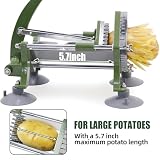
The Ciao Stilista cutter is engineered for serious durability: cast iron body with powder-coated finish that resists rust and scratches in ways plastic never will. The 5.7-by-4.3-inch cutting chamber is notably larger than most home models, meaning you can fit whole potatoes and sweet potatoes without pre-cutting in most cases. This 20 percent size increase translates to faster batches; one press does more work per cycle.
Owners emphasize the weight and solidity; this tool doesn't shift or wobble during use, and the suction cups hold it in place reliably. The extended handle design reduces hand strain over long prep sessions. The 3/8-inch blade is a middle-ground thickness, not quite the thick steak-fry size, but chunkier than hash-brown thickness, which suits most home cooks.
The tradeoff is obvious from feedback: this is a bulky, heavy object. One reviewer noted it is "awkward as can be if not mounted on the wall somewhere," which hints that floor counter space becomes a real consideration if you don't have wall-mounting capability or permanent cabinet real estate. Rust arrived on one unit due to storage damage, and blade sharpness was questioned by one buyer, though this may reflect that particular shipment rather than design. Compared to the lighter Sopito or Prepworks models, this demands respect as a permanent fixture, not a grab-and-stow tool.
Pros
- Cast-iron construction built to last decades with minimal degradation
- Larger 5.7x4.3 inch cutting chamber fits whole potatoes
- Suction feet hold firmly; extended handle reduces hand fatigue
Cons
- Heavy and bulky; requires dedicated counter or wall-mount space
- Not portable; best suited for permanent kitchen placement
Key features (4)
- Heavy-duty cast-iron body with scratch-resistant powder coating
- 3/8-inch stainless steel blade for medium-thickness fries
- Oversized cutting chamber accommodates whole potatoes
- Four strong suction cups and extended handle for ergonomic operation
The Prep Naturals cutter appeals to budget-conscious buyers and gadget collectors alike. It is genuinely : slice (for thin potato shreds), dice (for cubed vegetables), and julienne (for spiral cuts), all from one tool with swappable blades. This makes it useful beyond just fries: owners report success slicing potatoes for gratins, dicing for salads, and even grating cheese. The included safety glove and cleaning brush add value that other models charge extra for or omit entirely.
For sweet potatoes, the slicer blade works reasonably well, though it requires more downward force than the Sopito or Vevor models. The tool's clever design nests all pieces into a chop box for storage, which appeals to anyone with packed kitchen cabinets. Assembly is straightforward, and cleanup involves just rinsing the plastic walls and drying the steel blades immediately to prevent rust.
Limitations are real: the cutting chamber is smaller, so large or tall potatoes require halving first. The julienne blade earns mixed reviews: some users found it difficult to operate or achieve consistent results, suggesting it works better for softer vegetables like cooked beets than raw carrots. One reviewer noted veggie scraps can wedge between blades, requiring manual picking. If you want one tool for occasional fry-making plus dicing and slicing tasks, and you are willing to accept some extra prep or physical effort, this undercuts the specialty-focused models. Compared to the commercial options, it trades power and volume for affordability and multi-functionality.
Pros
- Three interchangeable blades cover slicing, dicing, and julienne tasks
- Safety glove and cleaning brush included at no extra cost
- Compact nesting design fits easily into drawers or small cabinets
Cons
- Smaller chamber requires pre-cutting large or tall potatoes
- Julienne blade is inconsistent on harder vegetables and requires more effort
Key features (4)
- Three interchangeable stainless steel blades for slicing, dicing, julienne
- Integrated chop box catches cut ingredients and nests for storage
- Includes safety glove and cleaning brush for convenience
- Manual operation with dual plastic walls for blade alignment and stability
How to Choose a French Fry Cutter
Understand Sweet Potato vs Regular Potato Cutting Challenges
Sweet potatoes are denser and harder than standard russets, requiring either a more powerful lever system or advance softening. The sweet potato vs regular potato difference matters: russets yield easily to most cutters, while sweets need micro-waving for 1-3 minutes (as the Sopito manual suggests) or a tool with extra leverage, like the Vevor commercial model. If sweet potatoes are your primary focus, prioritize cutters that explicitly mention handling them or feature robust lever mechanisms designed for dense vegetables.
Consider Your Counter Space and Storage Needs
Manual cutters range from compact (Prepworks tower fits in a drawer) to industrial (Ciao Stilista demands cabinet or wall space). If you have a small kitchen or apartment, look for tools that disassemble fully or fold down; removable handles and nested designs save precious real estate. Larger, heavier units like the commercial-grade Vevor and Ciao Stilista excel at high-volume prep but become permanent fixtures. Match the footprint to your actual kitchen, oversizing for features you won't use is a common regret.
Match Blade Options to Your Cooking Habits
Single-blade models (Sopito 1/2-inch, Prepworks standard, Ciao Stilista 3/8-inch) simplify use but lock you into one fry thickness. Multi-blade tools like the Vevor (four options) or Prep Naturals (three) let you create steak fries, thin matchsticks, hash browns, and diced vegetables from one unit. If you make fries one way every time, a single-blade cutter saves money and storage. If you experiment with thickness or cut multiple vegetables, interchangeable blades are worth the added complexity.
Balance Ease of Use with Cutting Power
Lever-based cutters (Sopito, Vevor) require less hand strength than downward-press models (Prepworks, Prep Naturals), which matters if you have arthritis, weak grip, or make large batches. Commercial-grade tools trade simplicity for power and durability; they are unforgiving of poor technique but deliver speed at volume. Home-focused models are gentler on hands but may require more force for dense vegetables. Test your own comfort level with hand strength before choosing a tool that relies purely on leverage or pure downward force.
Our picks at a glance
2
Best Commercial-GradeVevor
3
Best Compact DesignPrepworks
4
Best for Heavy-Duty DurabilityCiao Stilista
5
Best Budget-Friendly Multi-ToolPrep Naturals
Frequently asked
Do I need to peel sweet potatoes before using a french fry cutter?
No, you can leave the skin on: many owners prefer it for nutrition and texture. However, skin can clog the cutting grid, so rinse the potato well first. For easier cleanup, peel after cutting, or accept spending a few extra minutes with a brush on the grid. Either way works; it's a preference question, not a requirement.
Why does my sweet potato keep getting stuck in the cutter?
Sweet potatoes are denser than russets. If a potato gets stuck, it's usually too hard or too large. Microwave it for 1-3 minutes to soften slightly, or cut it in half lengthwise first. Alternatively, some cutters (like the Vevor) cut better when you insert the potato at an angle or point-side down. Experiment with softening and orientation before assuming the cutter is defective.
Can these cutters handle other vegetables like carrots or zucchini?
Yes, most cutters work on firm carrots, zucchini, cucumbers, and other dense vegetables. Results vary by tool and vegetable density. Softer vegetables like tomatoes are harder and may require adjustments. Harder vegetables like carrots sometimes need halving first, depending on the cutter's blade design and chamber size. Check product reviews for the specific vegetables you plan to cut.
How do I clean a french fry cutter safely?
Always handle blades with care: they are razor-sharp. Rinse immediately after use, dry blades right away to prevent rust, and use a stiff brush or the included cleaning tool to clear the cutting grid. Most non-blade parts are dishwasher safe, but hand-wash and air-dry blades. Never touch the cutting surface directly; use brushes or cloth instead. Some models allow full disassembly, which makes deep cleaning easier.
What is the difference between a 1/4-inch, 3/8-inch, and 1/2-inch blade?
Blade size refers to the thickness of the cut fries. 1/4-inch produces thin, crispy fries ideal for air fryers; 3/8-inch is medium (good general-purpose size); 1/2-inch gives thick steak fries that stay soft inside. Thinner cuts crisp faster and use less oil, while thicker cuts hold texture better and feel heartier. Choose based on your cooking method and texture preference, or buy a multi-blade cutter if you like variety.