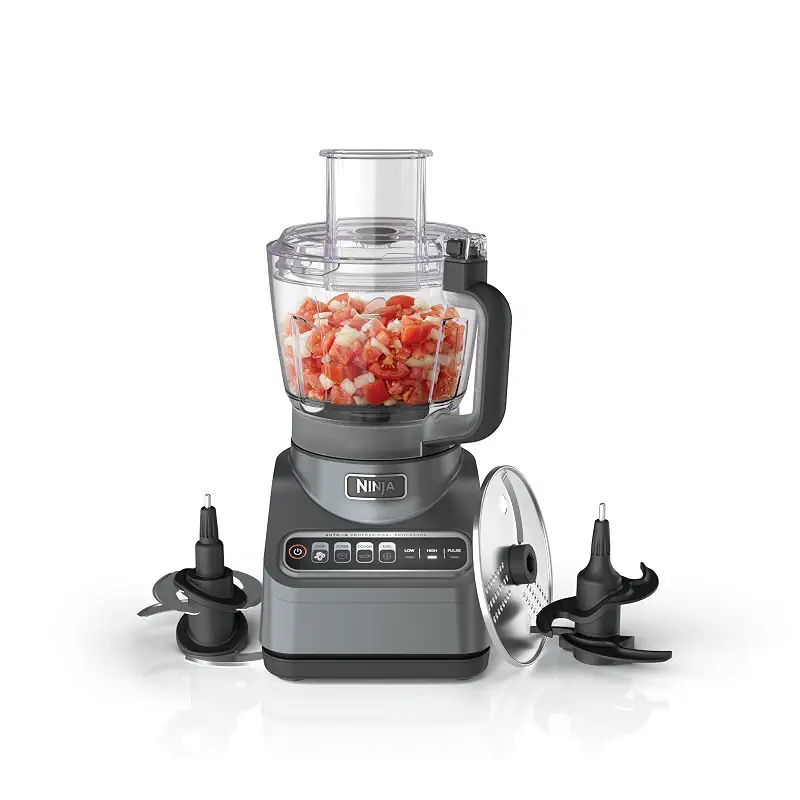
Ideal for: Home cooks who value speed, ease of use, and consistent results in everyday meal prep.
The Ninja Professional Plus stands out because it handles the full range of food prep jobs with minimal fuss. Its 1000-peak-watt motor and Auto-iQ preset buttons (chop, slice, puree, dough) mean you're not constantly adjusting speed and timing: you press a button and the machine does the thinking for you. The 9-cup bowl is large enough for real family meals or meal-prep batches without being awkwardly large for everyday tasks. Owners consistently praise how quickly the sharp stainless steel blades work and how the suction-cup feet keep the unit stable during operation, even at full power.
The design includes thoughtful details that matter in daily use: no hole in the bottom of the bowl (unlike older models), a clean feed chute, and a lid gasket that prevents spilling if you overfill. Cleanup is straightforward since all removable parts go in the dishwasher. Some users note the flashing lights when the machine powers down can be jarring, and the chute won't fit a whole cucumber, so you'll still need to quarter large vegetables.
Compared to the Hamilton Beach 12-cup, the Ninja trades bulk capacity for smarter programming and a more compact footprint: a real advantage if your countertop space is limited. If you cook from scratch regularly and want a machine that feels responsive and powerful without requiring a manual, this is the pick.
Pros
1000-peak-watt motor handles tough ingredients effortlessly
Auto-iQ presets eliminate guesswork for chopping, slicing, pureeing, dough
Suction-cup feet keep unit stable during operation
Sharp stainless steel blades chop ingredients uniformly and fast
Cons
Flashing lights after shutdown may be distracting for some users
Feed chute width limits whole-vegetable processing without pre-cutting
Key features
1000-peak-watt motor with four Auto-iQ intelligent preset programs
9-cup stainless steel bowl with sealed, leak-free design
Three precision blades plus dough blade for versatile food prep
Suction-cup feet and compact silver design fit any kitchen layout
#2 Pick
Best for Large Batches
Hamilton Beach
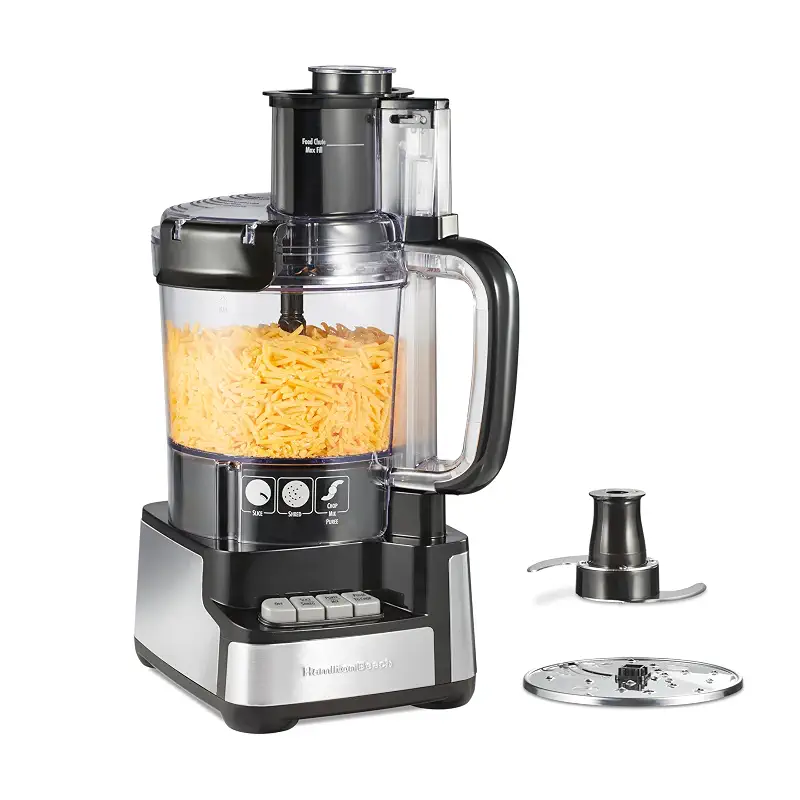
Hamilton Beach 12 Cup Stack & Snap Food Processor and Vegetable Chopper | BPA Free | Stainless Steel Blades | 2-Speed 450 Watt Motor |Easy Stacking Assembly | Black | 70725A
4.5(28,812)
Generous 12-cup capacity and sturdy build. Ideal when you're cooking for a crowd or batch-prepping for the week.
Ideal for: Home cooks processing large quantities, entertaining, or anyone batch-prepping meals for the week.
The Hamilton Beach 12-Cup Stack & Snap excels at volume. Its 12-cup sealed bowl handles significantly more food than mid-size models, which matters if you're prepping vegetables for a dinner party, making large batches of salsa, or grinding meat for multiple meals. Owners who process whole pumpkins or multi-pound batches of rice report finishing in minutes what would take hours by hand. The reversible slicing/shredding disc and chopping blade cover the core functions, and the suction feet keep it planted even under heavy use.
The Stack & Snap assembly system is genuinely easier than the screw-lock designs on older models: no wrestling with plastic threads. The "Big Mouth" chute fits larger whole foods, though you'll still need to halve potatoes or tomatoes. One realistic trade-off: the bowl is tall, and some food can settle above the blades, especially with delicate work. Also, the sealed lid design means moisture can collect in the locking mechanism, though owners report it typically dries overnight.
Where the Ninja Professional Plus offers automated presets, the Hamilton Beach requires you to choose your blade and speed manually. That's fine if you cook intuitively, but it's less forgiving for beginners. The 450-watt motor is about half the Ninja's power, yet users find it sufficiently strong for routine tasks: cheese, nuts, vegetables all process cleanly. This trade-off (less power, more capacity) makes it the pick for batch cooking over precision small-work.
Pros
12-cup sealed bowl processes significantly larger batches in one go
Stack & Snap assembly is simpler than screw-lock alternatives
Big Mouth chute accepts larger whole foods with less pre-cutting
Reversible slicing/shredding disc and chopping blade cover most tasks
Cons
Moisture can collect in sealed lid mechanism between uses
450-watt motor less powerful than Ninja; some tasks require more time
Key features
12-cup sealed bowl with centered pour spout for mess-free serving
Ideal for: Solo cooks, small households, or anyone with limited kitchen storage who chops small quantities regularly.
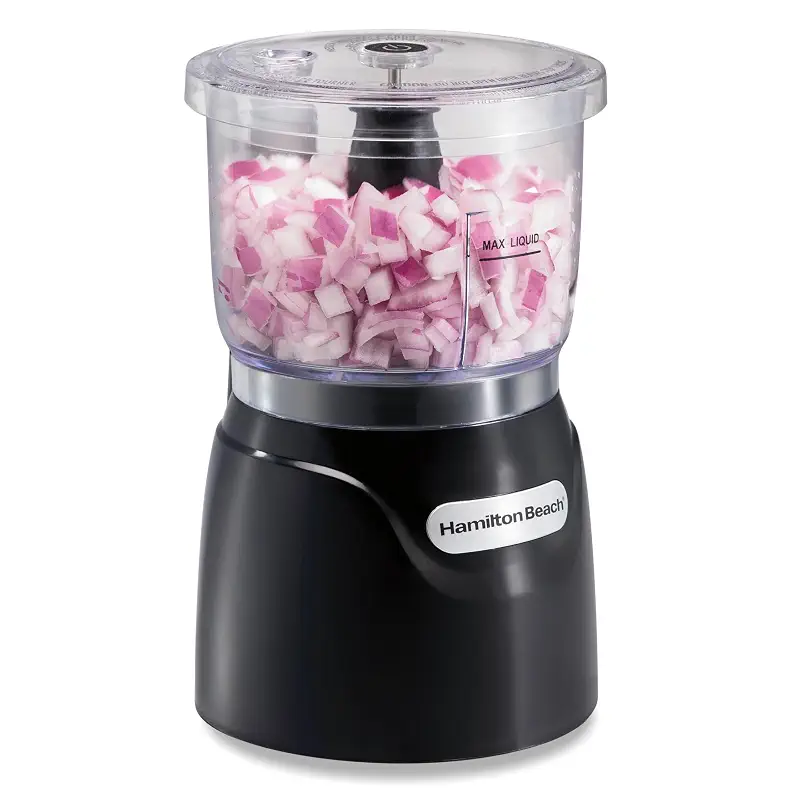
The Hamilton Beach 3-Cup Electric Vegetable Chopper proves that size doesn't guarantee power. Its 350-watt motor and straightforward stack-and-press design make it the fastest way to mince garlic, dice onions, or chop herbs: a two-second press handles what takes minutes with a knife. Owners with hand arthritis or tremors report it's life-changing; the machine does the work safely while they manage the bowl. For small households, it's genuinely the workhorse they reach for multiple times a week, even though it takes up almost no counter space.
The trade-off is obvious: 3 cups is fine for a single onion or a handful of garlic, but not for cooking for four. If your typical meal prep is "chop one onion" rather than "process five pounds of vegetables," this is your machine. The motor is powerful enough for nuts and herbs, though some users note that very soft foods (like avocado) can turn mushy if you pulse for more than a second or two. The motor gets warm after extended use, so give it a brief cooldown between jobs if you're processing multiple batches.
Compared to the larger Hamilton Beach 12-cup, this sacrifices capacity and versatility for speed and footprint. If you have limited storage, cook mostly for one or two people, or keep a full-size processor elsewhere, this small chopper becomes the thing you actually use daily instead of the imposing appliance that stays in the cabinet.
Pros
Powerful 350-watt motor minces garlic and onions in seconds
Compact size fits small kitchens and storage without fuss
Stack-and-press design is simple and intuitive, no assembly needed
Dishwasher-safe parts and quick cleanup make daily use easy
Ideal for: Home cooks who make sauces, purees, or nut butters and appreciate clever kitchen design.
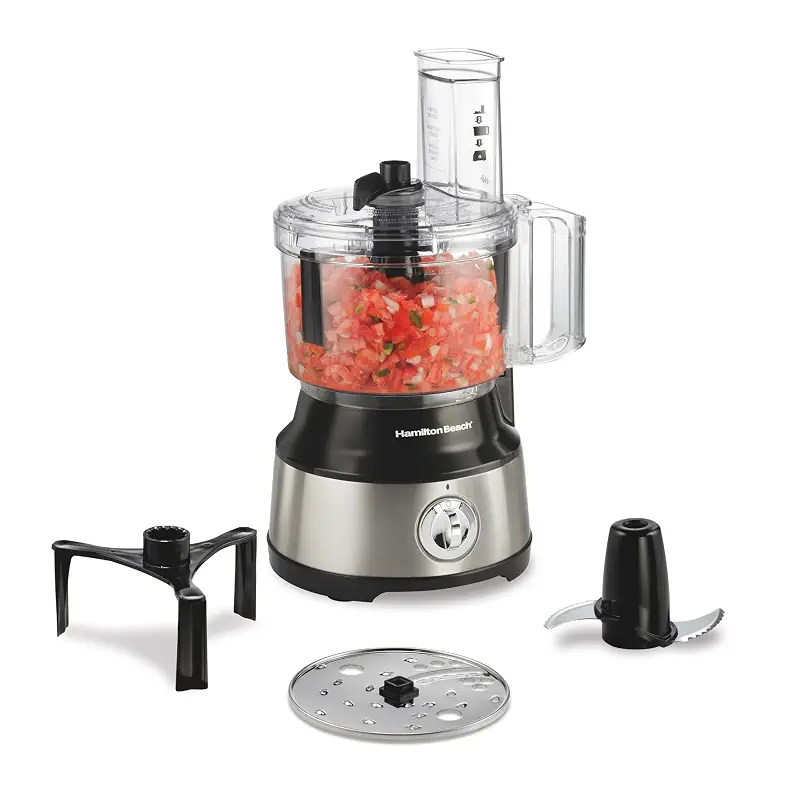
The Hamilton Beach Food Processor & Vegetable Chopper with the built-in bowl scraper solves a real problem: food clinging to the sides of the bowl while the blades spin uselessly. Just swipe the scraper side-to-side while the processor runs, and the food stays in contact with the blades for even results. Owners who make hummus, nut butters, or sauces find this feature genuinely useful, not a gimmick. The 10-cup bowl sits in the middle ground between the 9-cup Ninja and the 12-cup Hamilton Beach, offering plenty of volume without being unwieldy. The 450-watt motor, two speeds plus pulse, and reversible slice/shred disc give you the control for both rough chopping and fine work.
This model leans toward versatility and smart design over sheer power. It's been in production for over a decade, and owners report units still running flawlessly after 10+ years of regular use: a testament to the build quality. The scraper itself is made of plastic, so it won't ding the bowl, but it also won't reach below the blade level, so you'll still need to stop and hand-scrape occasionally. Some users note the base feels lighter than they'd expect, though it handles normal tasks without wandering across the counter.
Where the Ganiza with two bowls separates uses (meat vs. vegetables), this Hamilton Beach does it all in one machine and just cleans up easily. If you make homemade sauces, nut butters, or hummus regularly, the scraper justifies the choice; if you mostly chop vegetables, the Ninja Professional Plus or the 12-cup Hamilton Beach may be a better fit.
10-cup capacity handles large prep jobs without excess bulk
Two speeds plus pulse offer precise control for varied textures
Proven durability; owners report 10+ years of reliable use
Cons
Scraper doesn't reach below blade level; occasional hand-scraping still needed
Base feels lightweight compared to older heavy-duty models
Key features
Built-in side scraper that clears bowl walls while motor runs
10-cup BPA-free bowl with two speeds and pulse control
Reversible stainless steel slice/shred disc and chopping blade included
Suction-cup feet and dishwasher-safe parts for easy cleanup
#5 Pick
Best Value with Two Bowls
Ganiza
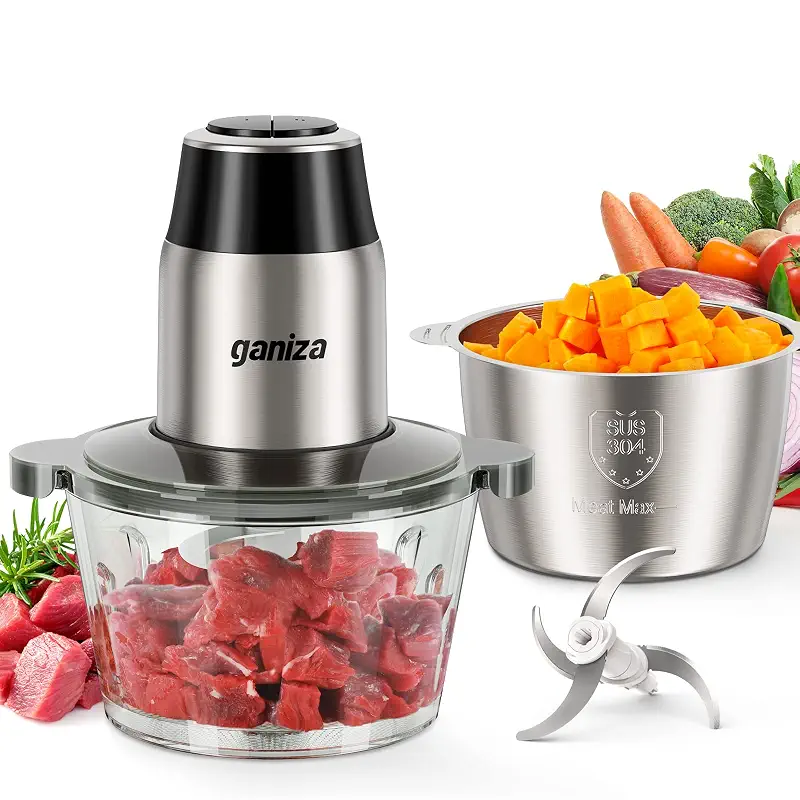
Ganiza Food Processors with 2 Bowls, 450W Meat Grinder Vegetable Chopper | 2-Speed Electric Food Chopper with 8 Cup Glass & 8 Cup Stainless Steel Bowls -Includes 2 Sets of Blades for Fruits/Meat/Nuts
4.4(7,494)
Two bowls and two blade sets for under $50. Separates meat prep from vegetables: a smart choice for food-safety conscious cooks on a budget.
Ideal for: Budget-conscious cooks who grind meat, want separate vegetable and meat bowls, or batch-prep for canning.
The Ganiza Food Processor with 2 Bowls punches far above its budget price. You get an 8-cup glass bowl and an 8-cup stainless steel bowl, each with its own blade set, plus a 450-watt motor and two speeds. The real value lies in the separation: use glass for vegetables, stainless for raw meat, and never cross-contaminate. Owners consistently report surprise at how well it grinds meat (one pound of pork in under 10 seconds) and how sharp the blades are out of the box. The copper motor is rated for longer service life than standard models, and the overheating protection system (common on budget units) means you pulse for 15-20 seconds, check, then pulse again rather than running continuously.
The trade-offs are real but manageable. The plastic lid is thin, and some users report food settling above the blade level, especially with delicate ingredients. The blades look less robust than heavier-duty competitors, though they perform well in practice. The motor gets warm if you're processing multiple batches back-to-back, so the design encourages you to take breaks between jobs. One owner noted debris collecting in the coupling area where the bowl connects; a quick rinse with a toothpick solves it.
Compared to the food processor bowl size guide, having two dedicated bowls eliminates the guesswork about what to use for what. If you grind your own meat, make fresh salsa, or prep for canning and want the safety of separate prep stations without the storage burden of two full machines, this Ganiza delivers. It's not a workhorse for commercial prep, but for home cooking on a tight budget, the value is genuinely hard to beat.
Pros
Two complete bowl-and-blade sets prevent meat and vegetable cross-contamination
450-watt motor grinds meat quickly and efficiently for the price
Copper motor rated for three times longer service life than standard motors
Two-speed control lets you dial in texture from rough chop to fine puree
Cons
Plastic lid is thin and may not feel as durable as glass or metal alternatives
Motor requires brief cooldown between batches; overheating protection limits continuous use
Key features
Two 8-cup bowls in glass and stainless steel with separate blade sets
450-watt full-copper motor with two-speed control and overheating protection
Spring-loaded, detachable blades stop rotating immediately when motor ejects
Nonslip base and compact design fit any kitchen counter or storage space
How to Choose a Food Processor
Four trade-offs that actually matter when matching a food processor walmart to your kitchen.
Capacity Matters More Than You Think
The food processor bowl size guide shows that bigger isn't always better. A 12-cup bowl works great if you're batch-cooking for the freezer or entertaining, but it's overkill if you live alone and chop one onion at a time. The Ninja's 9-cup offers a practical middle ground for most families, while the 3-cup Hamilton Beach does rapid daily work without dominating your cabinet. Think about your typical use: are you processing one meal's worth of vegetables, or a week's worth of salsa? The answer shapes which capacity serves you best.
Motor Power vs. Real-World Performance
Wattage gets marketing attention, but what matters is how the motor handles your actual ingredients. The Ninja's 1000-peak-watt motor shreds cold cheese and frozen fruit effortlessly, while the 450-watt Hamilton Beach models work fine for routine vegetable chopping: they just take slightly longer on tough jobs. If you frequently make nut butters, grind raw meat, or puree frozen fruit, higher wattage saves time and reduces motor strain. For occasional use, a modest motor is fine.
Design Details That Affect Daily Use
Small features compound into real convenience. Suction-cup feet prevent the unit from sliding during operation. A sealed bowl design with no center hole means you can soak parts without water pouring out. The built-in scraper on the Hamilton Beach with scraper saves a hand-scraping step. A dough blade is essential if you bake bread. Auto-iQ presets on the Ninja remove guesswork. Read reviews focused on cleanup, assembly, and what owners actually use daily: that's where you'll find the features that matter in your kitchen.
Cleaning and Maintenance Reality
Dishwasher-safe parts are standard, but edges of the lid and the coupling where the bowl connects can trap food. A food processor cleaning guide helps, but the practical takeaway is: rinse immediately after use and don't let food dry on. Stainless steel bowls resist odors better than plastic (a real advantage if you process garlic or onions regularly). Two separate bowls, like the Ganiza offers, eliminate cross-contamination concerns and simplify storage if you grind meat.
Preset Programs vs. Manual Control
Auto-iQ presets on the Ninja simplify the learning curve: press a button and let the machine decide speed and duration. Manual control (as in the Hamilton Beach models) requires you to choose blade, speed, and pulse timing yourself. Beginners often prefer presets; experienced cooks appreciate the control of speed and pulse buttons. There's no wrong choice, just personal preference.
Frequently asked
Quick answers to the questions readers ask most.
Can I use a food processor to grind meat?
Yes, but only with raw, chilled meat cut into chunks. Pulse in 5-10 second bursts rather than running continuously. The Ganiza with its two-speed motor is specifically praised for meat grinding, while the Ninja and Hamilton Beach models handle it fine for occasional use. Never process cooked meat in the same bowl you use for vegetables without washing in between, or use the Ganiza's dedicated stainless steel bowl to avoid cross-contamination.
What's the difference between a food processor and a food chopper?
Food choppers (like the 3-cup Hamilton Beach) are smaller, simpler, and best for quick tasks like mincing garlic or dicing onions. Food processors have larger bowls, more attachments, and multiple speeds, letting you slice, shred, chop, and puree in one machine. If you cook frequently or need versatility, a full processor pays off; if you mostly chop small quantities, a compact chopper is faster and easier to store.
How often should I replace the blades?
Most food processor blades last years with normal use. You'll notice dullness when they stop chopping cleanly or leave uneven pieces. Stainless steel blades (like those on the Ninja and Hamilton Beach models) resist dulling longer than budget alternatives. Don't sharpen them yourself: replacements are affordable on Amazon and take seconds to swap. Handle blades carefully when washing; they're extremely sharp and will cut a sponge or your fingers instantly.
Can I process hot food or liquids?
Avoid hot food: it can warp plastic parts and create steam pressure in the sealed bowl. Let soup or hot sauce cool first. For liquids, the liquid capacity is roughly 1/3 to 1/2 of the bowl's stated dry capacity; overfilling causes splashing out the center shaft or lid seams. Pulse short bursts with liquids rather than running continuously, and don't fill above the 2-cup line marked on most bowls.
Which food processor is quietest?
None of these are quiet: they all produce a whirring or growling sound during operation. The Ninja is described as less loud than some older models, but if noise is a concern, use the processor during daytime hours rather than early morning or late evening. The compact 3-cup chopper, with its shorter runtime for small jobs, creates less cumulative noise than running a large processor for minutes on end.