Best Filet Knife Sharpener: 5 Top Picks for Clean Cuts
Find the best filet knife sharpener for your kitchen or tackle box. Compare adjustable angle, portable, and pull-through sharpeners with expert guidance.
Ideal for: Home cooks and kitchen professionals with filet knives and other straight-edge blades needing consistent angle control.
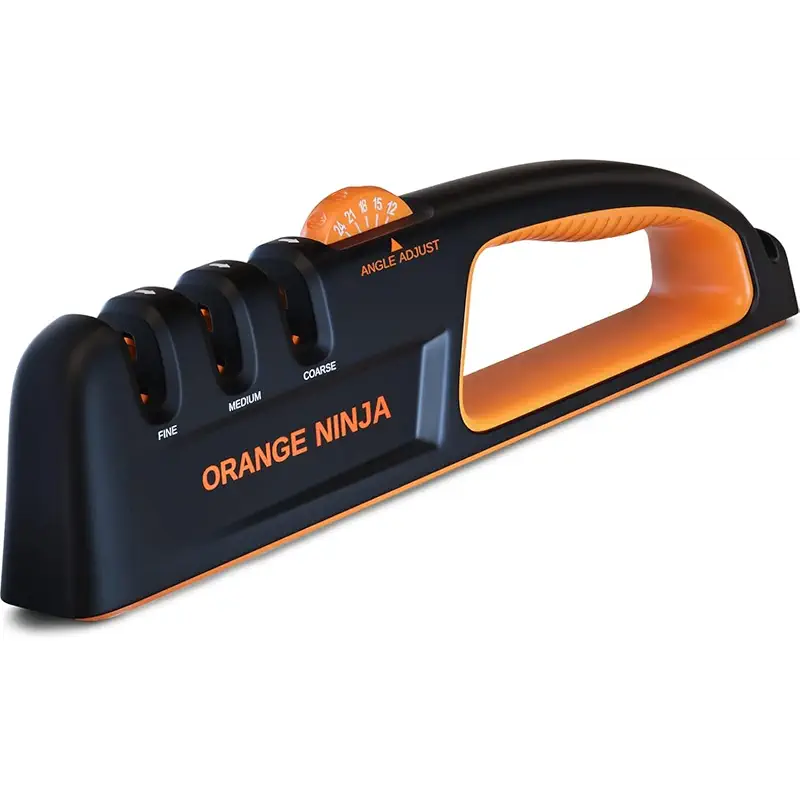
This sharpener stands out because it lets you dial in the angle for your filet knife instead of forcing you into one fixed geometry. Owners who sharpen a variety of blades especially praise the ability to match angle to blade type: filet knives get their sharpest edge at tighter angles, and this tool accommodates the full range. The three-stage system (coarse diamond, medium, and fine polish) works like a progression: you rebuild the edge on a dull blade, then refine it to a true V, then polish out burrs. For a fillet that glides through skin and bone without tearing, this methodical approach pays off.
The trade-off is size and control. Buyers report that the larger footprint and nonslip rubber base actually improve stability during the stroke, which matters when you're passing a long filet blade through the slots. However, a few owners note that very small pocket knives don't fit cleanly because the plastic walls are thick, so kitchen-knives-first cooks won't see that limitation. One negative review flagged a defective adjustment dial, but that's rare among thousands of ratings.
Compared to the AccuSharp, which prioritizes speed and portability, this system trades convenience for precision. If you have multiple knives and want repeatable, angle-specific sharpening, this is the more flexible choice.
Pros
Five adjustable angle settings match any straight-edge blade
Three-stage progression rebuilds and polishes edges
Stable footprint and nonslip base for controlled strokes
Effective on 30-year-old neglected kitchen knives
Cons
Larger footprint takes up counter or drawer space
Thick plastic housing excludes very small pocket knives
Key features
Five preset sharpening angles from 12° to 24° for blade-specific precision
Three-stage coarse, medium, and fine honing progression
Ergonomic design with nonslip rubber base for stable strokes
Suitable for kitchen, pocket, and hunting knives with straight edges
#2 Pick
Best for Speed and Everyday Touch-Ups
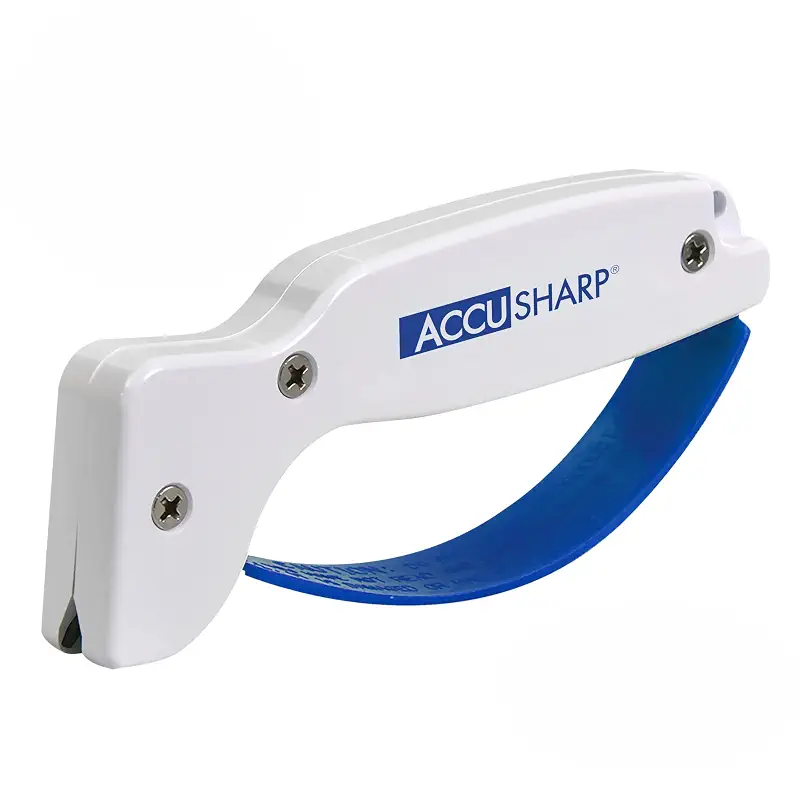
Accusharp
AccuSharp Knife Sharpener, Ergonomic Comfortable Handle, Compact & Easy to Use, Restore and Hone Straight & Serrated Knives, White
4.7(28,394)
Compact pull-through with diamond-honed tungsten carbide, fast 10-second sharpening, and durability that lasts years of use.
Ideal for: Busy home cooks wanting quick, reliable touch-ups on kitchen and filet knives without learning complex technique.
AccuSharp earned its massive review count (28,000+) by solving a real problem: most home cooks never sharpen because the process feels slow and fussy. This tool cuts through that friction. A filet knife goes from dull to functional in roughly ten seconds, and owners who've tried everything from water stones to honing steels report being surprised by the quality of edge it produces. The diamond-honed tungsten carbide is one of the hardest materials available, so it bites into steel reliably and won't wear smooth quickly.
The catch is that this is a pull-through, not adjustable-angle. It applies a fixed geometry, and the company makes different models for different blade angles (this is the standard; a 15-degree Gourmet version exists for sharper kitchen knives). One highly satisfied owner swapped from the basic model to the Gourmet after finding the original model worked better for cleavers than chef's knives. If your filet knives are quality carbon or German steel, test this carefully or go straight to the angle-specific version. The tool also removes more metal per pass than a water stone, which purists dislike, but practical cooks see it as the cost of speed.
Where the Sharp Pebble emphasizes precision, AccuSharp prioritizes convenience. It's compact enough to live in a kitchen drawer and doesn't intimidate users who've never sharpened before.
Pros
Sharpens most blades in approximately ten seconds
Diamond-honed tungsten carbide lasts 5-10 years between replacements
Reversible blades double the tool's working life
Ambidextrous design with full finger guard for safety
Cons
Fixed angle may not match specialty blade geometries optimally
Removes more metal per pass than stone methods
Key features
Diamond-honed tungsten carbide blades for durable, fast cuts
Double-beveled design with reversible blades for extended life
Preset sharpening angle optimized for chef and kitchen knives
Full-length finger guard and ergonomic handle for both hand types
#3 Pick
Best for Fishing and Outdoor Portability
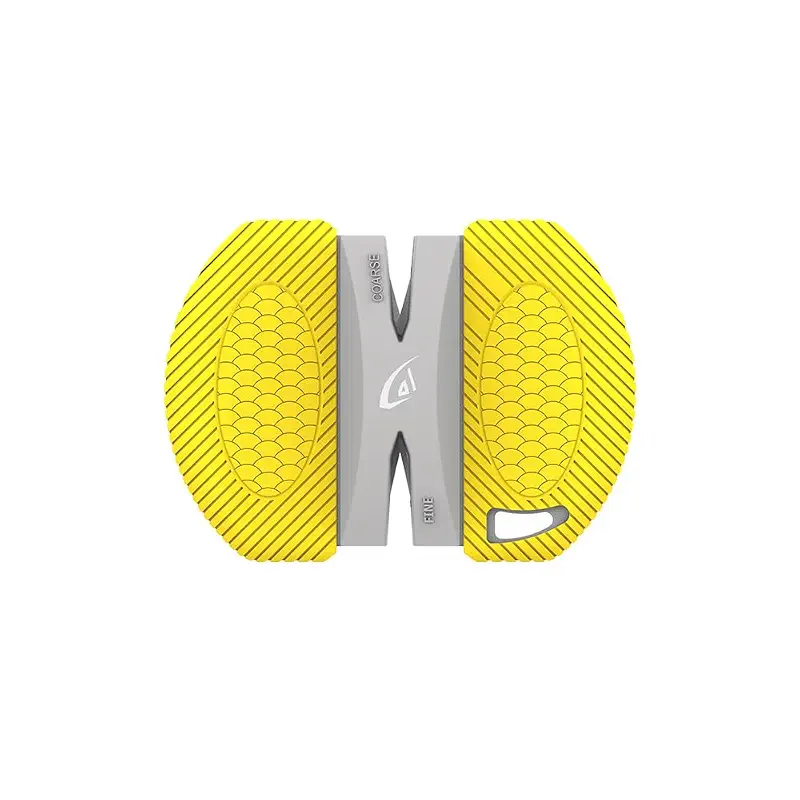
Gambler
Gambler danco Fishing Fillet Knife Sharpeners, Small Enough to Fit in Tackle Box, Outdoor Handheld Knife Sharpener, Fishing, Hunting, Fillet, Pocket Knives
4.3(7)
Lightweight two-stage sharpener with lanyard hole, coarse and fine surfaces, and textured grip for tackle-box carry.
Ideal for: Anglers, hunters, and outdoor enthusiasts sharpening filet and pocket knives in the field or at camp.
This sharpener is purpose-built for anglers: it weighs almost nothing, fits in a tackle box or backpack pocket, and comes with a nine-inch lanyard so you can tether it to your vest or pack. A five-star buyer who uses it for outdoor knives and filet work praises the textured grip and notes that while it won't produce a razor edge on par with diamond stones or a professional strop, it's fast and practical when you're on the water or in camp. The two-stage design (coarse and fine) mirrors other outdoor sharpeners: rough out the damage with the coarse surface, finish with fine.
The compact size and portability mean you sacrifice the control and precision of a larger, stationary sharpener. This tool excels at field touch-ups and bringing a dulled filet blade back into working order on short notice, but it's not the pick for restoring a severely neglected blade or achieving a surgical edge. Smith's 2-Step (the next product in this lineup) offers similar portability with a slightly more robust build. I'd choose this one if you want the absolute lightest carry weight and don't mind a slightly smaller footprint.
Owners report satisfaction with the quality of packaging and build; the brand clearly cares about presentation, which is a good sign for durability.
Pros
Compact and lightweight with nine-inch lanyard for easy carry
Coarse and fine surfaces handle touch-ups and restoration
Textured dual-grip design for control and comfort
Works handheld or on a stable surface
Cons
Two-stage system less precise than multi-angle or stationary tools
Best suited for field maintenance, not professional-grade restoration
Key features
Two-stage coarse and fine honing surfaces for field sharpening
Textured TPR grip and lanyard hole for secure outdoor carry
Compact design fits in tackle boxes and outdoor packs
Handheld or tabletop use for flexibility in any setting
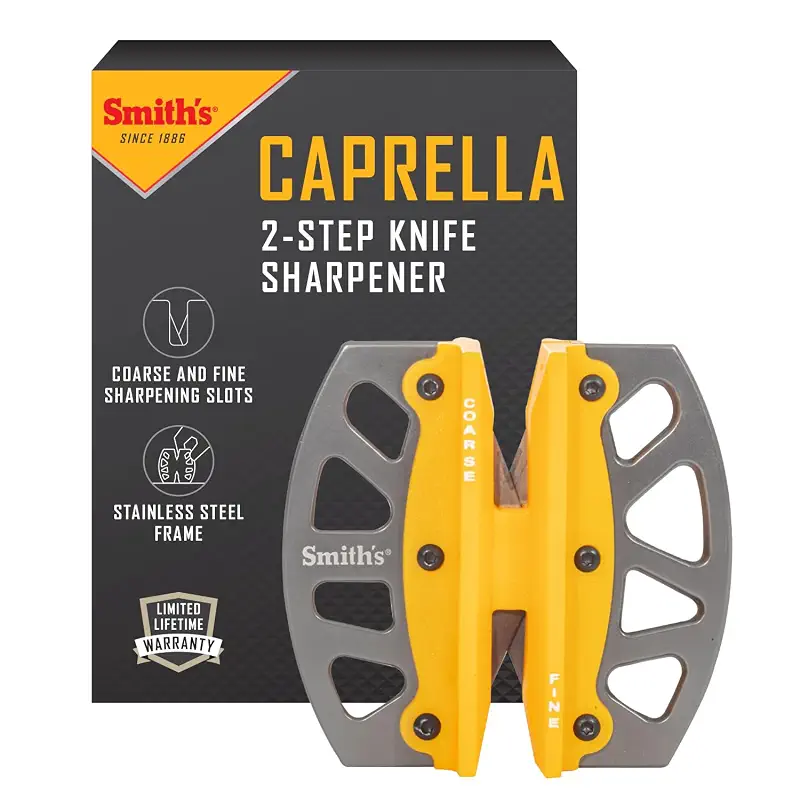
Ideal for: Hunters, fishermen, and outdoor adventurers needing reliable, corrosion-resistant filet knife touch-ups in pack or tackle box.
Smith's has a reputation for building outdoor tools that survive abuse and this sharpener reinforces that. The stainless-steel frame won't rust if you're working near saltwater or leave it wet in a pack, and the preset 20-degree angle is a solid middle ground for most filet and hunting knives. The tungsten carbide stage handles dull blades (3-4 strokes restore an edge), then the ceramic rods hone an already-sharp blade to final smoothness. Owners across hunting and fishing report that it works reliably and fits in a pocket without drama.
The 20-degree angle is fixed, so this works best on knives that expect a blade geometry in that range; very acute Japanese filet blades or Western cleavers might not optimize to that angle. But for practical outdoor blades, it's a safe default. Compared to the Gambler sharpener, Smith's adds the stainless frame and ceramic refinement stage, which pushes the quality up a notch, though at the cost of slightly less portability (still tiny, but slightly heavier). Non-slip rubber feet and a lanyard hole round out the design; this is a tool that respects how it will be used.
Built to withstand hunting, fishing, and outdoor adventures, Smith's takes the field-sharpening category seriously.
Pros
Stainless-steel frame resists rust and corrosion in wet environments
Tungsten carbide and ceramic stages for efficient edge restoration
Preset 20-degree angle optimized for outdoor and filet knives
Tiny footprint and lanyard hole for keychain or pack attachment
Cons
Fixed 20-degree angle may not suit specialty blade geometries
Compact design limits hand comfort for extended sharpening sessions
Key features
Crossed tungsten carbide blades and ceramic rods preset to 20-degree angle
Stainless-steel frame with non-slip rubber feet for wet-environment durability
Measures 2.56" × 2.64", weighs 2.24 oz for pocket and tackle-box carry
Lanyard hole and compact keychain design for outdoor accessibility
Ideal for: Budget-conscious cooks willing to experiment with technique to restore and maintain kitchen knife edges.
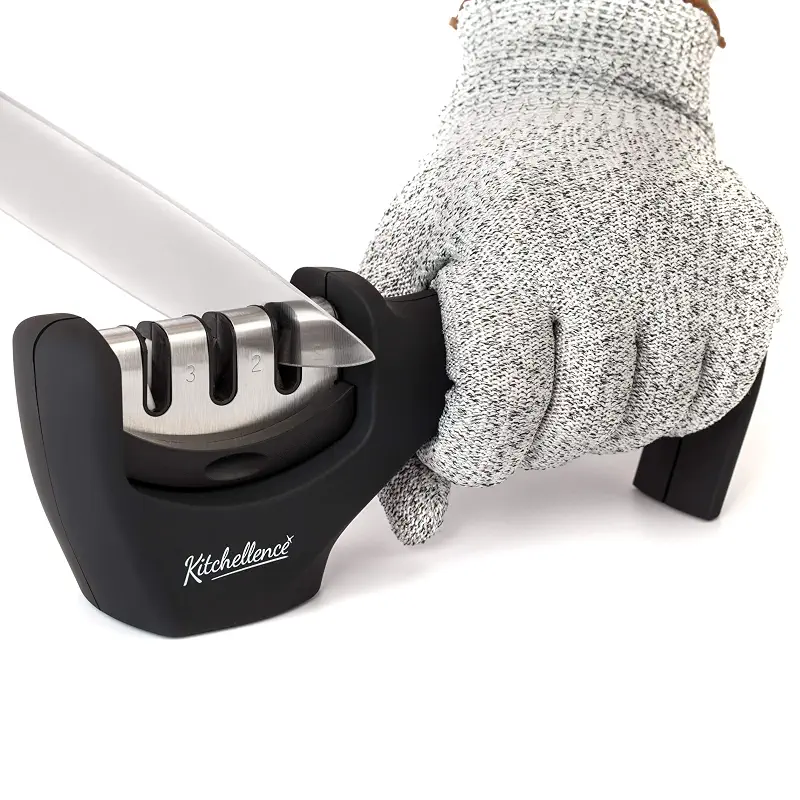
Kitchellence bundles a three-stage sharpener with a cut-resistant safety glove and prices it below single-tool alternatives. The diamond-rod coarse stage supposedly straightens damaged edges, the medium stage restores the V-shape, and the fine stage polishes to smooth. Forty thousand reviews suggest the tool has found a broad audience, though owner feedback reveals nuance worth understanding.
A five-star buyer shares detailed experience: the sharpener works, but the manufacturer's recommended technique doesn't optimize results. After experimentation, they skipped the coarse stage entirely, applied a 30-45 degree angle (not perpendicular), and used downward pressure on the blade. With that adjustment, they restored half-century-old knives and kept their kitchen blades reliably sharp. This tells you the tool has potential but rewards tinkering; it's not a "follow the instructions and get restaurant-quality edges" product. The included glove is thoughtful but one owner found it awkward. The solid ABS plastic build should last years.
Compared to the AccuSharp's simplicity or the Sharp Pebble's angle control, this sits in the middle: more stages than AccuSharp, less precision than Sharp Pebble. It's a budget pick that works if you're willing to experiment and don't mind the learning curve: a fair trade-off for the price point.
Pros
Three-stage progression from coarse diamond to fine polish
Includes cut-resistant safety glove for peace of mind
Solid ABS plastic construction designed for long-term use
Restored neglected vintage knives to usefully sharp condition
Cons
Requires technique adjustment beyond manufacturer instructions for best results
Initial learning curve steeper than plug-and-play alternatives
Key features
Three-slot system with diamond repair, medium sharpening, and fine polish stages
Ergonomic handle fits both right and left-handed users
Non-slip base provides comfortable control during sharpening strokes
Bundled cut-resistant glove adds safety-first value
How to Choose a Filet Knife Sharpener
Four trade-offs that actually matter when matching a filet knife sharpener to your kitchen.
Understand Filet Knife Blade Geometry
Filet knives typically have a thinner, more flexible blade than chef's knives and work best with a sharper angle: usually between 12 and 18 degrees. This geometry lets the blade glide through delicate fish skin and separate flesh from bone without tearing. Standard kitchen sharpeners often apply 20+ degree angles, which is fine for heavy cutting but may not optimize a filet blade. Adjustable-angle sharpeners like the Sharp Pebble give you control over that angle. Pull-through and preset tools accept a fixed angle, so check that the angle matches your blade type before buying.
Pull-Through vs. Adjustable Angle: Which Fits Your Workflow
Pull-through sharpeners (AccuSharp, Smith's, Gambler) are fast and beginner-friendly. You pull the blade through a slot in 10-20 seconds and move on. They work well for regular maintenance and are excellent if you sharpen often and don't mind a preset angle. Adjustable-angle sharpeners (Sharp Pebble, Kitchellence) require you to set the angle and make multiple passes, but give you control over edge geometry. If you own multiple blade types or want to restore a neglected knife, adjustable tools reward the extra effort. For filet knife sharpener types, pull-throughs suit field and tackle-box use; stationary angle-adjustable systems suit serious home cooks.
Portability vs. Control
If you fish, hunt, or cook outdoors, portability matters. Tiny tungsten-carbide pull-throughs (Smith's, Gambler) weigh ounces and attach to keychains. Larger, stationary sharpeners (Sharp Pebble, Kitchellence) live on a counter and offer more stable control during sharpening. Outdoor sharpeners excel at emergency touch-ups but rarely produce the refined edge a stationary system can. Match the tool to where and how often you'll use it.
Material Removal and Edge Longevity
Different sharpening methods remove metal at different rates. Tungsten-carbide pull-throughs (AccuSharp, Smith's) remove more material per pass, which speeds sharpening but shortens blade life over years of heavy use. Water stones and ceramic honing remove less but demand more skill and time. For filet knives that see regular but not extreme use, a pull-through or three-stage system offers a practical balance. Professional steelworkers often reserve expensive blades for stone sharpening; home cooks usually choose speed and simplicity.
Safety and Learning Curve
The safest sharpeners have guards or controls that keep your fingers away from the blade. AccuSharp features a full-length guard; pull-throughs generally protect you by design. Adjustable-angle systems require more awareness since you're handling the blade more deliberately. The Kitchellence bundle includes a cut-resistant glove, which is smart if you're nervous. Plan for a sharpening filet knife guide if you're new to edge maintenance; even experienced cooks benefit from understanding the technique that suits their tool.
Frequently asked
Quick answers to the questions readers ask most.
Can I sharpen a serrated filet knife with these sharpeners?
Most pull-through and adjustable-angle sharpeners in this guide are designed for straight-edge blades only. Serrated filet knives require a rod that fits between the teeth, which these tools don't provide. AccuSharp and Kitchellence advertise serrated compatibility, but check product details and owner reviews for your specific blade type. For serrated edges, a honing rod or specialty serrated sharpener is usually a better choice.
How often should I sharpen my filet knife?
It depends on use. If you filet fish 2-3 times a week, a quick pull-through touch-up every 1-2 weeks keeps the edge working. Professional kitchens sharpen daily or between shifts. Home cooks who fillet occasionally can go months between sharpening. A sharp blade should glide through skin with minimal pressure; when you feel drag or resistance, it's time to sharpen.
What's the difference between sharpening and honing?
Sharpening rebuilds the blade's edge by removing metal, using coarse abrasives (diamond, carbide). Honing realigns the edge by smoothing the existing geometry, using ceramic or fine abrasives. Most multi-stage sharpeners combine both: the coarse stage sharpens, and the fine stage hones. A honing steel or ceramic rod between sharpenings keeps an already-sharp blade aligned, extending the time before true sharpening is needed.
Can I use these sharpeners on chef's knives, paring knives, and other kitchen blades?
Yes, most of these tools work on straight-edge kitchen knives. Filet knives are relatively thin and flexible, so they sharpen faster than heavy chef's knives. Pull-through sharpeners apply a fixed angle (usually 15-20 degrees), which suits most kitchen knives but may not optimize filet geometry. Adjustable-angle sharpeners let you dial in the ideal angle for each blade type, which is why serious cooks favor them for multi-knife collections.
Do these sharpeners work on pocket knives and hunting blades?
Yes, all five tools here handle pocket and hunting knives, though the fit depends on size. The Sharp Pebble has thicker plastic walls that may exclude very small pocket knives. Pull-through portable sharpeners (Smith's, Gambler, AccuSharp) work on most outdoor blades. If you carry a specialty folding knife with an unusual angle or geometry, check the sharpener's preset angle or adjustability against your blade before committing.