Kitchen & Dining · Gadgets
Best Espresso Stirrer
Needle tools break up clumps in the portafilter, while spoons and whisks stir the cup. See which kind suits your espresso routine.
Affiliate disclosure: As an Amazon Associate I earn from qualifying purchases.
At a glance
1
Classic Walnut PickZolunu
2
Compact Espresso Spoon SetImeea
4
Best for Mixing PowdersGosh That's Good! Brand
5
Self-Cleaning WDT PickNessus
6
Best for Tall GlassesBriout
Detailed reviews
This is the most traditional-looking needle tool of the group: five stainless steel needles at 0.4mm, set in a natural walnut handle that rests in a matching stand. The needles are thicker than the 0.35mm ones on the Nessus WDT Espresso Distribution Tool, which suits a light touch on a modest dose but gives you fewer points of contact in the bed.
Owners report that it breaks up clumps and improves shots, and it is credited with easing channeling on a machine. The wood finish draws praise too, and the rinse-and-dry cleaning is simple.
The feedback on construction is where we'd slow down. A common complaint is that the needles are fragile, that prongs have come loose from the base, and that it fell apart quickly after minimal use. It is also described as smaller than expected, with tinier needles than advertised, and as prone to not staying put during use. For a careful home barista who values the look, it can work; for daily heavy use, we'd lean toward a sturdier build.
Pros
- Fine stainless needles break up clumps
- Walnut handle with matching stand
- Simple rinse-and-dry cleaning
Cons
- Needles reported fragile and detaching
- Smaller than advertised, tiny needles
- Reported to shift out of place
Key features (3)
- Five stainless steel needles at 0.4mm diameter
- Natural walnut handle with an integrated stand
- Corrosion-resistant needles with a grip-friendly handle shape
This is a set of four brushed stainless spoons, each about 5.9 inches long, made from one seamless piece of steel. They are built for stirring espresso, cappuccino and demitasse cups, or for scooping small amounts of sugar and spices, so think of them as drink stirrers rather than a stand-in for the Zolunu Espresso Coffee Stirrer 5 Needles.
Owners report that the weight feels reassuring and that the length and size suit small cups. They also hold up in the dishwasher without staining or nicking, and they work for loading loose coffee into refillable pods. We found nothing in the feedback that points to a weakness.
If your goal is a tidy, sturdy spoon for a cup rather than a tool for the portafilter, this is the easiest recommendation among the spoons.
Pros
- Seamless one-piece steel is easy to clean
- Weighty, comfortable rounded handle
- Dishwasher-friendly and resists stains
- Suited to small cups
Key features (3)
- Food-grade stainless steel in a seamless one-piece design
- Length of 5.9 inches with a narrow tip for small cups
- Heavier than typical mini spoons with a rounded grip
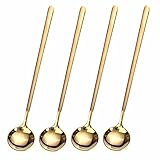
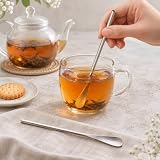
Where the Imeea Mini Espresso Spoons Set of 4 stays short for small cups, this set of four stretches to 6.7 inches, which reaches the bottom of deep mugs, tall glasses and iced drinks. The mirror-polished 304 stainless steel has smooth, burr-free edges and a gold color that works as decor on a coffee station.
Owners report that the finish holds up in the dishwasher without fading or scratching, and that the length is right for tall glasses and deep tea mugs. Buyers also like them for homemade specialty coffees and describe them as pretty without being fragile.
They are general-purpose stirring spoons, so we'd pick them for the cup, not for the portafilter. If looks matter on an open coffee bar, they earn their place.
Pros
- Long reach for tall mugs and glasses
- Gold finish keeps its look
- Smooth, burr-free mirror-polished edges
- Hand or dishwasher washing
Key features (3)
- Food-grade 304 stainless steel with a mirror-polished gold finish
- Long handle at 6.7 inches suited to deep cups
- Smooth, burr-free edges safe for hands and mouth
This is a barista whisk, not a distribution tool: its shape is meant to reach the corners of cups and pitchers and blend powders and syrups. It is a single stainless piece at about 10 inches long that can replace a few spoons and stir sticks, and it suits matcha, hot chocolate and protein drinks as well as coffee.
Owners report that it mixes powders into liquid quickly, reaches the whole base of a cup, and rinses clean with ease. Matcha and creamer are cited as good matches. It is also said to spread espresso grounds effectively.
The weak spots are real, though. A common complaint is that it came apart after a month or two of use, and the results on clumps are split: it is said to clear lumps, yet also to create more of them. If clumps in the grounds are your target, the Meion WDT Espresso Distribution Tool is the tool built for that job; this one is for drinks.
Pros
- Reaches the whole base of cups
- Quickly blends powders into drinks
- Rinses clean without fuss
Cons
- Reported to come apart within months
- Clump results are inconsistent
Key features (3)
- Compact stainless steel whisk about 10 inches in length
- Shaped to reach the corners of cups and pitchers
- Handles coffee, matcha, tea, hot chocolate and protein drinks
The built-in brush is what sets this tool apart: each time the needles go back into the base, the brush wipes off the grounds clinging to them. It carries ten 0.35mm stainless needles, a spare ten in a storage tube, and an aluminum alloy handle with a silicone-bottomed stand. You can also fit anywhere from five to nine needles, so it adapts to your preferred setup.
Owners report that it breaks up clumps, evens the bed before a shot, and cleans easily. A sweeter cup is credited to the more even bed, and the compact look gets compliments. It also costs the user little time to assemble, and the extra needles are a welcome inclusion.
There are limits on build. A common complaint is that needles bend or twist over time, and the pins may not line up with their holes, so assembly can need patience. The stand is narrow too. Compared with the wooden Zolunu Espresso Coffee Stirrer 5 Needles, it gives you a denser needle field and an easier clean, which is why we think it suits a home barista who wants a ready-to-go WDT setup.
Pros
- Built-in brush cleans needles automatically
- Spare ten needles included
- Needle count can be changed
- Breaks up clumps before the shot
Cons
- Needles can bend and twist
- Pins may not align with holes
- Stand is narrow
Key features (3)
- Ten food-grade stainless needles at 0.35mm with ten spares
- Configurable with five to nine needles in the head
- Aluminum alloy handle with a silicone-bottomed stand
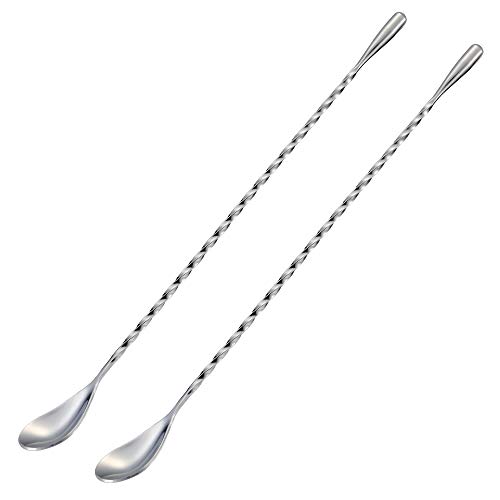
These two 12-inch spoons have a twisted handle and polished 18/8 stainless steel, built to reach the bottom of tall glasses, pitchers and shakers. The reach is the point: while the Genrice 4 PCS 6.7 Inches Coffee Spoons stop at deep mugs, these go well beyond into mixing-glass territory.
Owners report that the weight feels balanced rather than flimsy, that the spoons don't bend even through ice, and that the spiral helps a smooth stir. They get used for cocktails, iced coffee, tea and smoothies, and they go in the dishwasher. The finish is reported to lose a little color with time.
For stirring drinks rather than grounds, the best coffee stirrers cover the wider spoon-and-stick category, while this pair stays focused on long reach. It is a cup tool, not a portafilter tool, but a good one.
Pros
- Twelve-inch reach for tall glasses
- Balanced weight without bending
- Twisted handle guides smooth stirring
- Dishwasher safe polished steel
Cons
- Finish can lose color over time
Key features (3)
- Mirror-polished 18/8 stainless steel construction
- Twelve-inch twisted handle for control and reach
- Set of two spoons that suit tall cups
This tool comes with seven 0.35mm stainless needles installed and seven spares in a storage tube, set in an aluminum handle with a matching stand. Needles pop in and out without tools, so you can run three, four, five, six or seven. That flexibility is the main draw, and the Nessus WDT Espresso Distribution Tool offers a similar idea with a higher ceiling and a cleaning brush.
Owners report that it breaks up clumps, improves extraction, and that the aluminum build feels well made. Owners also report that running only a few needles works better, because a full set can push grounds toward the center. Owners who already have a quality conical grinder find the benefit smaller, which echoes what we say in the guide below.
Sturdiness draws mixed comments: a common complaint is that the stand tips over easily, and the hollow base lets grounds collect underneath. Even so, for a first needle tool with room to experiment, we think this is a sensible choice.
Pros
- Needles install and remove without tools
- Spare needles stored in a tube
- Anti-slip aluminum handle
- Breaks up clumps before tamping
Cons
- Stand can tip over easily
- Full needle set can crowd grounds
- Hollow base lets grounds collect
Key features (3)
- Seven 0.35mm stainless needles with seven spare needles included
- Needle count adjustable from three to seven
- Aluminum handle and stand with a non-slip pattern
Side by side
| Pick | Item dimensions |
|---|
#1 Classic Walnut Pick
Zolunu | — |
#2 Compact Espresso Spoon Set
Imeea | 5.91 × 0.47 × 0.39 inches |
#3 Gold Finish Pick
Genrice | — |
#4 Best for Mixing Powders
Gosh That's Good! Brand | 10.5 × 0.5 × 0.75 inches |
#5 Self-Cleaning WDT Pick
Nessus | 4.12 × 1.23 × 1.22 inches |
#6 Best for Tall Glasses
Briout | 12 × 1.18 × 0.04 inches |
#7 Most Adjustable WDT
Meion | — |
How to Choose an Espresso Stirrer
Do you actually need a needle tool?
Stirring grounds with fine needles, known as the Weiss Distribution Technique, breaks up the clumps that grinding creates and levels the bed before tamping, which helps the water flow evenly. How much it matters depends on your routine. If you pull classic espresso on a capable grinder, the gain may be small, and owners with a good conical grinder report little change. If you chase higher extraction or your grinder produces static and clumps, an even bed counts for more.
A better grinder shrinks the clumping problem before a needle ever touches the bed, and the best espresso grinder under 100 lineup on this site covers that side of the setup.
What makes a good set of needles?
Needle diameter and count are the two choices that change how the tool behaves. Needles around 0.25 to 0.4mm are the usual range: thin enough to break clumps without carving channels of their own, but not so thin that they bend. Tools in this category commonly ship with around eight or nine needles, though running fewer can stop grounds from being pushed into the center. For that reason, the adjustable Meion WDT Espresso Distribution Tool is a good fit if you want to experiment.
- Needle diameter that breaks clumps without leaving channels
- Removable needles so you can run fewer
- Spare needles in case one bends
- A stand that protects the needle tips
Can a spoon or a whisk stand in?
They do different jobs. A spoon stirs the drink in the cup and cannot level grounds in a portafilter, so spoons suit cappuccino, iced coffee and cocktails instead. A whisk like the Gosh That's Good! Brand Barista Whisk mixes powders into liquids. For clumps in grounds before the shot, a needle tool is the right instrument, and the Nessus WDT Espresso Distribution Tool is our pick when easy cleaning between beans is a priority.
Our picks at a glance
1
Classic Walnut PickZolunu
2
Compact Espresso Spoon SetImeea
4
Best for Mixing PowdersGosh That's Good! Brand
5
Self-Cleaning WDT PickNessus
6
Best for Tall GlassesBriout
Frequently asked
What does WDT stand for, and what does it do?
WDT stands for Weiss Distribution Technique. You stir the grounds in the portafilter with fine needles to break up clumps and even out the bed, which reduces channeling and supports a more even extraction before you tamp.
How many needles should I use?
Fewer than the full set is often enough, and owners report running just three in a triangle because a crowded head can push grounds toward the center. The Meion WDT Espresso Distribution Tool lets you run anywhere from three to seven, which makes it easy to find your own number.
How do I clean a needle tool?
A quick rinse and wipe works for most, and the Nessus WDT Espresso Distribution Tool wipes its needles on a brush each time they return to the base. Let metal parts dry before storing them in their stand.