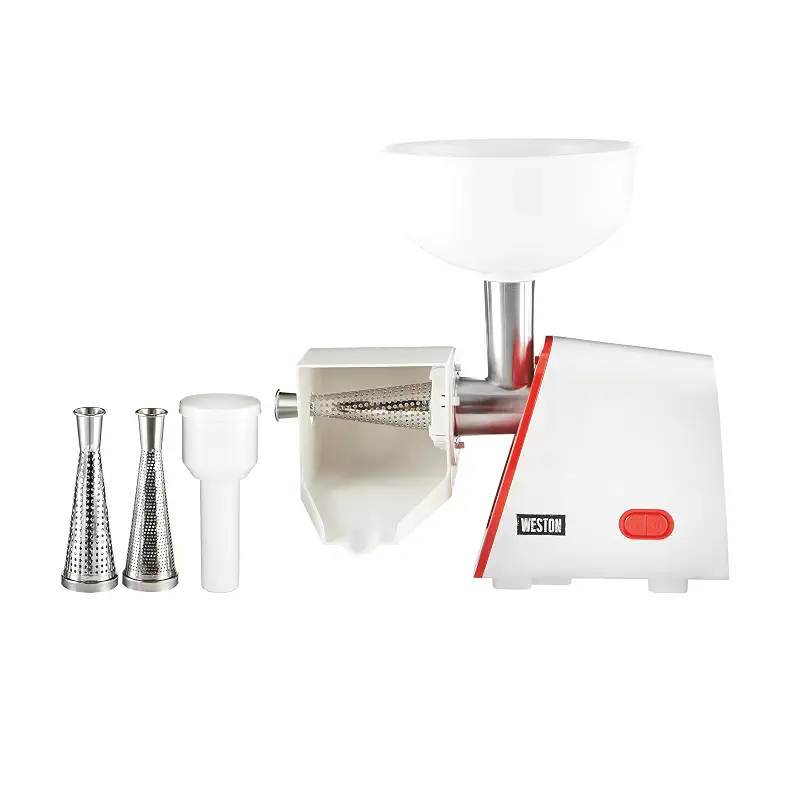
Ideal for: Home canners processing 30-100 lbs of tomatoes per season; beginner to intermediate sauce makers.
The Weston Deluxe is the machine most home canners gravitate toward, and the reviews make clear why. Owners report finishing 7+ quarts of tomato sauce in 30 minutes, and the aluminum head (though it requires a light oil coating to prevent gray discoloration) has earned a loyal following. The real strength is the three interchangeable screens (1.5mm, 3mm, 6mm), which let you make everything from fine tomato puree to chunky salsa, something you won't find on every competitor at this price point.
The machine isn't perfect. Some buyers discovered the hard way that the aluminum head can't go in the dishwasher and needs food-grade silicone spray or vegetable oil to run cleanly. The motor is also modest at 250 watts, so Weston's instruction to run it for no more than 5 minutes at a time, then clear the chute before the next batch, becomes a workflow rhythm you'll need to respect. But owners who follow those rules consistently report no leaks, no jamming, and sauce that's genuinely clean.
If you're doing 30-60 pounds of tomatoes a year and want a machine that's easy to assemble, doesn't require Italian heritage to troubleshoot, and comes with excellent English instructions, this is the entry point most canning guides recommend. Compared to the Imperia, the Weston costs less and is lighter to move around, though the Imperia's made-in-Italy pedigree appeals to those who prioritize long-term durability.
Pros
Three stainless-steel screens for varied texture control
Fast processing: 7+ quarts of sauce in under 30 minutes
No-leak operation when aluminum head is oiled lightly
Clear, concise English instruction manual
Cons
Aluminum head requires regular oil coating; discolors if dishwashed
250W motor demands 5-minute run cycles with clearing breaks
Key features
1.5mm, 3mm, and 6mm stainless-steel screens for texture variety
250-watt motor with forward and reverse speeds to prevent jamming
One-gallon hopper for large-batch tomato processing
Lightweight, no-clamp design fits any countertop setup
#2 Pick
Best for High-Volume Commercial Output
Arinoo
Electric Tomato Strainer, 450W Tomato Juicer Maker Machine | Commercial Stainless Steel Tomato Press & Sauce Maker with Pure Copper Motor for Blueberry Strawberry Jam, 200-350 lbs/h 110V
4.1(15)
Heavy-duty 450W copper-motor machine built for speed; excellent when it works, but assembly quality control issues reported.
Ideal for: High-volume canners and small farms processing 200+ lbs of tomatoes; risk-tolerant buyers seeking commercial-speed at mid-range pricing.
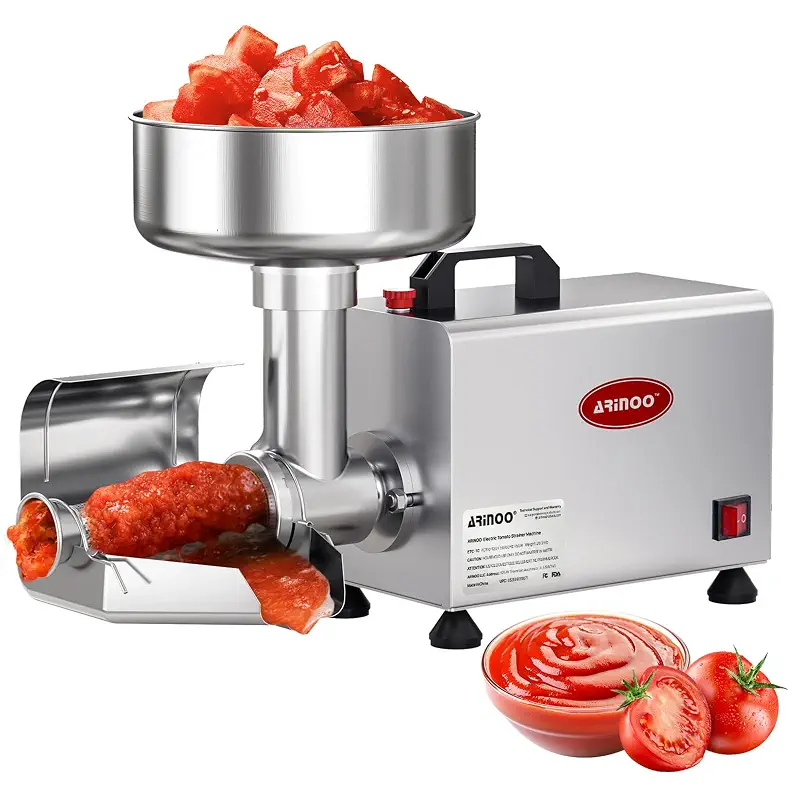
The Arinoo sits at the intersection of home and commercial use. Its 450-watt pure copper motor and stainless-steel construction suggest serious capacity, and the handful of five-star reviews glow about processing boxes of Roma tomatoes with ease. The dual-channel separation system is advertised to eliminate the need for extra filtering, which appeals to canners who want pure speed without fuss.
But the buyer feedback also flags real concerns. One five-star reviewer had to troubleshoot assembly problems right out of the box, and a one-star buyer reported the strainer cone simply wouldn't click into place no matter how firmly it was turned. That's not a design flaw you can work around; it suggests inconsistent quality control at manufacturing. The shipping-plug issue (loose oil creating a mess) and the fact that a relatively recent purchase already had missing replacement screens tells you this brand may not stock parts the way Italian-made machines do.
If you can confirm assembly integrity upon arrival and you're willing to accept that customer service may be limited, you're looking at a machine that will churn through tomatoes faster than the Weston. But compared to the Reber or Imperia, you're accepting less assembly confidence and potentially weaker long-term support for the speed gain.
Pros
450W pure copper motor processes 330 lbs/hour when operating smoothly
Fully stainless-steel construction resists rust and wear
Automatic dual-channel separation eliminates extra filtering step
Cons
Assembly quality control inconsistent; some units won't fit together properly
Limited availability of replacement screens and parts
Key features
450-watt pure copper motor with 330 lbs/hour processing capacity
Food-grade 304 stainless-steel hopper, body, and filter system
Dual-channel automatic straining with no filter cartridge needed
Five-year factory warranty with lifetime customer support claim
#3 Pick
Best Made-in-Italy Mid-Range Workhorse
Imperia
OMRA Spremy Electric Tomato Strainer 1/4 HP Model 850
4.5(1,042)
Italian-made with proven durability; lower height and plastic auger are trade-offs for mid-level output and solid build.
Ideal for: Dedicated seasonal canners (50-200 lbs/year) who value Italian durability and heritage equipment.
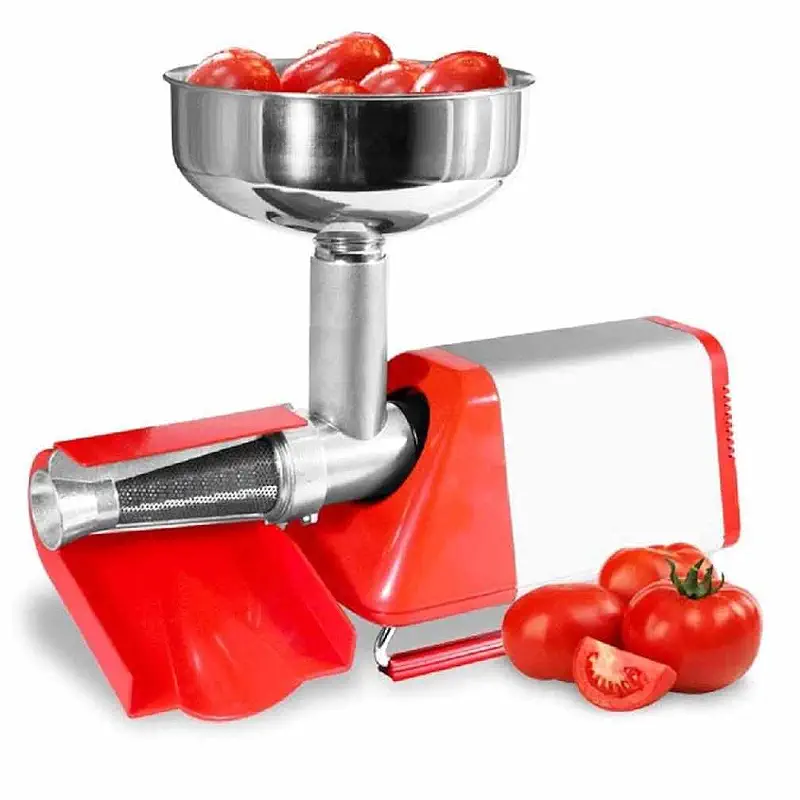
The Imperia OMRA Spremy represents a different philosophy: lighter power (1/4 HP), lower price than the heavy Italian machines, but unmistakable Italian craftsmanship. Owners processing 100+ quarts per year report this machine hasn't let them down across multiple seasons. The 110 RPM masticating-style auger preserves enzymes (a detail canning purists appreciate), and the stainless-steel hopper won't corrode over years of storage.
The machine does sit low to the table, and several owners immediately elevated it on a step stool or board to fit a proper catch bowl underneath. The plastic auger and chute aren't stainless steel, which matters if you're planning to own this for 20 years, but the die-cast metal housing is solid. One reviewer even modified the plunger design because the stock version didn't grip well with hot cooked tomatoes; that's not a showstopper, just a sign that small refinements exist if you're willing to adapt. Compared to the Weston, you pay more and get Italian heritage and a proven track record, but slightly less everyday convenience. Compared to the Reber or Vbenlem, this is the accessible entry point to the "serious canning machine" tier.
Pros
Proven durability over multiple seasons and hundreds of pounds of tomatoes
Masticating 110 RPM action preserves enzymes and flavor
Made in Italy with solid die-cast metal housing and stainless hopper
Cons
Machine sits very low; requires elevation to fit catch bowls underneath
Plastic spiral auger and chute wear over extended use
Key features
1/4 horsepower motor with 330 lbs/hour production capacity
Stainless-steel hopper and food-grade nylon masticating auger
110 RPM enzyme-preserving rotation for flavor-forward sauce
Made in Italy with die-cast metal housing for long-term reliability
#4 Pick
Best Premium All-Metal Construction
Reber
Reber Electric Tomato Strainer N.5 650W for Tomato Sauce and Preserves | for Jams and Fruit Juices - Output up to 772 lbs/h - Stainless Steel Accessories – Induction Motor – Made in Italy
4.5(1,205)
Top-tier Italian machine with 650W induction motor and all-metal gears; exceptional durability and speed at a significant investment.
Ideal for: Serious preservation enthusiasts and small commercial operations processing 200+ lbs regularly; lifetime-equipment buyers.
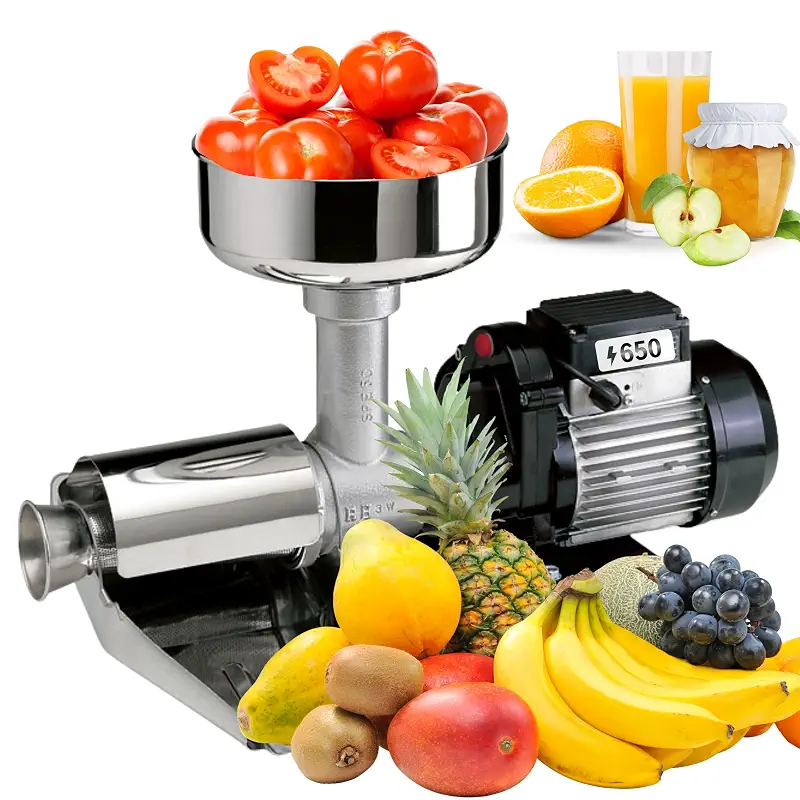
The Reber N.5 is the machine you buy if you're not just canning tomatoes, you're building a legacy. The 650-watt induction motor is the most powerful in this lineup, the oil-bath gearbox is maintenance-free and designed to outlast most home kitchens, and every component that touches food is stainless steel or cast iron with epoxy coating. Processing 772 pounds per hour sounds like overkill for home use, but it means zero stress on the motor even when you're running batches continuously.
Owners consistently report that this machine saved them a full day of work compared to hand-straining or older electric units. One reviewer processed 8 bushels in 3 hours and called it a lifetime investment. The optional attachments (pasta press, meat grinder, grater, mixer) transform it into a full food-processing hub, though those cost extra. The English-language manual issue that tripped up one buyer appears to be a one-off. Italian and French manuals are clearly the original documentation, but most English-speaking buyers report finding adequate information online or in supplementary sheets.
Compare this to the Weston and you're paying roughly triple the price for a machine that will genuinely last 20-30 years with zero maintenance. Compare it to the Imperia, and you're upgrading from 1/4 HP to 650W, from plastic auger to all-metal gears, and getting professional-tier output. It's not for everyone's budget, but if you're doing massive harvests or considering a tomato-processing side business, the Reber's reliability and power justify the cost.
Pros
650W induction motor with all-metal gears for professional-grade reliability
Produces up to 772 lbs/hour with zero motor strain or safety concerns
Fully stainless-steel and cast-iron construction with maintenance-free oil bath
Cons
Manual comes primarily in Italian and French. English documentation requires searching
Significantly higher investment than mid-range home models
Key features
650-watt induction motor with maintenance-free oil-bath gearbox
All-metal gearing and cast-iron body for multi-decade durability
Food-grade epoxy-coated cast iron and AISI 304 stainless accessories
Compatible with optional pasta press, meat grinder, and other attachments
#5 Pick
Best Budget Commercial-Grade Alternative
Vbenlem
VBENLEM 110V Electric Tomato Strainer 370W Commercial Grade Tomato Milling Machine Stainless Steel Tomato Press and Strainer 90-160 Kg/H Pure Copper Motor Food Strainer and Sauce Maker | Stainless Steel Tomato Press with 90-160 kg/h Output and Pure Copper Motor for Straining Tomatoes and Preparing Fresh Sauces
3.9(288)
Affordable stainless-steel option with 370W motor; solid for tomatoes but demanding short duty cycles and modest screen geometry.
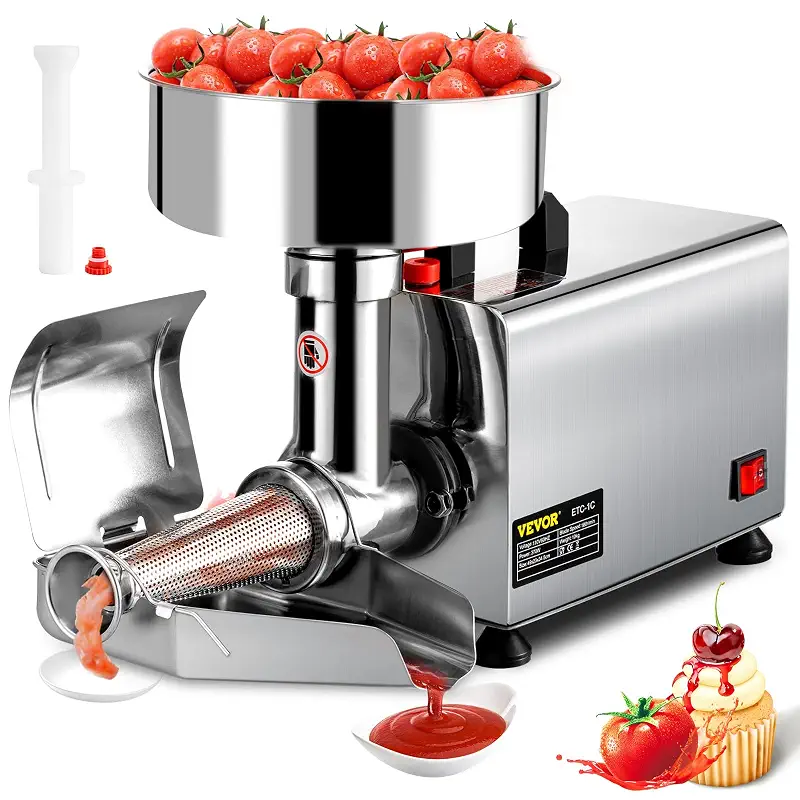
The Vbenlem occupies the tricky middle: it costs less than the Imperia yet markets itself as commercial-grade, with full stainless-steel construction and a pure copper motor. For buyers who want the idea of durability without committing to Italian pricing, the appeal is clear. Reviews of successful batches (50 lbs of tomatoes, 100 lbs/hour throughput) prove the machine can work when used correctly.
But the caveats matter. The 370-watt motor (larger than the Weston but smaller than the Reber) comes with the same instruction to run for no more than 15 minutes, then cool. One buyer found the cone sieve wobbles during operation because the plastic auger's rotation is what keeps it seated, which raises durability questions over time. Another reported the machine ground seeds into paste rather than ejecting them cleanly, yielding bitter sauce; whether that's operator error (pre-processing choice) or design limitation isn't fully clear, but it's a risk flagged by a buyer.
Compared to the Weston, you gain stainless-steel components and theoretically higher speed, but you lose the interchangeable screens and face tighter duty cycles. Compared to the Imperia or Reber, this is the budget option, which means accepting some uncertainty about long-term performance and parts availability. If your budget is strict and you're processing tomatoes just a few times per year, the Vbenlem can work; if you're expecting 20-year reliability, look higher.
Pros
Full stainless-steel construction resists rust and corrosion
370-watt pure copper motor delivers 90-160 kg/hour output
Adjustable discharge trough prevents splashing and controls flow
Cons
Short 15-minute duty cycles with mandatory cool-down periods required
Plastic auger doesn't seat the cone sieve securely; wobbling during operation
Key features
370-watt international pure copper motor in stainless-steel housing
Nine-inch diameter hopper and angle-adjustable discharge trough
All food-contact parts manufactured from 304 stainless steel
Waterproof level-II rating for easy wet-environment cleaning
How to Choose an Electric Tomato Juicer for Canning
Four trade-offs that actually matter when matching a electric tomato juicer for canning to your kitchen.
Motor Power and Duty Cycles
Motor wattage ranges from 250W (Weston) to 650W (Reber), but higher isn't always better if you're processing intermittently. The Weston's 5-minute run cycles suit home canners who clear the chute between batches. The Reber's 650W motor handles continuous operation without stress, ideal for processing 200+ pounds in one session. The Vbenlem and Arinoo sit in between but still recommend 15-minute maximums. If you're doing one big canning day per year, even a 250W motor is fine; if you're processing multiple times weekly, a 450W+ machine saves time and reduces motor strain.
Screen Size and Processing Power
The Weston is unique in including three interchangeable screens (1.5mm, 3mm, 6mm) that let you adjust texture from fine puree to chunky salsa. Most other machines come with a single cone screen. For canning sauce, a mid-range screen (3-4mm) is typical; for jams or applesauce, finer separation is useful. A screen size and processing power guide will help you match your recipe needs to machine capacity. Test-processing raw versus cooked tomatoes also matters: frozen or pre-stewed tomatoes feed more smoothly, but raw tomatoes give you more control over flavor development.
Construction Materials and Longevity
Budget models (Weston, Vbenlem) use aluminum heads or plastic augers; mid-range machines (Imperia) blend metal housings with plastic spirals; premium machines (Reber, to some extent Arinoo) employ all-metal gears and stainless-steel throughout. If you're canning 50 pounds per season, the Weston will serve you for a decade. If you're processing 300+ pounds annually or planning to keep the machine 20+ years, Italian-made all-metal construction (Imperia, Reber) justifies the investment. Stainless-steel hoppers resist corrosion better than aluminum if the machine sits idle for months between seasons.
Height, Clearance, and Setup
Nearly every buyer notes the machine sits low to the counter, requiring elevation on boards or step stools to fit catch bowls underneath. The Imperia is particularly compact and sits lower than the Weston. The Reber and Arinoo are bulkier but still need clearance space. Before ordering, measure your kitchen countertop height and plan where you'll position the machine relative to your sink or work surface. A machine elevated on a 6-inch board costs nothing but saves frustration and spilling.
Maintenance and Spare Parts
The Weston ships with clear instructions and spare screens are readily available. Italian-made machines (Imperia, Reber) have loyal communities online and sourced parts through manufacturer websites, but availability varies by region. The Arinoo and Vbenlem are newer brands; spare screens and service documentation can be harder to find. If you plan to own the machine for many seasons, confirm that replacement screens, gaskets, and augers are purchasable before committing. Budget machines may become orphaned if a brand stops importing or supporting them.
Frequently asked
Quick answers to the questions readers ask most.
Do I need to blanch and peel tomatoes before running them through an electric juicer?
No, but pre-processing affects output quality. Raw tomatoes work fine if they're ripe and cut into manageable pieces. Cooked or frozen tomatoes (thawed overnight) feed more smoothly and reduce jamming. Pre-blanching removes skins, but the juicer's job is to separate skins anyway, so it's optional. Many canners cook tomatoes down briefly to concentrate flavor, then run them through the machine. Experiment with your machine's preferred input to find your routine.
How long can I run an electric tomato juicer continuously?
Most machines recommend 5-15 minute run cycles, then cooling breaks. The Weston suggests 5 minutes; the Reber, with its larger motor, handles longer stretches. Running continuously for 30+ minutes risks motor burnout and loud operation as the motor heats. The practical workflow is to load, run for 5-10 minutes, stop, clear the chute and refill, then repeat. This rhythm actually improves consistency because you're not forcing half-processed tomatoes through a tired motor.
What's the difference between a tomato juicer and a food mill?
A tomato juicer (strainer) separates seeds and skins from pulp using a motorized auger that forces the mixture through a cone screen, ejecting solids while liquid flows out. A food mill is a manual or electric device that purees without necessarily removing skins and seeds: it's more about texture than separation. All the machines reviewed here are technically strainers, designed specifically to remove solids. If you want whole-tomato pulp with skins, a blender or food mill serves better.
Can I process fruit other than tomatoes in a tomato juicer?
Yes. Apples, berries, and stone fruits all work, though some require pre-cooking to soften. Berries and grapes can jam the screen if their skins are very thick; one reviewer noted that grapes clogged the Imperia quickly. Apples work beautifully, especially pre-cooked applesauce recipes. Always pre-cut large fruit and avoid overloading the hopper. If you plan to make jams frequently, confirm that your machine's screen size suits the fruit you're processing.
How do I clean the screen and auger without damaging them?
Most screens clog with seeds and skin; a long-handled bottle brush or pipe cleaner reaches inside the cone to dislodge trapped debris. Soak screens in hot water for 10 minutes before brushing to soften residue. The auger is either plastic or metal and washes easily with warm soapy water. Never force the screen off before running a few tomatoes through, because tomato acids loosen buildup naturally. Dry all parts thoroughly before storage to prevent mold in the vents and auger cavities, especially if the machine will sit for months between seasons.