Best Electric Lunch Box Food Heater for Hot Meals On-the-Go
Find the best electric lunch box for work, travel, or your car. Compare heated lunch boxes with fast heating, leak-proof containers, and multi-voltage support.
Ideal for: Office workers, truck drivers, construction crews, and anyone who wants proven durability and three-in-one power flexibility.
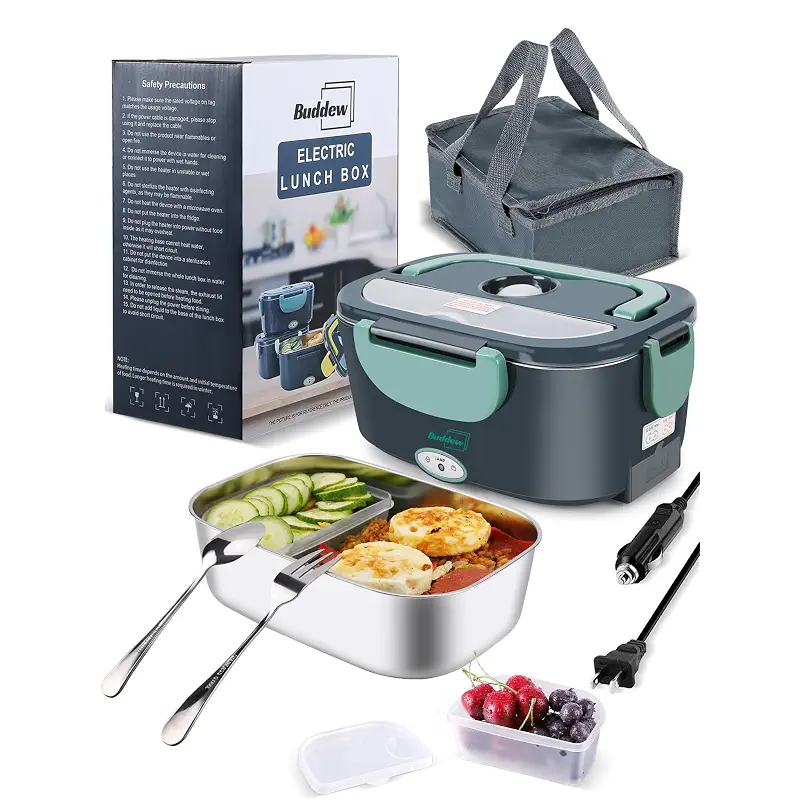
The Buddew model stands out because it delivers exactly what buyers consistently report they need: fast, reliable heating that doesn't dry out food, combined with the flexibility to plug into home, truck, or car power. The 100W PTC heating element warms meals in 15 to 30 minutes, and owners praise how food stays moist rather than becoming rubbery. The 304 stainless steel container is food-safe, dishwasher-friendly, and holds enough for a full adult meal. With over 7,400 reviews averaging 4.6 stars, the product has proven durability in real working conditions: construction sites, long-haul trucking, office jobs.
The reinforced heating module is worth noting because it addresses a real pain point: some earlier lunch-box designs fail after a handful of uses. Buddew's approach here reduces that failure rate, and buyers who've owned one for years attest to that. The included carrying bag, utensils, and dual power cords (car and home) mean you're not hunting for adapters. One-year free replacement and a two-year warranty back the commitment.
The main caveat is minor: a few owners noted the plastic carry bag feels thin, and one early review flagged a power-cord issue that was ultimately resolved through warranty service. The stainless steel container also won't fit back into the bag if you pack the plastic fruit container inside it, so organization matters. Still, for everyday reliability and broad use cases, this model is the safest choice.
Pros
Three power options: 110V home, 12V car, 24V truck
Durable PTC heating module rated for years of use
1.5L stainless steel container, dishwasher-safe
Includes carrying bag, utensils, and both power cords
Cons
Plastic carry bag is thinner than ideal for rough handling
Stainless container doesn't fit back in bag with all accessories
Key features
100W PTC heating technology warms food in 15–30 minutes
Ideal for: Workers with bigger appetites, those on 12+ hour shifts, meal preppers who want separated containers, and anyone prioritizing maximum capacity.
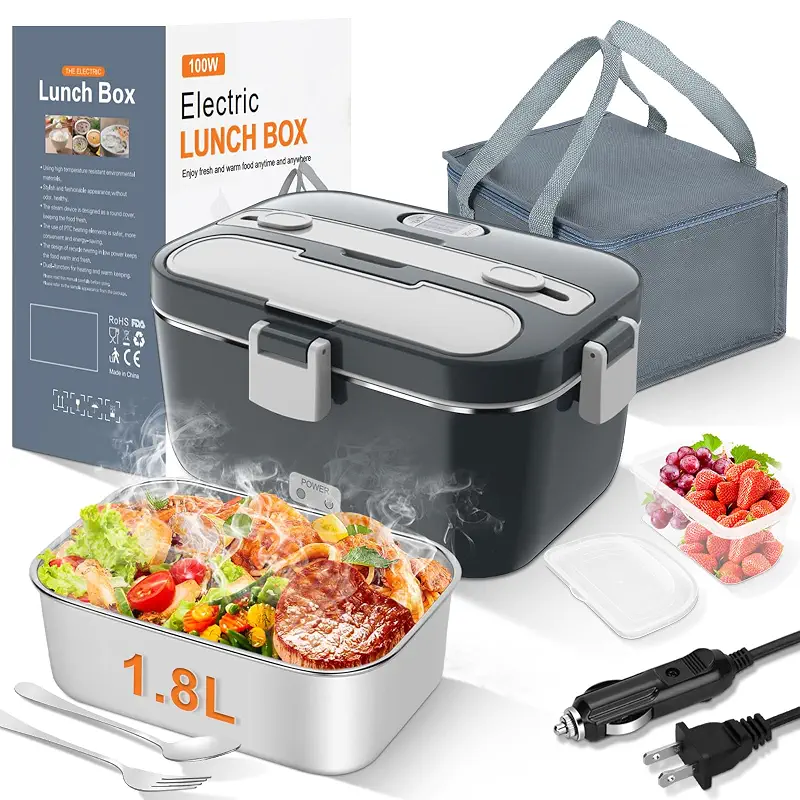
The Dupasu model stands out for sheer capacity: a 1.8L stainless steel container paired with a 0.45L salad compartment gives you room to pack a complete meal with sides and snacks without multiple trips. That extra 300mL over the Buddew matters when you're working a 12-hour shift or have a genuinely large appetite. The dual-container setup also lets you keep a salad or fruit separate, preventing flavors from mixing and keeping everything fresher longer.
Heating performance is solid at 100W, with owners reporting even warming in 20 to 30 minutes for standard portions. One detailed buyer noted that frozen food takes longer (potentially 50 minutes to 2 hours) so the model works best if you prep meals from the fridge rather than the freezer the night before. The stainless steel container and included fork and spoon are dishwasher-safe, and the silicone seal on the lid resists leaks well. Compared to the Buddew, the Dupasu includes an insulated carry bag and the same three-voltage support, making it competitive on convenience.
The tradeoff is minor but real: some owners found the lid latches tight and occasionally stubborn to close. Another mentioned that the non-heating plastic salad compartment is a limitation if you want to warm everything together. For most use cases, this is the better pick over other premium models because the extra capacity justifies the slightly higher complexity.
Pros
1.8L stainless steel container plus 0.45L salad compartment
Larger capacity than standard models, fits full meal plus sides
Silicone-sealed lid resists leaks effectively
Dishwasher-safe container and utensils
Cons
Lid latches can be tight and require firm hand pressure to close
Plastic salad compartment cannot be heated, only storage
Key features
1.8L stainless steel container with 0.45L dedicated salad box
100W fast heating in 20–30 minutes for standard portions
Three voltage modes: 110V–230V home/office, 12V/24V vehicle
Includes insulated carry bag, fork, spoon, and both power cords
#3 Pick
Best for Flexible Container Options
Aotto
Aotto Portable Oven, Electric Lunch Box Food Heater - 12V/24V/110V 3-in-1 Car Food Warmer - Mini Personal Microwave Heated Lunch Box Warmer for Car, Truck, Travel, Office & Home Use - Black
4.6(4,895)
Works with your own glass, metal, or ceramic containers; automatic temperature control prevents overcooking and drying.
Ideal for: Meal preppers with existing containers, those who prefer glass or ceramic over stainless steel, and anyone wanting maximum reheating flexibility.
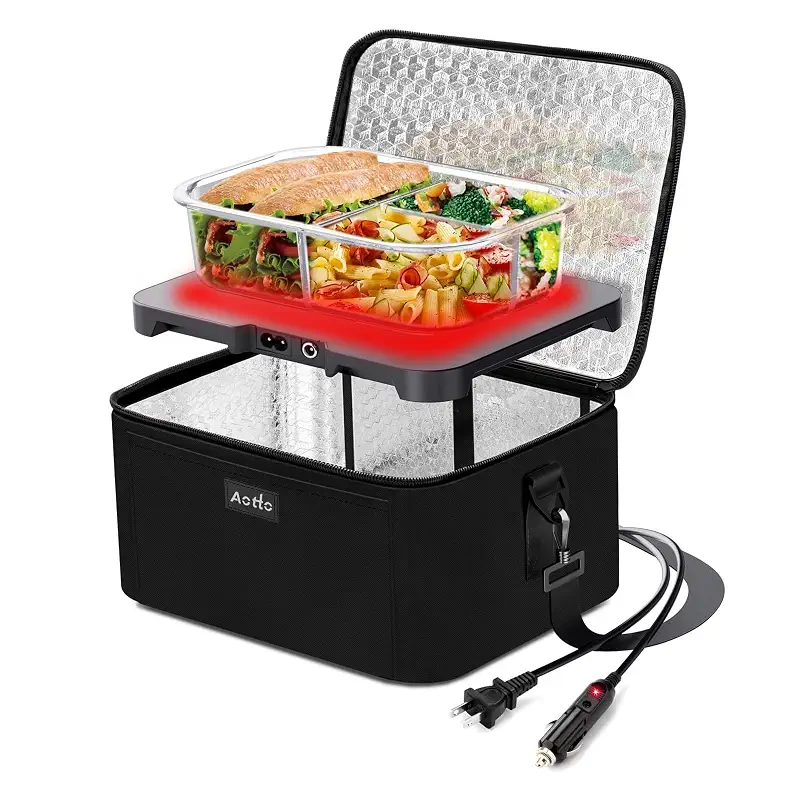
The Aotto portable oven takes a different design philosophy: instead of including a proprietary stainless steel container, it's a heated enclosure with a hot plate that accepts any flat-bottomed container up to 9.76 inches by 7.01 inches. This means you can bring your favorite glass Pyrex dish, metal container, ceramic plate, or even foil, giving you total flexibility to meal-prep the way you already do. Many buyers love this because they already own containers they trust and don't want to buy yet another branded lunch box.
The automatic temperature control is another strength. Rather than a simple on-off heater, the Aotto uses thermal sensing to maintain safe eating temperature for hours without overcooking or drying out food. One owner reported using it to scramble eggs in a glass container and got perfectly set eggs without runny spots: a real test of even, controlled heating. Another praised it for accommodating her aunt in a rehab setting where aggressive heat was a safety concern; the gentle, even warmth solved that problem.
Compared to the Buddew, the Aotto heats more slowly (30 to 45 minutes depending on density and container type), and the heating is conduction-based rather than penetrating, so thicker or denser foods need more time. The collapsible design with adjustable shoulder strap is convenient for carrying, and it works on power. Where the Aotto lags slightly is in the included accessories: you get the heating plate, bag, and two cords, but no container or utensils, so you're responsible for bringing your own meal prep. This is actually a feature for repeat meal preppers but a drawback for someone wanting a complete all-in-one package.
Pros
Accepts your own glass, metal, ceramic, or stainless containers
Automatic temperature control prevents overcooking and drying
Gentle, even heat ideal for delicate foods and safety-conscious users
Collapsible design with shoulder strap for easy carrying
Cons
Slower heating than coil-based models, 30–45 minutes typical
Does not include container or utensils; you must provide your own
Key features
Thermal sensing technology maintains safe eating temperature automatically
Compatible with flat-bottom containers up to 9.76L x 7.01W x 3.94H inches
multi-voltage support for vehicles and home use
Collapsible design with insulated carrying bag and shoulder strap
#4 Pick
Best for Heavy-Duty Work
Annie & Mia Design
Annie & Mia Design Electric Lunch Box for Adults, 100w 3.5L 2-Layer Portable Food Warmer, Dual Mode 2.5L + 1L Heated Lunch Box for Adults, Home/Car/Office/Truck Use, Lonchera Eléctrica Portátil
4.5(683)
Extra-large 3.5L dual-layer capacity with independent heating modes for separating main dishes and sides.
Ideal for: Construction workers, field technicians on long shifts, anyone with a hearty appetite, and workers needing to heat two separate meals in one day.
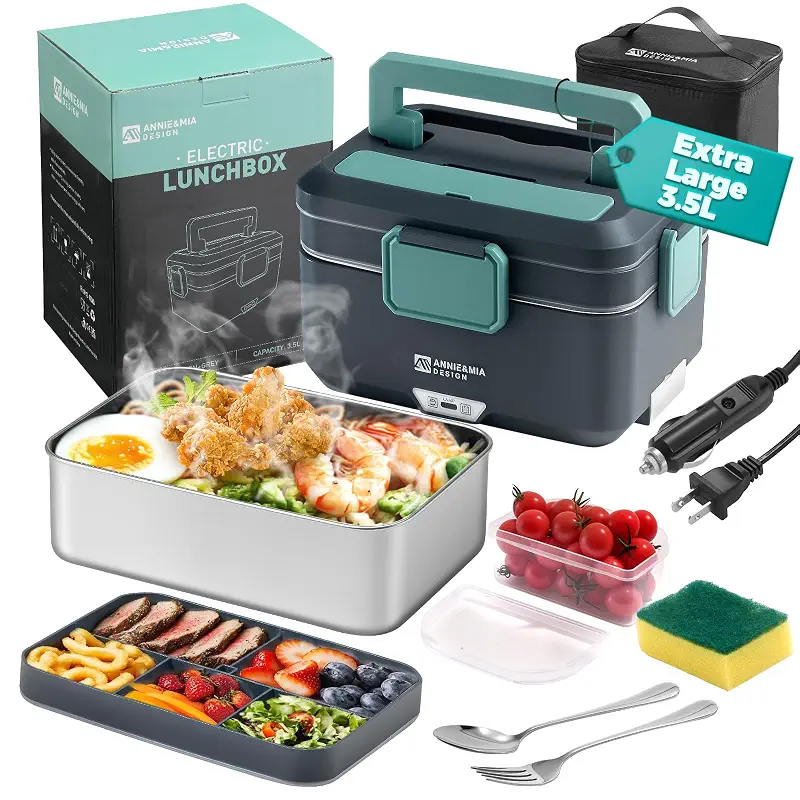
The Annie & Mia Design electric lunch box is built for workers with serious appetites and long shifts. At 3.5L total: a 2.5L stainless steel main container, a 1L PP secondary container, and a 0.45L fruit tray: it's the roomiest option here. What sets it apart is the dual-mode heating: you can heat both layers simultaneously for a complete meal, or only the stainless steel layer if you want something lighter. That flexibility addresses a real problem for people who prep meals the night before and want to keep some components cold (like a salad) while heating the main course.
The 100W PTC heater self-regulates temperature to prevent overheating, and buyers report piping-hot results in 20 to 30 minutes. One owner described bringing a sectioned silicone insert with protein, two vegetables, and a grain, all heated evenly and arriving hot enough to turn heads at the job site. The food-grade 304 stainless steel interior is durable, and the detachable design makes dishwasher cleaning trivial. The model supports the same multi-voltage scheme as competitors.
Where the Annie & Mia model differs from the Buddew or Dupasu: it's slightly bulkier due to the dual-layer design, and the plastic secondary container doesn't seal completely, so if you prep the night before, items inside can dry or harden by lunchtime. One buyer also noted the included stainless steel fork and spoon began rusting after a single wash, suggesting a quality variance in the flatware (though this is rare). For construction workers, field technicians, or anyone on a 24-hour shift needing to pack two hot meals, the extra capacity more than justifies the bulk.
Pros
3.5L total capacity: 2.5L stainless steel plus 1L secondary container
Dual-mode heating allows independent control of main and side containers
Even heating without drying out food, 20–30 minutes typical
Detachable containers are fully dishwasher-safe
Cons
Larger and bulkier than single-container models, takes up more space
Secondary plastic container doesn't seal completely for overnight prep
Key features
3.5L dual-layer design separates main course from sides and snacks
100W PTC self-regulating heater with even thermal distribution
Dual-mode heating: both layers together or stainless steel only
compatibility for car, truck, and home outlets
#5 Pick
Most Convenient Cordless Option
Charmdoo
Cordless Electric Lunch Box for Adults, 24000mAh Rechargeable Food Warmer | CHARMDOO Battery Powered Self Heating LunchBox, Smart Heated Food Heater Portable for Office, Car, Outdoor, Work, Travel, Men
5.0(32)
Rechargeable battery eliminates need for plugs or outlets; smart controls with preset timing and temperature regulation.
Ideal for: Outdoor workers, campers, travelers without reliable power access, and anyone prioritizing cordless convenience over traditional plug-in reliability.
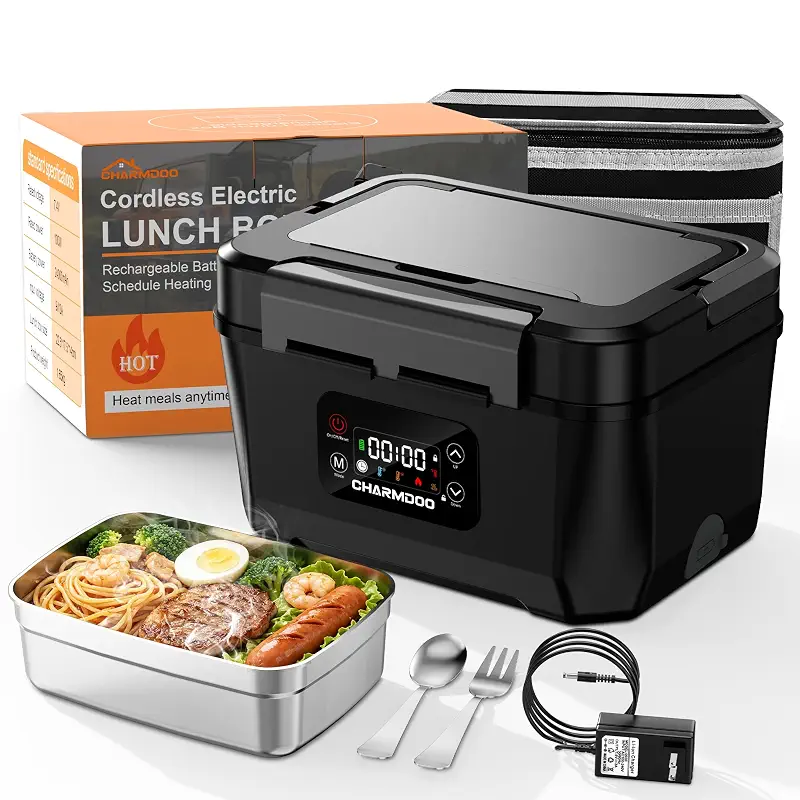
The Charmdoo cordless electric lunch box is the only truly untethered model in this lineup. Its 24,000mAh battery charges via USB and runs heating cycles independently, which is a game-changer for outdoor work, camping, or any situation where a power outlet isn't available. Most cordless lunch boxes on the market are underwhelming, but this one's 100W uniform heating and customizable 8-level temperature control make it competitive with plug-in models in terms of actual warming performance. One owner used it for work lunches without access to any outlet and reported even heating and reliable battery life across a full workday.
The smart preset feature is genuinely useful: you can set it to auto-heat at a specific time (up to 12 hours ahead), so your meal is ready when you arrive at lunch rather than waiting 30 minutes after you sit down. The automatic 30-minute warm-keep function prevents food from cooling if you're delayed. The 304 stainless steel container is leakproof, and the detachable inner tank lets you store prepped meals in the refrigerator and simply swap them in when you're ready to heat.
The tradeoff is battery management: you need to charge it regularly, and very cold environments or extremely dense foods will draw the battery faster. With only 32 reviews (versus thousands for the Buddew or Dupasu), the Charmdoo is newer and has less real-world longevity data. The price point is also higher because of the battery technology. However, if you work outdoors, camp frequently, or travel to places without reliable power, this is the only model that truly frees you from hunting for an outlet. Compare this to the Buddew or Dupasu if you prioritize total cord-free convenience; the trade is less cumulative user feedback, though current owners are enthusiastic.
Pros
24,000mAh rechargeable battery eliminates need for power outlets
Smart preset timing allows food to auto-heat up to 12 hours in advance
8-level temperature control with automatic warm-keep function
5-cup capacity with leak-proof 304 stainless steel container
Cons
Fewer user reviews than established models; less long-term durability data
Battery requires regular charging and drains faster in cold or dense foods
Key features
Rechargeable 24,000mAh battery with preset auto-heating up to 12 hours
100W uniform heating with 8-level temperature adjustment
Four trade-offs that actually matter when matching a electric lunch box food heater to your kitchen.
Power Source and Voltage Flexibility
Most electric lunch boxes offer three voltage options: 110V for home or office, 12V for cars, and 24V for trucks. If you work primarily at a desk or in a break room, a single 110V model saves money, but the portability and flexibility of three-in-one designs like those in this guide matter more for construction workers, drivers, or people who move between job sites. The Charmdoo cordless model eliminates this decision entirely if you're often away from outlets. Consider where you'll heat most meals: that determines whether you actually need the 12V car adapter or if a basic home-only heater would suffice.
Container Size and Capacity
Standard lunch boxes hold 1.5L to 1.8L, which covers a typical adult meal with moderate portions. If you have a big appetite, work 12+ hour shifts, or want to pack two separate meals (like breakfast and lunch), jump to 3.5L dual-layer models that let you heat components independently. Smaller containers fit better in tight spaces, but they force you to choose between having a full meal or leaving room for snacks. Think about a typical day: is one 1.5L meal enough, or do you consistently find yourself still hungry? That answer shapes your capacity choice.
Heating Speed and Even Temperature
Most electric lunch boxes take 20 to 45 minutes to heat a typical meal, depending on food density and container material. Denser foods like rice or meat take longer than broth-based soups. Stainless steel containers heat faster than glass, and frozen food takes considerably longer than refrigerated food. If you need meals hot fast, prep from the fridge rather than the freezer the night before. The electric lunch box power options and heating technology determine whether you get dry, overcooked food or gentle, moist warming. PTC heating technology (used in most models here) self-regulates better than simple coil heaters.
Leak Prevention and Durability
Silicone seals and secure latches prevent soups and sauces from leaking into your bag during transport. Stainless steel containers are more durable than plastic and resist staining and odors better, but they're heavier. Check that the lid locks securely and the seal is replaceable if it wears out. For the electric lunch box cleaning guide, note that while most inner containers are dishwasher-safe, the heating base itself should only be wiped with mild soapy water to avoid electrical shorts. Stainless steel will outlast plastic if you plan to use the lunch box for years, especially in rough work environments.
Accessories and Complete Package Value
Budget models include just the heating unit; premium options bundle carrying bags, utensils, extra power cords, and sometimes fruit containers. If you already own a lunch bag and utensils, a bare-bones model saves money. If you're buying a complete solution and want everything ready to go on day one, look for packages that include home and car cords, a sturdy insulated bag, and stainless steel fork and spoon. The Aotto model trades included accessories for container flexibility, letting you use your own Pyrex or metal dishes: a real advantage if you already have favorite containers or prefer a specific meal-prep system. Evaluate what you actually need versus what's just packaging.
Frequently asked
Quick answers to the questions readers ask most.
Will an electric lunch box dry out my food?
Not if you cover the food and avoid leaving it running for hours after it heats. Most modern models with PTC heating self-regulate temperature to prevent overcooking. Stainless steel containers retain moisture better than plastic. If you're concerned, pack slightly wetter dishes (like rice with extra sauce) or cover your food inside the container. Most owners report food tastes fresher than microwave reheating because the heat is gentler and more even. Heating times of 20 to 30 minutes are ideal; longer than that increases drying risk.
Can I use a frozen meal straight from the freezer?
You can, but expect 50 minutes to 2+ hours of heating time instead of the standard 20 to 30 minutes. Most users thaw meals in the refrigerator overnight or remove them 15 to 30 minutes before plugging in the lunch box. This gives consistent, faster heating and saves battery (for cordless models) or electricity. If you meal-prep fresh, thawing overnight is a small investment for predictable heating and better food quality anyway.
Are electric lunch boxes safe to leave plugged in while I work?
Yes. Modern models with PTC heating or automatic temperature control regulate themselves and won't overheat food or create fire hazards. Most are designed to stay plugged in during your entire shift: in fact, that's the normal use case. Some models have preset timing that lets you delay heating, so food is ready exactly when you want to eat rather than after 30 minutes of sitting warm. Always keep the heating base away from water and avoid unplugging while it's actively heating.
How do I keep the electric lunch box clean and functioning long-term?
Most inner containers and utensils are dishwasher-safe, which is the easiest approach. Hand-wash if you prefer. Never soak the electrical heating base or plug: only wipe it with a damp cloth and mild soap, then dry immediately. Check the silicone seal regularly and replace it if it becomes loose or discolored, as this affects leak protection. The heating element itself rarely needs maintenance beyond keeping the contact points clean. Store in a cool, dry place when not in use. If you follow the electric lunch box cleaning guide, most units last for years of daily use.
What's the difference between 12V and 24V power options?
12V is standard for most cars and small vehicles; 24V is typical for trucks and industrial vehicles. Both are DC power drawn from the vehicle's battery. A dual 12V/24V model works in either vehicle type, making it ideal if you drive both cars and trucks. 110V (AC home/office power) is standard wall outlet power and heats faster than either 12V or 24V because it's higher wattage. If you only ever heat at home or in an office with wall outlets, you don't need the vehicle adapters, but they're inexpensive insurance if your situation changes.