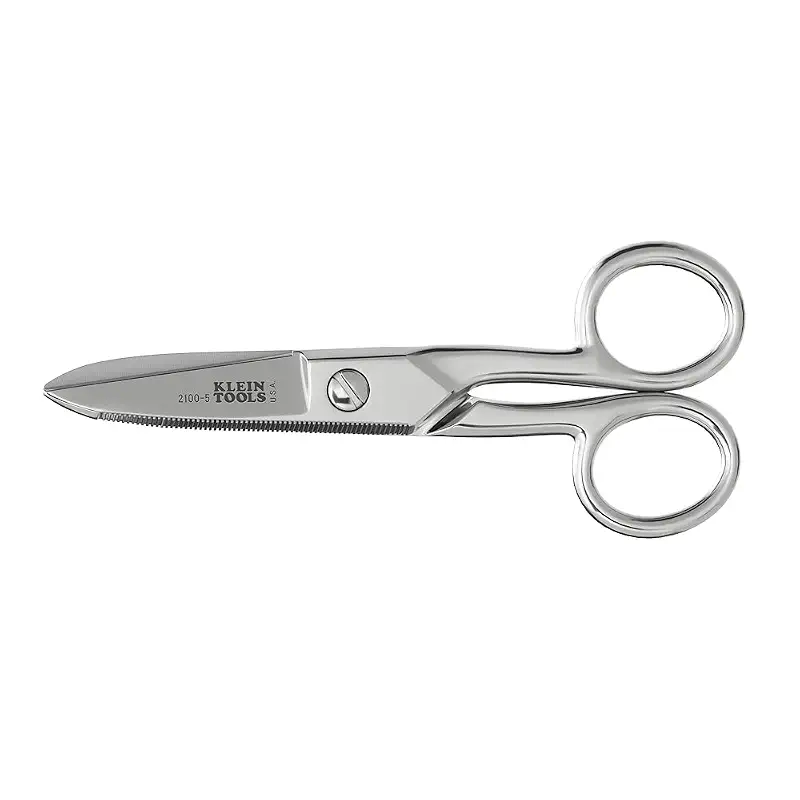
Ideal for: Electricians, telecom technicians, professionals doing daily cutting of cable, wire, and heavy materials.
Klein Tools has spent over 160 years refining hand tools for professionals, and these scissors reflect that lineage. The tempered steel blades stay sharp through extended use cutting wire, cable, plastics, and light metals, and the nickel-plated finish resists the corrosion that kills cheaper scissors after a few months of real work. Owners consistently report that they reach for these more than pocket knives: a telling vote from people who carry both.
The scraper and file built into the blade exterior serve a specific purpose: removing oxidation from copper wires during electrical work, a detail that shows Klein designed for actual job demands rather than theoretical versatility. The adjustable screw hinge lets you tune tension as the tool ages, and the ergonomic handles fit hands large enough to wear work gloves without sacrificing the compact 5.25-inch form factor.
The trade-off is weight and rigidity. These are not delicate: they're built like a tool, not a trinket. If you need something lighter or more feminine in the hand, folding options like the Fiskars offer a gentler feel. But for anyone doing electrical, telecom, or general heavy-duty cutting in a professional setting, Klein's reputation and owner loyalty speak louder than spec sheets.
Pros
Tempered steel holds edge through heavy use without frequent sharpening
Built-in scraper and file for copper wire oxidation removal
Adjustable screw hinge allows tension tuning over time
Compact yet comfortable fit even with work gloves
Cons
Heavier and more rigid than lightweight folding alternatives
Not TSA-compliant for air travel carry-on
Key features
Nickel-plated tempered steel blades resist corrosion in demanding environments
Scraper and file on blade exterior for electrical work preparation
Adjustable hinge mechanism for custom tension and long-term adjustment
Made in USA with 160+ years of Klein Tools craftsmanship
#2 Pick
Best for Travel
Fiskars
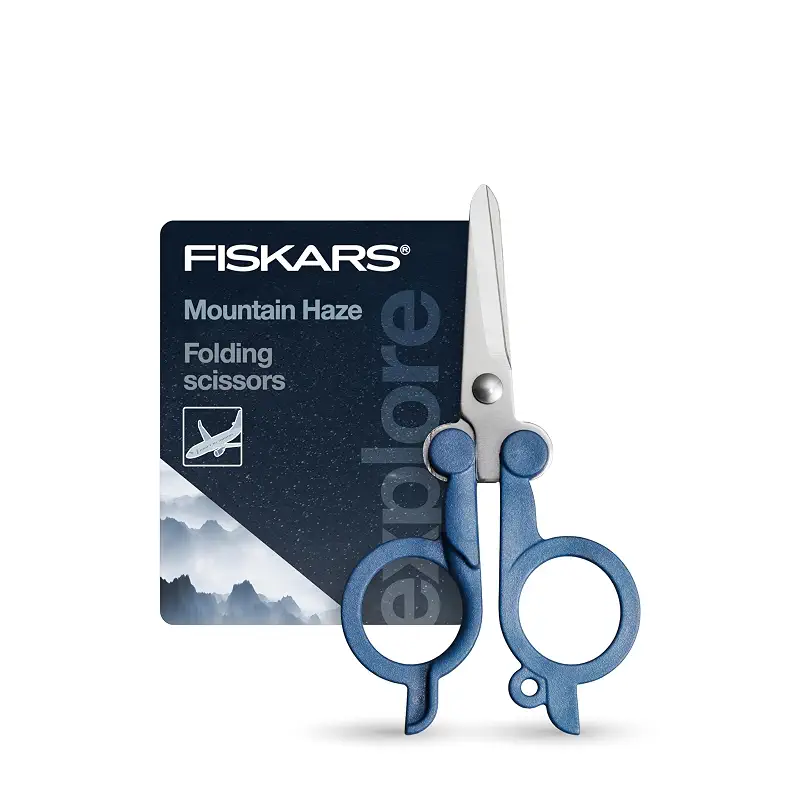
Fiskars Travel Folding Scissors, TSA-Compliant, Compact and Portable for Crafting and Quick Snips, Stainless Steel Blades, Explore Collection, Mountain Haze
4.4(1,128)
TSA-approved folding design with sharp stainless blades. Ideal for crafters, travelers, and anyone who prioritizes portability.
Fiskars earns its reputation through thoughtful design that solves real carrying problems. These folding scissors meet TSA guidelines: the blades are shorter than 4 inches, so they fold into your carry-on luggage without a second look. The double-loop handle accommodates both right- and left-handed users, a detail many brands overlook. The stainless steel blades are sharp enough for precision work like thread trimming, embroidery, and detail cutting, yet the rounded tips prevent accidental punctures in a crowded bag.
Owners report buying multiple pairs and stashing them everywhere (car, wallet, craft bag, first aid kit) because at this price and weight, having scissors available where you need them actually becomes practical rather than aspirational. The folding frame is durable and snaps open and closed smoothly on most units, though a few buyers note it requires firm pressure to open, which could be a concern for anyone with weak hand strength or arthritis.
Compared to the Klein Tools electrician scissors, the Fiskars trades heavy-duty cutting capacity for travel legality and lightweight carry. It's not designed to cut copper wire or denim repeatedly; it excels at the everyday snips that most people actually encounter. If you fly regularly or need scissors that weigh almost nothing, Fiskars is your answer.
Pros
TSA-compliant with blades under 4 inches for airline carry-on
Sharp stainless steel blades for detail work and thread trimming
Double-loop handles fit both right- and left-handed users
Lightweight and folds flat to fit wallets, bags, and desk drawers
Cons
Requires firm pressure to open and close, challenging for arthritic hands
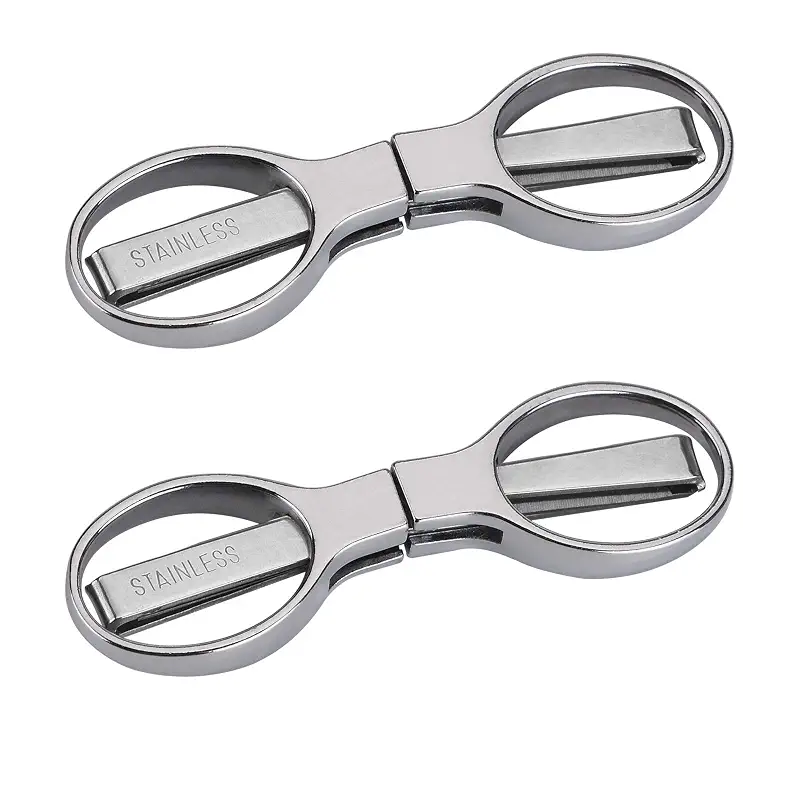
The firiKer Friker scissors succeed by doing one thing well: provide genuinely sharp, functional cutting in the smallest possible package at the lowest possible price. At folded size, they resemble a glass tube or piece of office equipment: people literally miss them sitting in open desk cups and pencil holders, a feature one owner deliberately exploited to prevent coworkers from borrowing her scissors. When you unfold them, the blades slide out smoothly and turn easily without wobble, and the stainless steel is sharp enough to handle tape, cardboard, thread, and light fabric work.
Owners report keeping multiple pairs scattered throughout cars, toolboxes, and bags, treating them as disposable essentials rather than premium investments. The folding mechanism is simple and secure: blades retract into protective slots without any pinch hazard when closing. For the price, you're getting a tool that actually works rather than a novelty.
Where these fall short of the Engineer and Klein Tools options is durability under professional, daily use. The lighter stainless steel won't handle continuous wire cutting or heavy leather work the way heavier multipurpose shears do. One reviewer noted that after 40+ years of ownership, their original pair is still functional, suggesting build quality is solid for casual use, but these aren't engineered for trade work. If you want affordable scissors everywhere without guilt, Friker delivers.
Pros
Sharp stainless steel blades that cut smoothly without resistance
Disguises itself as desk decor, preventing borrowed-and-never-returned loss
Smooth folding mechanism with no pinch risk or blade rattle
Lightweight and affordable enough to buy multiple pairs for different locations
Cons
Lightweight stainless steel not rated for professional heavy-duty cutting
Blade length and design limit cutting through thick materials like denim or rope
Key features
Folds into compact 3.1 x 0.96-inch form that hides in plain sight
Stainless steel construction resists passivation and rust from frequent use
Simple folding design removes pinch hazards and reduces injury risk
Ideal for sewing, crafting, office work, light travel, and emergency kits
#4 Pick
Best Multi-Tool
OrbitShell
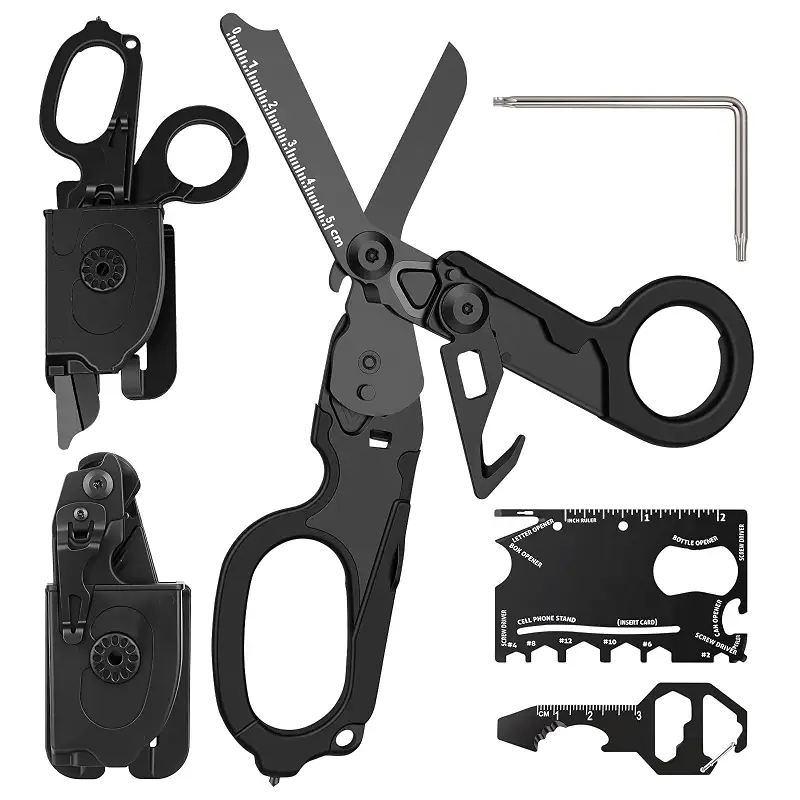
6-in-1 Trauma Shears Foldable Kit, Heavy Duty Emergency Tools with Glass Breaker Seatbelt Cutter and Holster, Multipurpose Scissors for Car Safety, EDC, Medical, First Aid - Electroplated Black
4.3(52)
Six-in-one trauma shears with glass breaker and seatbelt cutter. Designed for first responders and vehicle emergency situations.
Ideal for: First responders, outdoor emergency preppers, vehicle safety kits, medical professionals seeking compact multi-function gear.
OrbitShell's trauma shears fold down to pocket size while integrating scissors, carbide glass breaker, seatbelt cutter, ring cutter, oxygen tank wrench, and ruler into one tool. The 420HC stainless steel blades have an electroplated black finish that resists corrosion better than bare steel, and they're ground sharp enough to cut through denim, leather, and thick bandages in a single pass. The blunt tip prevents accidental skin punctures, a critical safety feature in medical contexts where you're cutting clothing off an injured person.
Owners who carry this in vehicles specifically praise it for emergency preparedness: the glass breaker and seatbelt cutter address actual accident scenarios, not hypotheticals. The foldable design keeps sharp edges protected without requiring a separate sheath, and the included holster accommodates the tool both folded and unfolded.
However, buyers are candid about its limitations. This is a specialized emergency tool, not a daily-carry replacement for dedicated scissors. One reviewer noted the accessory kit (Allen wrenches, tool card) feels gimmicky and adds little practical value. The black finish will wear off with use, and the holster's rubber washer can rotate loose over time. If you're an EMT or paramedic using this daily, you'll want heavier-duty shears; for homeowners stashing one in the glove box or go-bag, the versatility of folding versus fixed edc scissors matters less than having something in case you need it.
Ideal for: Electricians, engineers, technicians, hobbyists doing heavy-duty cutting across multiple material types.
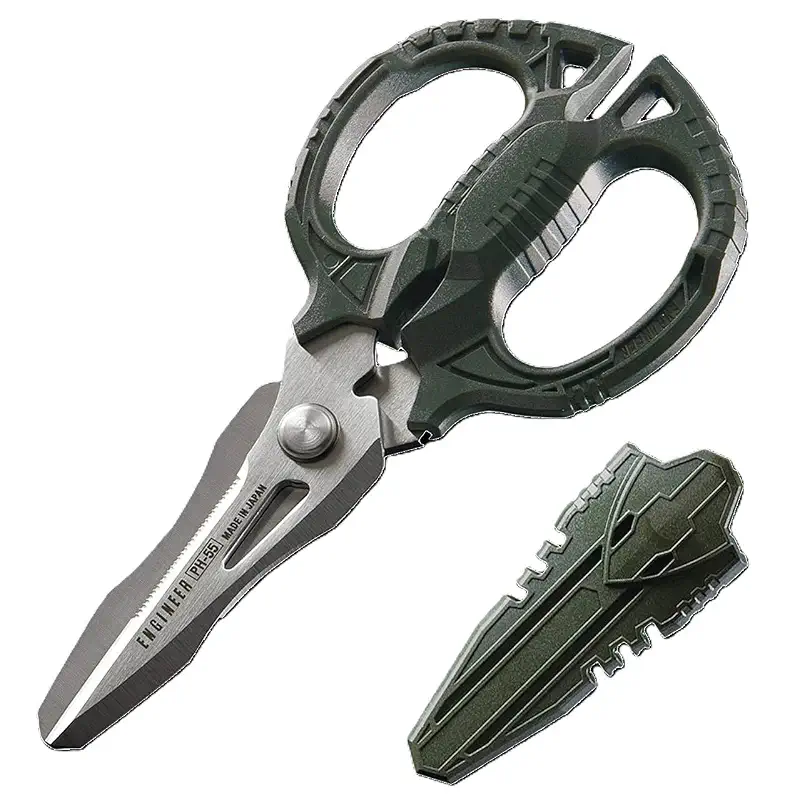
Engineer's represents a different philosophy from the Klein Tools electrician scissors: instead of optimizing for one task, it integrates four separate blade types into a single 6.3-inch tool. A flat blade handles paper and cloth smoothly, a micro-serrated section grips and cuts rope, leather, and cable without slipping, a dedicated wire cutter positioned near the handles cuts copper and steel wire, and a box cutter sits on the outside edge for opening cardboard. Made in Japan from premium stainless steel, these scissors demand respect: owners describe the joint hardware as "precision fit" with zero binding or wobble, and the cutting action itself is smooth across all material types.
The offset handles give you leverage and control whether you're gripping like a technician for maximum power or holding naturally for detail work. A protective cap with drain and vent holes comes included, signaling that Engineer expects these to work in wet, dirty environments and provides design details to support that reality. Owners consistently rate these as the best utility scissors they've used, and many note they belong in any serious toolbox.
The trade-off is that at 6.3 inches and 120 grams, these are heavier and longer than Klein's compact 5.25-inch design, making them less convenient for true pocket carry. If you prioritize cutting versatility and Japanese craftsmanship over minimal pocket footprint, and you're doing actual electrical, telecom, or engineering work, the Engineer outperforms single-function options.
Pros
Four integrated blade types: flat, micro-serrated, wire cutter, and box cutter
Premium Japanese stainless steel with precision-fit joint hardware: zero binding
Micro-serrated blade securely grips and cuts rope, leather, cable without walking
Protective cap with drain holes designed for wet, dirty field environments
Cons
Longer and heavier than compact folding options, less ideal for true pocket carry
Sheath lacks belt clip, requiring bag or toolbox carry rather than hip attachment
Key features
Four-in-one blade design: flat, micro-serrated, wire cutter, and box cutter
Premium Japanese stainless steel with precision-fit joint and smooth cutting action
Micro-serration prevents material slipping when cutting rope, leather, and cable
Protective sheath with drain holes for field work in wet or dirty conditions
How to Choose the Right EDC Scissors
Four trade-offs that actually matter when matching a edc scissors to your kitchen.
Fixed vs. Folding Design
The choice between fixed and folding comes down to carry method and safety priorities. Fixed scissors like the Klein and Engineer offer immediate access and are designed to stay in a holster or dedicated sheath on your belt or bag. Folding scissors like Fiskars and firiKer hide their blades entirely, making them safer for loose pocket carry and less likely to puncture bags or accidentally cut you when retrieving other items. Folding versus fixed edc scissors each solve different problems: fixed tools prioritize speed of access for professionals who reach for scissors constantly, while folding designs prioritize safety and stealth for casual carry. If you're wearing these on your hip daily or stashing them in a toolbag, fixed is faster. If you're carrying them loose in a pocket, drawer, or backpack, folding removes puncture risk.
Blade Type and Cutting Capacity
Not all scissors blades are equivalent. Flat blades work cleanly on paper and fabric but can struggle with rope or wire. Micro-serrated blades grip and secure materials that would slip on smooth edges, making them superior for cordage, leather, and cable. Some scissors integrate specialized cutters (wire cutters, box openers, glass breakers) that handle specific tasks that general blades cannot. Consider what you actually cut most often. If you're an electrician, Klein's scraper-equipped design or Engineer's integrated wire cutter directly supports your work. If you're a crafter, a flat blade with true sharpness matters more than multi-function gimmicks. The edc scissors blade types determine what materials you can cut confidently.
Weight, Portability, and Hand Fit
A pair of scissors you never carry is worthless. If you wear work gloves or have larger hands, compact folding scissors may feel cramped and uncomfortable, making you less likely to actually use them. The Klein Tools sit at a sweet spot for gloved hands, while the Fiskars and firiKer fold so small they disappear into desk cups. Weight matters for all-day hip carry: the Engineer at 120 grams becomes noticeable after eight hours, while the Fiskars and firiKer barely register. Consider where these will live: in a toolbag, on a belt, in a desk drawer, or rotated through multiple locations. The right EDC scissors match your hand size and your willingness to actually carry them.
Durability and Material Quality
Stainless steel resists rust but dulls faster than tempered steel under heavy use. Tempered steel holds an edge longer but requires corrosion protection: nickel plating, electroplating, or oils. Japanese-made scissors tend to feature precision engineering and superior joint hardware, visible in the Engineer 's smooth action and zero wobble. American-made options like Klein prioritize durability through material thickness and adjustability. Budget folding scissors work fine for occasional cutting, but professional daily users need blades that stay sharp and joints that don't loosen over months of heavy use. Read owner reports about longevity in your specific use case: a scissors that lasts 40 years in light duty may not survive six months of professional work.
Specialty Features and Trade-offs
Multi-function tools like the OrbitShell trauma shears integrate glass breakers, seatbelt cutters, and rulers, adding weight and complexity in exchange for emergency preparedness. Single-purpose scissors optimize blade design and weight for their specific task. Decide whether you're building an emergency kit (specialty features matter) or optimizing for daily professional work (single excellent function beats several mediocre ones). TSA compliance becomes relevant if you travel frequently by air. Budget matters too: the firiKer delivers genuine functionality at a fraction of Klein or Engineer's cost, making it ideal for buying multiple pairs. Premium options cost more upfront but often hold value and stay sharp longer, reducing replacement frequency.
Frequently asked
Quick answers to the questions readers ask most.
Are folding scissors as sharp as fixed scissors?
Folding and fixed scissors can both be sharp: it depends on blade material and design, not the folding mechanism. The Fiskars and firiKer folding options use stainless steel blades that cut cleanly for everyday tasks. The Klein and Engineer fixed designs use heavier steel that holds sharpness longer under heavy professional use. A sharp folding scissor cuts better than a dull fixed one. The real difference is durability under repeated heavy use: fixed scissors with thicker blades stay sharp longer with constant cutting of wire, cable, and thick materials.
Can I take EDC scissors on an airplane?
TSA rules allow folding scissors with blades shorter than 4 inches in carry-on luggage. The Fiskars Travel Folding Scissors and firiKer Friker both meet this requirement. Fixed scissors like Klein and Engineer exceed the 4-inch blade limit and must be packed in checked luggage only. If you fly regularly, a TSA-compliant folding pair deserves a permanent spot in your travel bag or backpack.
Which scissors cut through wire and cable best?
Dedicated wire cutters built into the scissors handle the job most reliably. The Klein Tools feature a scraper designed for copper oxidation removal, supporting electrical work. The Engineer integrates a true wire cutter near the handles, specifically sized for copper and steel wire. General scissors blades can cut thin wires and insulation if they're sharp, but a dedicated cutter removes guesswork and prevents blade damage. For frequent electrical work, choose a design with integrated wire cutting.
How do I keep EDC scissors from getting stolen at work?
The firiKer Friker scissors intentionally disguise themselves as desk decor when folded: many owners report that coworkers miss them entirely. Some people buy cheap folding scissors and treat them as disposable desk tools, accepting occasional loss. Others engrave their scissors with a name or initials as a theft deterrent. Klein Tools and Engineer scissors are more visibly tool-like, which actually deters casual borrowers; hide them in a toolbag rather than leaving them on a desk.
Do I need serrated blades on EDC scissors?
Serrated blades grip slippery materials like rope, fabric, and leather, preventing them from sliding sideways as you cut: a real advantage for field work. Flat blades cut paper and soft materials smoothly but can struggle with materials that want to move. For professional electricians and technicians handling cable and cordage daily, micro-serration is worth seeking. For casual desk and craft use, sharp flat blades are sufficient.