Kitchen & Dining · Cookware
Best Damascus Steel Chef Knives for Home and Professional Cooks
Find the best damascus steel chef knives with sharp edges and authentic patterns. Compare top 8-inch knives for professional cooking and home kitchens.
Affiliate disclosure: As an Amazon Associate I earn from qualifying purchases.
At a glance
1
Best Overall ValueShan Zu
2
Best for Edge RetentionShan Zu
4
Best for Collectors and Gift-GivingShan Zu
5
Best Japanese-Made CraftsmanshipAtumuryou
Detailed reviews
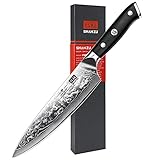
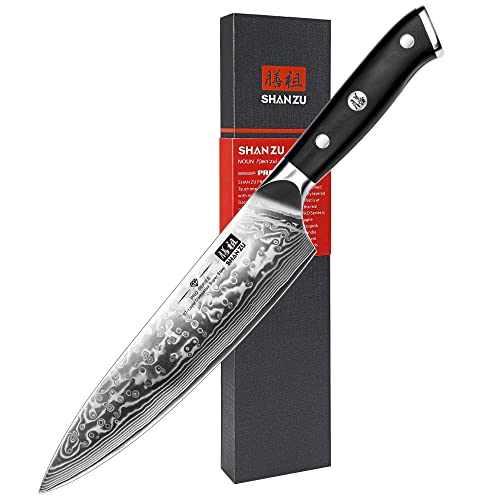
The Shan Zu 8-inch checks all the boxes for a home cook who wants authentic damascus construction without the premium price tag. Owners consistently praise how sharp it arrives, and many report the edge holds up well through weeks of regular use. The 10Cr15MoV core at 62 HRC hardness gives you real durability, and the 67-layer forging is genuinely layered steel, not laser-etched pattern work: a distinction that matters for both longevity and aesthetics.
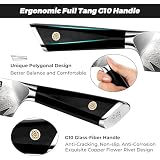
The G10 fiberglass handle deserves particular attention here. It's more durable than wood, resists moisture better, and the frosted texture provides reliable grip even when your hands are wet. Balance sits just slightly forward of the bolster, which feels natural for a pinch grip. At 270 grams, it has enough presence to feel substantial without the fatigue that heavier knives can cause over an hour of prep work.
Where this knife differs from the Shun Premier is in steel composition and edge angle. Shun uses VG-MAX stainless with a 16-degree edge, which holds sharpness longer but demands more care during sharpening. The Shan Zu's 15-degree angle means it arrives sharper and responds faster to honing, though you'll touch it up more frequently. For home cooks who hone regularly, that's not a drawback: it's actually an advantage.
Pros
- Genuinely sharp out of the box with clean cuts through tomatoes
- 67-layer authentic damascus construction, not laser-etched pattern
- G10 handle resists moisture and provides secure wet-hand grip
- Excellent edge retention for daily vegetable and protein prep
Cons
- Requires more frequent honing than premium stainless-core knives
- Handle lacks the refined feel of higher-end pakkawood or wood options
Key features (4)
- 10Cr15MoV Japanese steel core with 62 HRC hardness rating
- 67-layer damascus-forged blade with 15-degree cutting angle
- G10 fiberglass handle with ergonomic grip and full tang construction
- 8-inch blade length, 2.2mm thickness, 270g total weight
This second Shan Zu entry sits in a sweet spot between the entry-level option and true luxury knives. The 10Cr15CoMoV steel core is the same hardness (62 HRC), but the execution shows more refinement: the damascus pattern is more intricate, the G10 handle feels more substantial, and the included gift box signals a product positioned for gift-giving or personal investment.
Owners note the blade holds its edge remarkably well, with several mentioning six months of regular use before needing a touch-up. The reverse-tanto or K-tip profile (slightly angled tip) is borrowed from Japanese kiritsuke-style geometry, which lets you work with more precision on delicate cuts. It's not a full kiritsuke, but the modification shows thoughtful design rather than pure cost-cutting.
Compared to the Atumuryou knife below, this Shan Zu trades some hand-feel for stronger edge stability. The frosted G10 won't warm in your hand like stabilized wood, but it won't splinter or absorb odors either. If you cook five nights a week and want a knife that stays sharp through those sessions, this is the safer choice. The hammered finish (tsuchime-style dimpling) on the Shun Premier creates more drag reduction, but this blade's geometry accomplishes much the same effect through profile alone.
Pros
- Exceptional edge retention through weeks of frequent use
- Intricate damascus pattern with more visual depth than entry-level models
- Well-balanced K-tip profile for both rocking and precision slicing
- Comes with premium gift box and solid carrying case
Cons
- Slightly heavier in the handle than some prefer for extended prep sessions
- G10 handle, while functional, lacks the warmth of natural wood
Key features (4)
- 10Cr15CoMoV Japanese steel core at 62 HRC with 15-degree edge
- 67-layer authentic damascus with reversed-tanto blade tip geometry
- Frosted G10 fiberglass handle with three-rivet full tang reinforcement
- 8-inch blade, 2.2mm thickness with premium presentation packaging
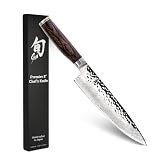
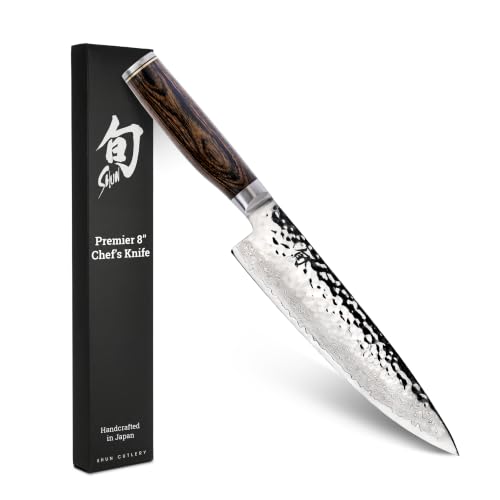
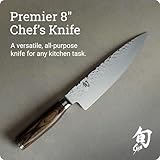
The Shun Premier represents a step up in every dimension. Handcrafted in Japan, each knife carries the weight of traditional cutlery-making: the kind of care you feel the moment you hold it. The VG-MAX steel core is engineered differently from the Shan Zu's 10Cr15 composition. VG-MAX holds an edge longer and resists staining better, which matters if your kitchen isn't fastidious about drying blades immediately after use.
What sets this apart visually and functionally is the tsuchime (hand-hammered) finish. Those surface dimples aren't decorative: they create a pattern of micro-air pockets that reduce friction and food drag. Owners frequently mention slicing tomatoes or onions with minimal resistance, a quality that becomes addictive once you experience it. The 16-degree edge angle is slightly more obtuse than the Shan Zu's 15-degree, trading a hair of initial sharpness for better durability and easier maintenance with a honing steel.
The contoured Pakkawood handle is warmer and more refined than G10, with superior moisture resistance compared to traditional hardwood. The balance point lands right at the bolster, giving you excellent control for both rocking cuts and precise slicing. Where the Shan Zu knives ask you to adapt your technique to their balance, the Shun feels like it's been waiting for your hand. The trade-off: this premium craftsmanship and Japanese-made status come with a significantly higher price point. Shun also backs their blades with free sharpening and honing services, turning maintenance into a long-term relationship rather than a solo skill.
Pros
- VG-MAX steel core with superior edge retention over extended periods
- Hand-hammered tsuchime finish genuinely reduces food sticking and drag
- Pakkawood handle offers warmth and superior ergonomic design
- Lifetime free sharpening and honing service from manufacturer
Cons
- Significantly higher price point than Shan Zu alternatives in the same size
- Blade height slightly lower than some prefer for knuckle clearance with larger items
Key features (4)
- VG-MAX steel core with 68 layers of damascus stainless-steel cladding
- Hand-hammered tsuchime finish reduces food adhesion on blade sides
- Contoured Pakkawood handle with optimal bolster for pinch-grip control
- Handcrafted in Japan with 16-degree edge angle for durability
This Shan Zu stands out visually: the copper layering creates a warm, golden pattern distinct from traditional steel damascus. It's genuinely striking, and several owners mention it becoming a conversation piece in their kitchen. The 33-layer construction (compared to 67 layers in the other Shan Zu models) is still hand-forged using repeated folding technique, not laser etching, so the authenticity is there: just with fewer layers and a different aesthetic.
The maple wood handle brings traditional warmth that G10 can't match. It's ergonomic and slip-resistant, though wood requires more diligent care than synthetic materials. You'll want to dry it promptly and avoid prolonged water exposure. The 10Cr15MoV core maintains the 62 HRC hardness standard across the Shan Zu line, so sharpness and edge retention sit in the same ballpark as other models here.
Where this knife justifies its existence is in presentation and aesthetics. If you're gifting to someone who appreciates knife craftsmanship as much as functionality, or if you cook less frequently and want an heirloom-quality piece to display and use occasionally, this checks both boxes. Compared to the Atumuryou below, the copper damascus pattern is more distinctive and artistic, though the Atumuryou's resin-wood handle offers slightly better durability for daily use. This knife whispers 'craft' where others shout 'performance.'
Pros
- Distinctive copper-damascus pattern with warm golden visual appeal
- Traditional maple wood handle brings kitchen elegance and warmth
- Hand-forged 33-layer construction with authentic folded-steel technique
- Well-balanced blade with exceptional sharpness for delicate work
Cons
- Maple wood requires regular drying and more maintenance than synthetic handles
- Fewer layers than other models may mean slightly faster dulling under heavy use
Key features (4)
- 33-layer hand-forged copper and carbon steel damascus construction
- 10Cr15MoV Japanese steel core at 62 HRC hardness for reliable sharpness
- Ergonomic maple wood handle with contoured grip and slip resistance
- 8-inch blade with artistic copper-pattern damascus and balanced weight
The Atumuryou enters this lineup with credentials that punch above its price: VG-10 steel core (a step up from the 10Cr15 variants used by Shan Zu), 67-layer damascus cladding, and hand-sharpening using traditional Japanese techniques. Owners frequently mention it arrives sharper than expected and holds that edge through serious daily use. One professional chef noted it outperforms knives from restaurant supply companies that cost significantly more.
The stabilized wood and resin composite handle is where this knife particularly shines. Unlike untreated hardwood, stabilized wood resists moisture absorption and won't splinter or check over time. The dimpled texture at the hilt provides genuine grip security without the synthetic feel of pure G10. It splits the difference: all the durability of fiberglass with the warmth of natural material. The balance is excellent, and several users mention reduced wrist fatigue during extended prep sessions.
Compared to the Shun Premier, the Atumuryou uses a steel composition (VG-10) that's nearly equivalent but forgoes the hammered tsuchime finish and hand-craftsmanship prestige. You get perhaps 85 percent of the Shun's performance and feel at a materially lower investment. The trade-off is warranty and brand legacy. Shun's lifetime sharpening program and Japanese heritage command their premium. For a cook who wants bona fide Japanese hand-forging without the luxury brand markup, this is a compelling entry point. If you're also interested in specialized Japanese blades, top yanagiba knives serve a different purpose (they're designed specifically for slicing raw fish) but the same principles of steel quality and hand-forging apply across traditional Japanese cutlery.
Pros
- VG-10 steel core provides superior edge retention and stain resistance
- Hand-sharpened using traditional Japanese techniques straight from factory
- Stabilized wood and resin handle offers durability with natural warmth
- Excellent balance and ergonomic design reduce fatigue during long prep sessions
Cons
- Smaller review sample than established brands, so long-term durability less proven
- Lacks hammered surface finishing of premium options like Shun Premier
Key features (4)
- VG-10 steel core at 62 HRC with 67-layer damascus stainless cladding
- Hand-sharpened using time-honored Japanese techniques in factory finishing
- Stabilized wood and resin composite handle with ergonomic dimpled grip
- 8-inch blade with excellent balance for both rocking and precision cuts
How to Choose a Damascus Steel Chef Knife
Authentic Damascus vs. Laser-Etched Pattern
Real damascus steel involves layering different carbon-steel compositions, heating them, and folding the blade repeatedly until the pattern emerges through the entire cross-section. Fake damascus uses a single forged blade with a pattern laser-etched onto the surface: it looks right initially but wears away with honing. Authentic construction requires the pattern to persist after sharpening. Examine product descriptions and buyer photos carefully. If a review mentions the pattern fading after a few sharpenings, that's laser etching. True damascus gets sharper and more visible as you maintain the edge over years of use.
Steel Core and Hardness: What the Numbers Mean
The core steel determines edge retention and staining resistance. VG-10 (found in the Atumuryou and Shun Premier) is a Japanese stainless composite that holds an edge exceptionally well and resists rust: ideal for cooks who don't baby their tools. 10Cr15MoV or 10Cr15CoMoV (used by most Shan Zu models) offers slightly faster dulling but easier sharpening at home. HRC (Rockwell Hardness) numbers above 60 indicate a harder, sharper edge; above 62 is excellent for home knives. All five knives here sit at 62 HRC or higher, so differences in edge retention stem more from steel chemistry and layer count than raw hardness.
Handle Material and Your Grip Style
G10 fiberglass (Shan Zu's standard) is synthetic, moisture-resistant, and virtually indestructible: perfect for busy kitchens where hand-washing happens fast. Stabilized wood and resin (the Atumuryou) offers warmth without traditional wood's fragility. Pakkawood (Shun Premier) and untreated hardwood (the copper-damascus Shan Zu) feel premium but require prompt drying. If you cook five or more nights a week and hand-wash immediately, any handle material works. If you're slower with cleanup or tend to leave knives wet, stick with G10 or stabilized composite. The damascus steel knife care guide covers maintenance to prevent handle degradation.
Layer Count and Durability
More layers mean more material transitions and microstructure, which can enhance toughness and edge retention, but 33 good layers beat 67 poor ones. All five knives here use genuine folded-steel construction with 33 to 67 layers. The difference isn't night-and-day in everyday use. What matters more is whether the blade gets honed and stored carefully. A 67-layer knife mistreated (dropped, left in a sink, used on bone) will chip before a 33-layer blade that's respected. Focus on finding a knife whose steel and handle suit your cooking style, then commit to proper care.
Edge Angle and Sharpening Frequency
A 15-degree edge (most Shan Zu models) arrives sharper and needs touching up with a honing steel every week or two of regular use. A 16-degree edge (Shun Premier) holds longer between sharpenings and is easier to maintain with a steel alone. Neither requires constant professional sharpening unless you abuse it. Home cooks honing weekly will love the 15-degree knife; those who touch up monthly should reach for 16 degrees. The damascus versus stainless steel comparison explores how different steels respond to at-home sharpening techniques if you're considering teaching yourself.
Our picks at a glance
1
Best Overall ValueShan Zu
2
Best for Edge RetentionShan Zu
4
Best for Collectors and Gift-GivingShan Zu
5
Best Japanese-Made CraftsmanshipAtumuryou
Frequently asked
Is damascus steel really more durable than regular stainless, or is it mostly looks?
Authentic damascus is more than appearance. The layered structure improves toughness and edge retention when compared to single-composition blades of the same hardness. The visual pattern is a byproduct of the folding and forging process that creates those performance gains. That said, proper care matters more than construction type. A mistreated damascus blade will chip; a well-maintained regular stainless blade will outlast it. Buy for the steel quality and sharpness, not the pattern alone.
How often do I need to sharpen a damascus chef knife?
Most home cooks using an 8-inch damascus blade for vegetables and boneless meat need professional sharpening once every 12-18 months with weekly honing-steel touch-ups. If you chop every single day or cut bones regularly, sharpen every 6-9 months. Honing (using a steel) straightens the rolled edge between sharpenings and takes 30 seconds. True sharpening removes metal to reform the edge and requires whetstones or a professional service. Both are part of ownership: neither is a flaw in the knife.
Can I put a damascus knife in the dishwasher?
No. High heat, harsh detergent, and tumbling cause staining, corrosion, and edge dulling. Hand-wash with warm soapy water and dry immediately. Wooden and G10 handles especially suffer in dishwashers; even stainless-core blades will discolor. It takes two minutes to hand-wash and dry a chef's knife: well worth avoiding damage and maintaining the investment.
What's the difference between a gyuto and a chef's knife, and does it matter which I buy?
Gyuto is the Japanese term for chef's knife; all five knives here are gyuto-style. The shape is nearly identical across brands: 8 inches, slight curve for rocking motion, straight edge from bolster to tip. Western chef's knives (German-style) tend to be heavier with more curve. Japanese versions are lighter and more precise. For most home cooking, the differences are minimal. Pick based on handle feel and brand reputation rather than terminology. The gyuto name simply signals Japanese-influenced design and likely Japanese or Japanese-style manufacturing.
Are these knives safe for children or less experienced cooks to use?
Yes, but with instruction. Authentic damascus blades at 62 HRC hardness are sharp enough to require respect and proper grip. Teach grip and posture before handing over the knife: a pinch grip on the bolster with the knife tip pointed down, never toward your body. The sharpness actually improves safety because a duller knife slips more often and demands more force, increasing accident risk. Supervise young cooks, keep the blade clean and dry between cuts, and store safely. A sharp knife is a safer knife in trained hands.