Verdict, analysis, and key features for each pick.
#1 Pick
Best Overall
Atumuryou
Japanese Chef Knife Set 3 Pcs, 67-Layer Damascus Kitchen Knife Set with VG10 Steel Core, Professional Sharp Damascus Knives with Ocean-Blue Ergonomic Handle, Include Elegant Cooking Gifts Box
4.8(124)
Hand-forged 67-layer Damascus with core, three-piece set, and the sharpest edge retention owners report.
Ideal for: Home cooks seeking a three-piece set with premium sharpness, balance, and edge retention.
The Atumuryou set lands at the intersection of craft and value. Owners consistently report that these knives arrive sharper than their expectations and hold that edge through weeks of prep work. The 67-layer construction is real, not etched, and the core at 62 HRC hardness gives you the kind of edge-retention profile you'd expect from blades three times the price. The three-piece kit covers what most home cooks actually need: an 8-inch chef's knife for the heavy lifting, a 7-inch Santoku for precision slicing, and a 3.5-inch paring knife for detail work. The ocean-blue resin handle with wood stabilization isn't just attractive; owners note it delivers genuine comfort during extended prep sessions, and the full-tang construction keeps the balance centered.
If you're comparing this to the Shan Zu single blade or the Wakoli set, the Atumuryou edges ahead for those seeking a matched trio that performs at the same level across all three knives. The hand-sharpening to a 12-degree angle per side is a detail that matters: that precision translates to cleaner cuts through tomatoes, cleaner strips of protein, less crushing of delicate herbs. Several owners mention it outperforms German stainless knives they'd paid more for, which is the kind of feedback that suggests real sharpness, not marketing.
The one caveat: while the handle is durable and the craftsmanship is evident, this is still an initial investment for a home kitchen. But if you're willing to hand-wash and store properly (no dishwasher), owners report these knives become kitchen favorites for years.
Pros
Arrives razor-sharp and retains edge through weeks of use
Full-tang construction with ergonomic ocean-blue resin and wood handle
Complete three-knife set handles 90% of home prep tasks
Cons
Requires hand-washing and careful storage to preserve edge
Hand-forged Damascus comes with a higher initial investment than basic sets
Key features
67-layer genuine Damascus steel with core, 62 HRC hardness
Hand-sharpened to 12° angle per side for precision cutting
Three-piece kit: 8" chef knife, 7" Santoku, 3.5" paring knife
Full-tang construction with ocean-blue resin and stabilized wood handle
Comes in elegant gift box with velvet-lined case
#2 Pick
Best Single Blade Choice
Shan Zu
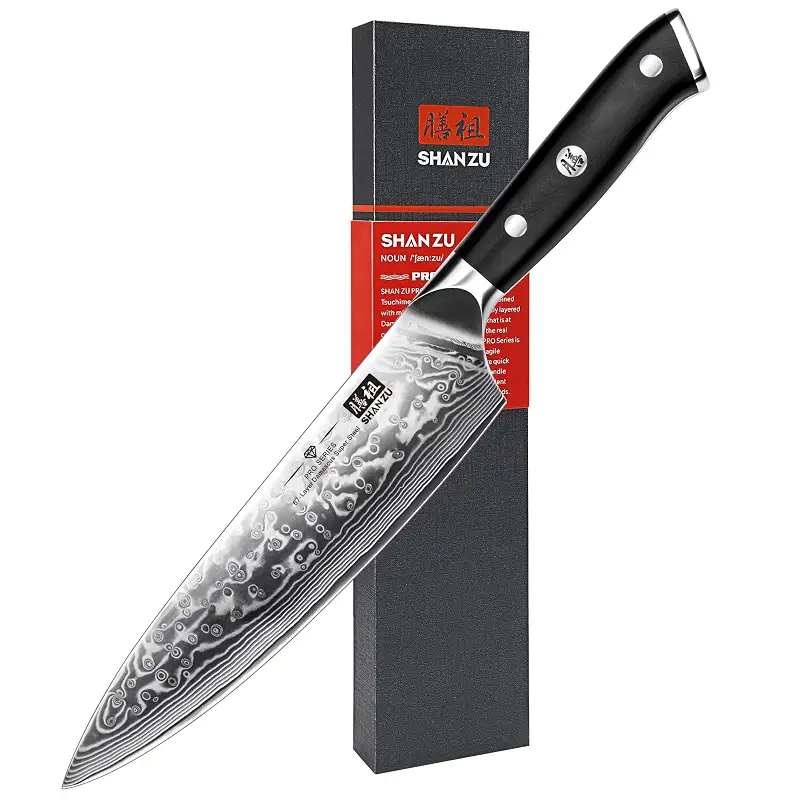
SHAN ZU Chef Knife 8 Inch Japanese Steel Damascus Kitchen Knife | Professional Kitchen Knives Ultra Sharp High Carbon Super Steel Kitchen Utility Knife
4.8(5,606)
Proven performer with 67-layer Damascus, G10 handle, and 5,600+ reviews backing its sharpness and balance.
Ideal for: Single-knife buyers and professionals who want a proven 8-inch blade with demonstrated durability and edge retention.
The Shan Zu 8-inch chef knife has earned its place through volume: over 5,600 verified reviews, the vast majority five-star. That's not marketing noise. Professional cooks and home practitioners alike report the same things: it arrives viciously sharp, it slices vegetables and proteins without crushing them, and the balance feels natural in the hand. The 67-layer Damascus with 10Cr15Mov core and 62 HRC hardness sits in the same hardness band as the Atumuryou, but Shan Zu's G10 handle (frosted glass fiber) takes a different approach than resin-stabilized wood. G10 is more durable in heavy use, more water-resistant, and favored in professional kitchens for that reason.
Compared to the Wakoli set, which spreads its steel across three smaller blades, Shan Zu commits everything to one blade size. If your kitchen routine centers on a single workhorse knife, this is the wiser choice. The 15-degree cutting angle (slightly different from Atumuryou's 12-degree) is still aggressive enough to give you fine control on tomatoes and herbs but with a bit more durability for tougher prep work. Several owners mention using it in professional restaurant settings for weeks with no meaningful dulling, which is harder to claim than it sounds.
One note: some reviewers mention the Damascus pattern is less pronounced than on other options, because it's formed through real folding and forging rather than etching, but that's actually a sign of authenticity. The visible wear-resistance and toughness owners report suggests function wins over flash here.
Pros
Over 5,600 verified reviews report consistent sharpness and edge retention
G10 handle is durable, water-resistant, and professional-kitchen proven
Balanced weight and ergonomic design reduce hand fatigue in extended use
Cons
Single knife means you'll need separate blades for specialized tasks
Some edge dulling reported after several months of heavy kitchen use
Key features
67-layer Damascus steel with 10Cr15Mov core, 62 HRC hardness
8-inch blade with 15° cutting angle and 2.2mm thickness
Frosted G10 handle for durability and water resistance in professional settings
Hand-sharpened and tested before shipment
12-month manufacturer warranty included
#3 Pick
Best Packaged Set for Gifting
Wakoli
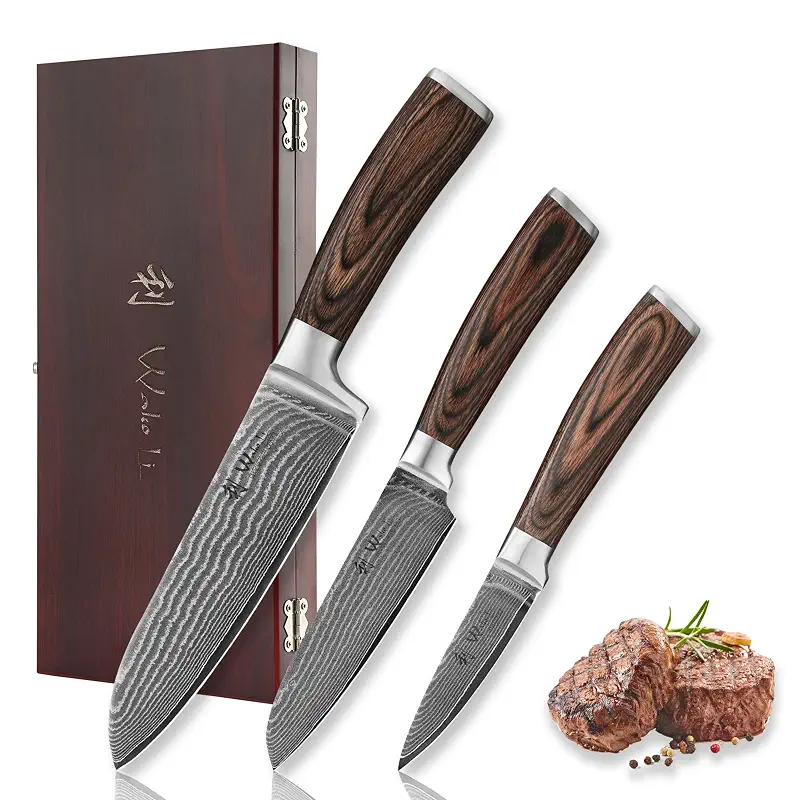
Wakoli EDIB 3-Piece Damascus Kitchen Knife Set in Wooden Gift Box | VG10 Core, 67-Layer Genuine Damascus Steel, 60 ± 2 HRC, Santoku, Utility and Paring Knife, Pakkawood Handles
4.7(3,601)
German-designed three-piece Damascus set with core, elegant wooden box, and consistent praise for balance and sharpness.
Ideal for: Gift-givers and home cooks who want a complete three-knife set with elegant presentation and balanced performance.
Wakoli's three-piece set comes out of a different supply chain than the others: designed and quality-checked in Germany by Oleio, even though the steel is Japanese. That manufacturing philosophy shows in the attention to detail: the wooden gift box isn't just packaging, owners report it's sturdy enough to become the long-term storage solution. The set includes a 6.7-inch Santoku (longer than typical utility blades, suited for slicing and dicing), a 4.7-inch small Santoku, and a 3.4-inch paring knife. It's a slightly different knife philosophy than a traditional Western chef knife lineup.
The core with 60 HRC hardness is fractionally softer than the Atumuryou or Shan Zu, but owners note this means the blade is easier to sharpen if you maintain it at home: a real advantage for cooks who want to keep their knives in shape without professional sharpening services. The Pakkawood handles (a composite of hardwood and resin) sit between traditional wood and G10 in terms of aesthetics and durability. Where the Atumuryou went for ornamental ocean blue and the Shan Zu for purely functional G10, Wakoli chose warmth and visual appeal without sacrificing grip or longevity.
One transparency note from reviews: some owners explicitly point out that while the marketing mentions 67-layer construction, the pattern is actually etched rather than formed through full Damascus forging: the care card that comes with the set states this. The knives still perform excellently, but if you're seeking authentic full-layer Damascus rather than aesthetically enhanced steel, the Emojoy or Atumuryou are clearer choices. If presentation and a matched three-knife set matter equally to sharpness alone, Wakoli edges past the others.
Pros
Includes elegant wooden gift box suitable for long-term storage
core at 60 HRC is easier to maintain and sharpen at home
Pakkawood handles balance aesthetics with durability and comfort
Cons
Damascus pattern is etched rather than formed through full layering process
Softer hardness (60 HRC) means more frequent sharpening than harder alternatives
Key features
67-layer Damascus steel with core, 60 ± 2 HRC hardness
Three-piece set: 6.7" Santoku, 4.7" small Santoku, 3.4" paring knife
Manually honed to 12-14° angle on waterstones for sharp, controlled cuts
Ergonomic Pakkawood handles suitable for right and left-handed cooks
Comes in premium wooden gift box, designed and quality-checked in Germany
#4 Pick
Most Versatile Multi-Piece Set
Dragon Riot
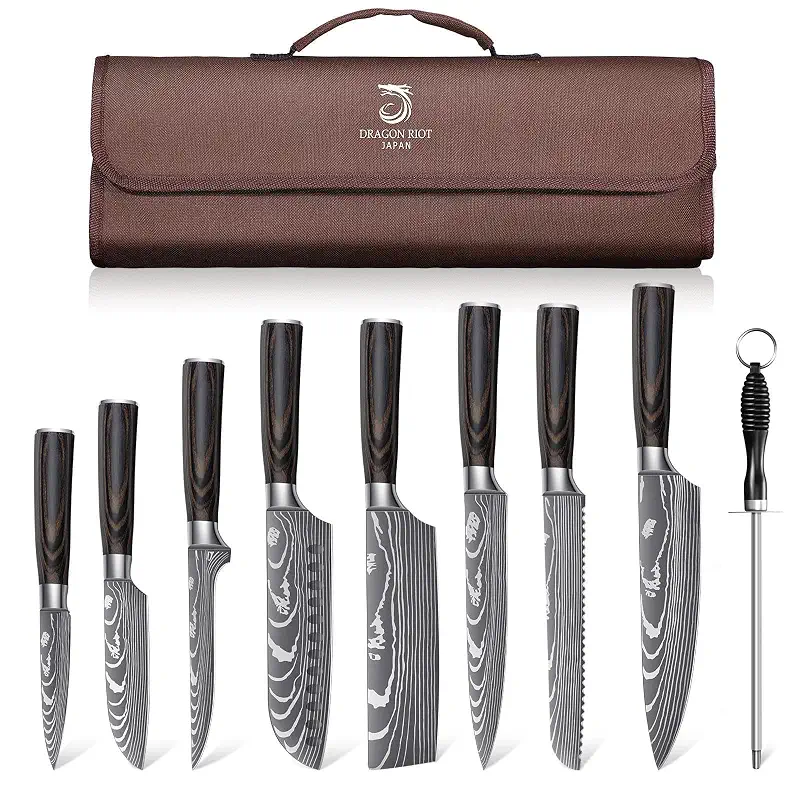
DRAGON RIOT Damascus Kitchen Knife Set, Damascus Steel, Brown Handle | Stainless Steel, Damascus Pattern, Roll Bag, For Meat Processing and Everyday Kitchen Prep
4.4(217)
14-piece Damascus set with leather roll bag for every cutting task from home prep to field work.
Ideal for: Professional and field-working cooks who need specialized blades for diverse prep tasks and appreciate portable storage.
Dragon Riot takes the "more knives" approach: 8-inch chef, 8-inch bread knife, 8-inch slicing knife, 7-inch cleaver, 7-inch Santoku, 6-inch boning knife, 5-inch utility, 4-inch paring knife, and a roll bag. If your cooking involves breaking down whole chickens, slicing loaves, precise herb work, and heavy vegetable prep all in the same evening, this covers each in a dedicated blade. The roll bag is genuinely useful: waterproof, stain-resistant, and genuinely portable, which is why field cooks and prep kitchens gravitate to this set.
The stainless steel construction with laser Damascus pattern (etched, not forged) is visually striking, and owners praise the sharpness out of the box and the non-slip Pakka wood handle. Hand-sharpened to 15 degrees, the blades are aggressive enough for clean cuts through meat and fine enough for vegetable work. Unlike the Wakoli or Atumuryou, which offer smaller curated sets, Dragon Riot banks on the idea that professionals and serious home cooks want options. The trade-off: you're paying for more blade steel, more handles, more heft. The bag makes it portable, but it also means more to maintain.
Compared to the Emojoy single-blade approach, this sacrifices the refined craftsmanship of a single premium knife for breadth. Some owners note the Damascus pattern is faint and hard to see in regular lighting, suggesting the aesthetic is secondary to function. If you're already maintaining three quality blades and want specialized tools for specific cuts, this is practical. If you're a home cook with counter space concerns, it's overkill.
Pros
14-piece set covers nearly every kitchen cutting task with dedicated blades
Includes waterproof, portable leather roll bag for transport and storage
Comes very sharp from factory with hand-sharpened 15° cutting angle
Cons
Large set requires significant counter or drawer space and ongoing maintenance
Damascus pattern is laser-etched rather than genuine layered construction
Key features
14-piece set with chef, bread, slicing, cleaver, Santoku, boning, utility, paring knives
Laser Damascus pattern on stainless steel with hand-sharpened 15° edge
Non-slip Pakka wood handles with seamless blade-to-handle construction
Includes waterproof, stain-resistant leather roll bag for portability
Professional-grade design for home kitchens and field or catering work
#5 Pick
Premium Single Blade with Artisan Handle
Emojoy
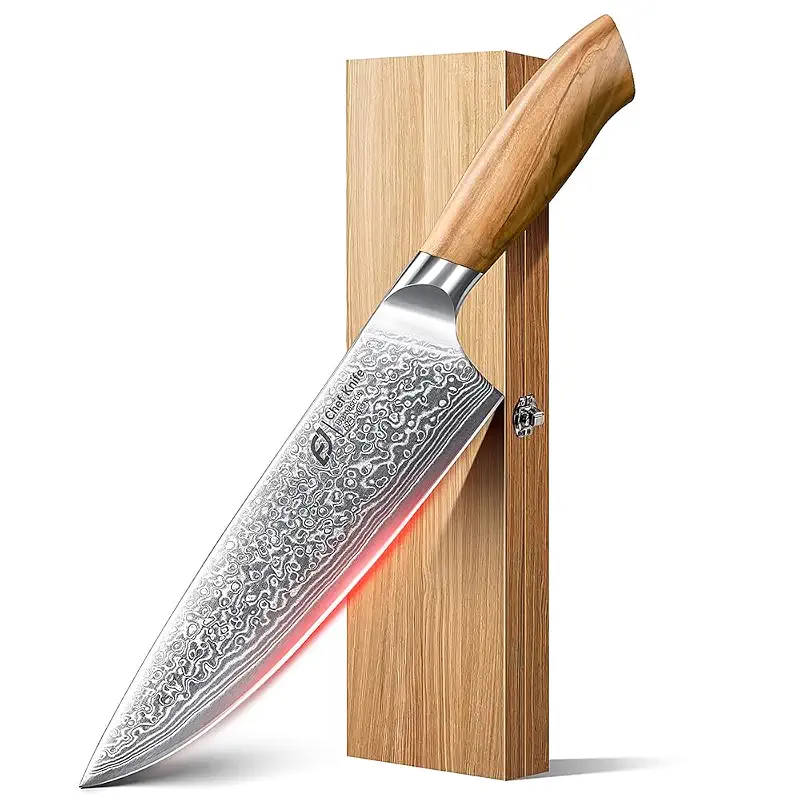
Damascus Chef Knife in Japanese Steel, 67-Layers Damascus Kitchen Knife with Wooden Gift Box and Original Olive Wood Handle, Cooking Knives for Home Kitchen Gift Idea
4.7(731)
Hand-forged 67-layer Damascus with Calabrian olive wood handle and lifetime warranty for discerning cooks.
Ideal for: Culinary enthusiasts who value hand-forged craftsmanship, aesthetic warmth, and a single premium blade for daily precision work.
Emojoy's single-blade approach mirrors Shan Zu's focus but diverges in philosophy. Where Shan Zu optimizes for professional kitchen durability with G10, Emojoy prioritizes aesthetic warmth and artisan finish with Calabrian olive wood. The 67-layer Damascus is hand-forged by experienced blacksmiths, which is the more labor-intensive (and traditionally correct) method, not laser-etched overlay. Owners consistently mention that the Damascus pattern is visually striking and that the olive wood handle develops character with use and mineral oil conditioning.
The 58 HRC hardness is slightly lower than the Atumuryou (62 HRC) or Shan Zu (62 HRC), but Emojoy positions this as an advantage: a slightly softer blade is easier to maintain at home and less likely to chip if you treat it with respect. The laser-calibrated 15-degree edge gives you precision work without the aggression of a lower angle. Owners report that the knife glides through vegetables and proteins, and several note they've owned Emojoy's other knives, suggesting the brand builds loyalty through consistent quality.
The lifetime warranty is noteworthy: it reflects confidence in the hand-forging and Japanese technique. Where the Shan Zu offers 12 months, Emojoy commits indefinitely, which matters if you're making a genuine long-term investment. Compared to the Wakoli set, this single blade requires you to own other knives for complete kitchen coverage, but if your primary knife work is slicing and dicing rather than heavy butchery, the Emojoy covers that beautifully. The olive wood handle requires more care than G10 or resin (mineral oil conditioning is recommended) but owners report it's worth the ritual.
Pros
Hand-forged 67-layer Damascus with genuine steel layering, not etching
Calabrian olive wood handle is warm, comfortable, and develops natural patina
Lifetime warranty reflects confidence in hand-forging and Japanese craftsmanship
Cons
58 HRC hardness requires more frequent sharpening than harder alternatives
Olive wood handle needs periodic mineral oil conditioning to maintain appearance
Key features
Hand-forged 67-layer Damascus steel with 58 HRC hardness
Laser-calibrated 15° cutting angle for precision slicing and dicing
Calabrian olive wood handle with half-bolster for secure, ergonomic grip
Includes wooden gift box suitable for storage and presentation
Lifetime warranty with strict quality inspection before shipment
How to Choose Damascus Kitchen Knives
Four trade-offs that actually matter when matching a damascus kitchen knives to your kitchen.
Real Damascus vs. Laser-Etched Patterns
Not all Damascus knives are created equally. True Damascus is formed through repeated folding and forging of layered steel, which creates strength and edge-holding properties along with the visual pattern. Laser-etched Damascus looks identical but uses engraving to create the appearance on a single piece of steel. Both can be sharp and functional, but authentic damascus steel layering explained separates the two: genuine construction is harder to produce and tends to cost more. The Atumuryou and Emojoy use real layering. Wakoli and Dragon Riot use etching. Neither approach is a defect: it's a choice between artisan process and visual appeal. Check product descriptions or contact sellers if the distinction matters to your purchase.
Hardness (HRC) and Edge Retention
Rockwell hardness (HRC) tells you how long an edge holds before dulling. Most of these knives fall between 58 and 62 HRC. Higher hardness (62 HRC, like Atumuryou and Shan Zu) means longer edge retention between sharpenings: valuable if you cook daily. Lower hardness (58 HRC, like Emojoy) means you'll sharpen more often but the blade is easier to maintain at home without professional equipment. Think about your maintenance habits. If you hand-wash and condition regularly, lower HRC works fine. If you want to cook for weeks between sharpening sessions, higher HRC saves time.
Handle Material and Comfort Across Different Uses
Three handle styles dominate: Pakkawood (composite hardwood and resin, warm aesthetics), G10 (frosted glass fiber, maximum durability and water resistance), and stabilized wood with resin (aesthetically unique, comfortable, requires care). Pakkawood suits home cooks who value appearance. G10 suits professionals or anyone hand-washing in a busy kitchen; stabilized wood with resin suits those who want both warmth and durability. Test a knife in hand if possible: balance and grip feel matter more than specs. The damascus knife maintenance guide covers how each handle type responds to care, so consider your washing routine when choosing.
Set vs. Single Blade
Three-piece sets (Atumuryou, Wakoli) cover most home cooks' needs: chef knife for bulk work, Santoku or utility for precision, paring knife for detail. Single blades (Shan Zu, Emojoy) let you invest heavily in one exceptional knife. Multi-piece sets (Dragon Riot's 14-piece) suit professionals or anyone who breaks down whole animals or handles many cutting styles. Honestly, most home cooks use one knife 80% of the time. Start with a single blade or matched three-piece if you're uncertain, rather than committing to a 14-piece set upfront.
Maintenance Expectations and Long-Term Value
Damascus knives are not stainless-steel maintenance-free. Hand-washing is non-negotiable; dishwashers destroy the blade and handle. Mineral oil conditioning on wood handles keeps them from cracking. You'll need to sharpen every few weeks with heavy use, or monthly with light prep. If you want a knife you pull out, use once a week, and ignore otherwise, buy German stainless instead. If you're willing to care for your blade, Damascus knives repay that attention with years of superior cutting and a tool that genuinely improves how you cook. That's the trade-off: craftsmanship for commitment.
Frequently asked
Quick answers to the questions readers ask most.
Is 67-layer Damascus worth the premium over regular stainless steel?
Yes, if you cook regularly and care about edge retention and cutting precision. The layering creates a blade that holds its sharpness longer, resists corrosion better, and handles the wear of daily prep work without chipping. Regular stainless blunts faster and crushes delicate foods. Damascus also looks and feels premium in your hand, which matters if you cook several times a week. For occasional cooks, regular stainless works fine. For home practitioners who prep multiple meals weekly, Damascus pays dividends in usability and durability.
Do I really need to hand-wash a Damascus knife?
Yes. Dishwashers expose the blade to heat, alkaline soap, and metal contact that degrade the edge and can pit or corrode the pattern. Hand-washing takes 30 seconds: warm water, mild soap, immediate drying. It's not onerous, but it's non-negotiable if you want the blade to last years rather than months. If you can't commit to hand-washing, a regular stainless knife in a block is more practical for your kitchen.
What's the difference between a chef knife and a Santoku for home cooking?
A chef knife (typically 8 inches) is a Western design with a curved blade that rocks on the cutting board; it's versatile for slicing, dicing, and mincing. A Santoku (typically 5-7 inches) has a straighter blade and is designed for precise slicing and dicing without a rocking motion. Santokus excel with vegetables and delicate proteins; chef knives handle tougher cuts and larger produce. Many home cooks use both. Santoku for precision, chef knife for bulk work. If you cook only vegetable-forward meals, Santoku covers your needs. If you process meat regularly, add a chef knife.
How often do I need to sharpen a Damascus knife?
With light home use (3-4 times per week), expect to sharpen every 4-8 weeks. Heavy daily use (restaurant or full-time cooking) requires sharpening every 1-3 weeks. You can extend intervals by using a honing steel before each cooking session, which realigns the edge without removing steel. Higher hardness (62 HRC) holds edges longer than softer blades (58 HRC). If you're new to sharpening, invest in a whetstone or professional sharpening service; a dull Damascus blade is still sharper than a dull regular knife, but proper technique matters.
Can I use a Damascus knife for meat and vegetables, or should I dedicate it to one task?
You can use it for both. Damascus is versatile. However, avoid bones, frozen foods, and cutting boards harder than wood or plastic, as these dull or chip the blade quickly. The steel is harder and more brittle than Western stainless, so treat it with respect. Use a wooden or soft plastic cutting board. Clean and dry immediately after use. If you're breaking down whole chickens regularly, a dedicated chef knife for that work and a separate Santoku for vegetables can extend the life of both blades, but one Damascus blade handles mixed prep if you're careful.