Kitchen & Dining · Gadgets
Best Dalstrong Knife
Compare Dalstrong chef knives, a meat cleaver and an 18-piece block set by steel hardness, handle style and weight to match how you cook.
Affiliate disclosure: As an Amazon Associate I earn from qualifying purchases.
At a glance
2
Best Statement DesignDalstrong
3
Best Western-Style WorkhorseDalstrong
4
Hardest Steel PickDalstrong
5
Best Complete SetDalstrong
6
Specialty Pick for ButcheryDalstrong
7
Best Collector's EditionDalstrong
Detailed reviews
This is the knife we'd point keen home cooks toward first. The 8-inch blade pairs an core at 62+ Rockwell with an 8 to 12 degree edge per side, a combination aimed at fine slicing and a long-lasting edge. The hammered finish is meant to cut down on food clinging to the blade, which helps with onions, cucumbers and other wet produce.
Edge life is the headline: owners report an edge that arrives keen and stays that way through months of regular use, along with a balance that feels settled in the hand and a finish that draws compliments. The contoured G-10 handle suits a pinch grip, though owners with smaller hands find the handle large. A common complaint on durability is the blade chipping, which fits the usual trade-off of very hard steel.
Pros
- Hard core for edge retention
- Hammered finish reduces food sticking
- Balanced, well-finished feel in hand
Cons
- Blade chipping reported in use
- Handle runs large for small hands
Key features (4)
- steel core at 62+ Rockwell hardness
- Hand-finished 8 to 12 degree edge per side
- Contoured G-10 handle with smooth spine
- Sheath and presentation box included
Unlike the Dalstrong 8" Japanese Chef Knife Gyuto, which leans slim and Japanese, the Valhalla is a single-piece forged blade at 60+ Rockwell with a hand-sharpened 8 to 12 degree edge, wearing a celestial resin and stabilized wood handle and a stainless bolster. A leather sheath comes with it. It suits cooks who want visible character on the counter and some heft behind each cut.
A keen edge that holds up, a pleasing weight and a balance that feels right at the hilt are what owners report, and the knife is described as versatile enough to become a go-to. Durability is the weak spot, though. A common complaint is chips in the blade, and owners also describe wear on the resin handle after washing and a handle that loosened with use. We'd hand dry it right away rather than leave it wet.
Pros
- Single-piece forged blade, 60+ Rockwell
- Weight and balance owners like
- Leather sheath included
Cons
- Blade chips reported in use
- Resin handle wear after washing
- Handle loosening reported
Key features (4)
- Forged single-piece high-carbon steel blade
- Celestial resin handle with stabilized wood
- Stainless steel bolster
- Valhalla-embossed leather sheath
The Dalstrong Scorpion Elite Chef Knife chases the hardest edge; this one settles for 56+ HRC and a wider 16 to 18 degree edge per side, which is the more forgiving, chop-it-all approach. The forged German stainless blade is full tang with a triple-riveted G-10 handle, and it is NSF certified, so it suits both home kitchens and busy prep.
Out of the box the edge is keen and lasts, by owner accounts, and the hefty, well-balanced feel carries through everything from onions to steak. The same weight that helps it through dense produce can wear on the hand over a long session. Owners also rate it good value for the money and call it durable, which is why it is our pick for a first or daily knife and for anyone upgrading from a basic starter blade.
Pros
- Full-tang forged German stainless steel
- Sharp out of the box, holds edge
- Owners rate it good value
Cons
- Weight can tire hands over long sessions
Key features (4)
- Forged high-carbon German stainless steel at 56+ HRC
- Hand-polished 16 to 18 degree edge per side
- Tapered blade with knuckle clearance
- Sheath and gift-ready packaging included
Cooks who already like the hard-steel approach of the Dalstrong 8" Japanese Chef Knife Gyuto can go further here: this knife uses at 66+ HRC, which the listing calls the hardest steel in the Dalstrong line, paired with a black Damascus blade and a honeycomb handle. It ships with a protective sheath and is aimed at people who want the longest stretch between sharpenings.
Comfort is the first thing owners mention, along with a sharp edge that fits the hand well, with an attractive blade pattern that looks and feels authentic, and it works cleanly on brisket and other tasks. Opinions on whether it justifies its cost are mixed, and the styling is dark and bold rather than understated, so it suits a kitchen where looks matter as much as performance.
Pros
- steel at 66+ HRC
- Comfortable, well-fitting handle
- Distinctive black Damascus pattern
Cons
- Owners disagree on worth of its cost
Key features (4)
- steel at 66+ HRC hardness
- Black Damascus blade with honeycomb handle
- Protective sheath included
- Gift-ready collector packaging
Its 8-inch chef shares the 56+ HRC German-steel spec of the Dalstrong 8" Chef Knife, and the rest of the block adds santoku, nakiri, bread, carving and kiritsuke blades, utility and boning knives, a paring knife, a honing rod and six steak knives, all in a handmade acacia wood block. The point is a matched kitchen in one purchase, with no gaps in sizes.
Owners rate the set as good value, with knives that are sharp straight from the box, keep their edge, and feel balanced and substantial without being bulky. Since its chef knife matches the spec of the Dalstrong 8" Chef Knife, buying the set means paying for breadth rather than a better blade. The limitations are specific: the steak knives are straight-edged rather than serrated, and a common complaint is the block cracking or splitting. Owners describe it as a possible lifetime set, so it suits a cook who would rather buy once than assemble a collection piece by piece.
Pros
- Covers chef to steak knives in one
- Full-tang German steel at 56+ HRC
- Matched look in an acacia block
Cons
- Block reported cracking or splitting
- Steak knives are not serrated
Key features (4)
- Eighteen pieces including honing rod and six steak knives
- Full-tang forged German stainless steel, 56+ HRC
- Handmade acacia wood block
- Triple-riveted ABS handles, NSF certified
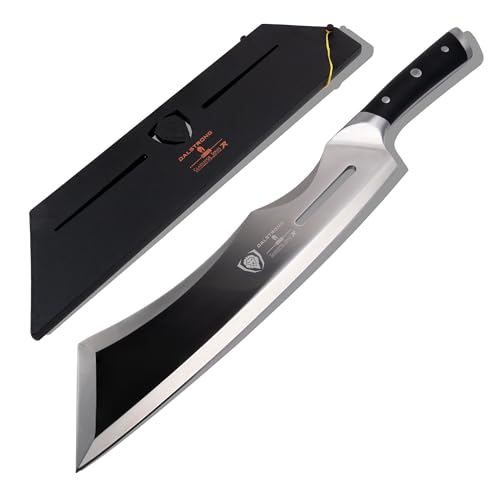
Treat this as a second knife; the Dalstrong 8" Chef Knife handles the daily slicing, while the Annihilator earns its place on bone-in work, big roasts, brisket trimming and tough produce such as squash and melons. The 14-inch blade is high-carbon 7Cr17MoV at 60 HRC, with a G-10 handle, a PerfectFit saya sheath and an acacia display stand.
The stand is a real draw for owners, who also report solid construction and a blade that moves cleanly through meat, cooked or raw. Opinions split on the details: sharpness draws both praise and complaints, and the weight and sheer size come up as a lot for a regular kitchen. Its size makes safe storage a real concern, especially in homes with children, so think through storage and handling before buying.
Pros
- Handles bone-in cuts and tough produce
- Included acacia display stand
- Full-tang G-10 handle construction
Cons
- Very heavy and large for kitchens
- Sharpness reports are inconsistent
Key features (4)
- 14-inch 7Cr17MoV carbon steel blade at 60 HRC
- Full-tang construction with G-10 handle
- Handcrafted acacia wood display stand
- PerfectFit saya sheath with pin and string
Both this and the Dalstrong Valhalla Chef Knife 8 Inch lean on looks, but the details differ: this edition carries etched artwork of Aragorn and Narsil on a satin German X50CrMoV15 blade at 54 to 56 HRC, with a 9-12° edge and a laser-etched ebony wood handle with copper accents. It comes with a leather sheath and a collector pin.
We have no owner feedback on file for this one, so we can only describe it from its specifications. At 54-56 HRC the steel is the softest on this page by hardness. It is best read as a gift or collector buy that also works as an 8-inch kitchen knife.
Pros
- Etched Aragorn artwork on the blade
- Ebony handle with copper accents
- Leather sheath and collector pin
Key features (4)
- German X50CrMoV15 steel at 54 to 56 HRC
- Laser-etched ebony wood handle with copper
- Genuine leather sheath with copper clasp
- Sloped hybrid bolster for pinch grip
Side by side
| Pick | Steel hardness | Edge angle per side | Item weight |
|---|
#1 Best Overall
Dalstrong | 62+ Rockwell | 8–12° | 0.6 pounds |
#2 Best Statement Design
Dalstrong | 60+ Rockwell | 8-12 degrees | 1.76 Pounds |
#3 Best Western-Style Workhorse
Dalstrong | 56+ HRC | 16–18° | 0.5 pounds |
#4 Hardest Steel Pick
Dalstrong | 66+ HRC | — | 1.41 Pounds |
#5 Best Complete Set
Dalstrong | 56+ HRC | 16–18° | 4.2 pounds |
#6 Specialty Pick for Butchery
Dalstrong | 60 HRC | — | 2.5 pounds |
#7 Best Collector's Edition
Dalstrong | 54-56 HRC | 9-12° | — |
How to Choose a Dalstrong Knife
Does harder steel make a better knife?
Not always. Steel hardness is rated on the Rockwell scale, and the trade-off is simple: a harder blade keeps its edge longer and takes a finer angle, while a softer one tolerates heavy chopping with less risk of chipping. The hardest options here suit slicing and precise work, and the softer ones suit rough daily use.
For the longest edge life, the Dalstrong Scorpion Elite Chef Knife is the pick at 66+ HRC. For a tougher everyday blade that you can rock through onions, roasts and herbs, the Dalstrong 8" Chef Knife at 56+ HRC settles that question better, and its wider edge angle forgives careless handling.
Which style and handle suit your cooking?
Dalstrong sells several series that differ in blade shape, weight and handle, so pick the series before the size. A defining question is whether you want Japanese-style lightness and fine cuts or Western-style heft for chopping.
- Japanese-style blades are slimmer, harder and suit fine slicing.
- Western-style blades are heavier, tougher and suit rocking and chopping.
- G-10 handles resist moisture and heat and suit a pinch grip.
- Resin and wood handles look striking but need careful drying.
- Heavier knives power through dense produce but tire hands sooner.
Single knife, full set, or a specialty blade?
If you cook daily and own nothing decent, one good 8-inch chef knife does most of the work, and the Dalstrong 8" Chef Knife is the one we'd start with; the Dalstrong 8" Japanese Chef Knife Gyuto suits cooks who specifically want a fine Japanese-style edge. If you are furnishing a kitchen from scratch, the Dalstrong Gladiator Knife Block Set gives you every common blade in matched style.
Narrow-job blades are a second purchase. A cleaver like the Dalstrong Annihilator 14" Meat Cleaver excels at bones and big cuts, while for delicate trimming of small produce, our separate look at the best mushroom knives suits the job better than any large blade. Whatever you choose, check how heavy it is against how long you usually stand at the board.
Our picks at a glance
2
Best Statement DesignDalstrong
3
Best Western-Style WorkhorseDalstrong
4
Hardest Steel PickDalstrong
5
Best Complete SetDalstrong
6
Specialty Pick for ButcheryDalstrong
7
Best Collector's EditionDalstrong
Frequently asked
Are Dalstrong knives sharp out of the box?
Owners report the chef knives and the block set as sharp straight from the box, while the cleaver's sharpness is mixed and the Aragorn edition has no owner feedback yet. For the hardest steel, we'd point to the Dalstrong Scorpion Elite Chef Knife at 66+ HRC; for a hard Japanese-style edge, the Dalstrong 8" Japanese Chef Knife Gyuto pairs an core at 62+ Rockwell with an 8 to 12 degree angle per side.
Where are Dalstrong knives made?
Owner feedback and the pages we reviewed note that the knives are made in China, with steel sourced from Germany or Japan by series. If origin matters to you, factor that in alongside steel and handle design.
Should a meat cleaver be my first Dalstrong knife?
No. A cleaver is built for bones, large roasts and tough produce, and owners describe its weight and size as a lot for everyday kitchens. Start with the Dalstrong 8" Chef Knife for daily prep and add the Dalstrong Annihilator 14" Meat Cleaver later if you break down meat at home.