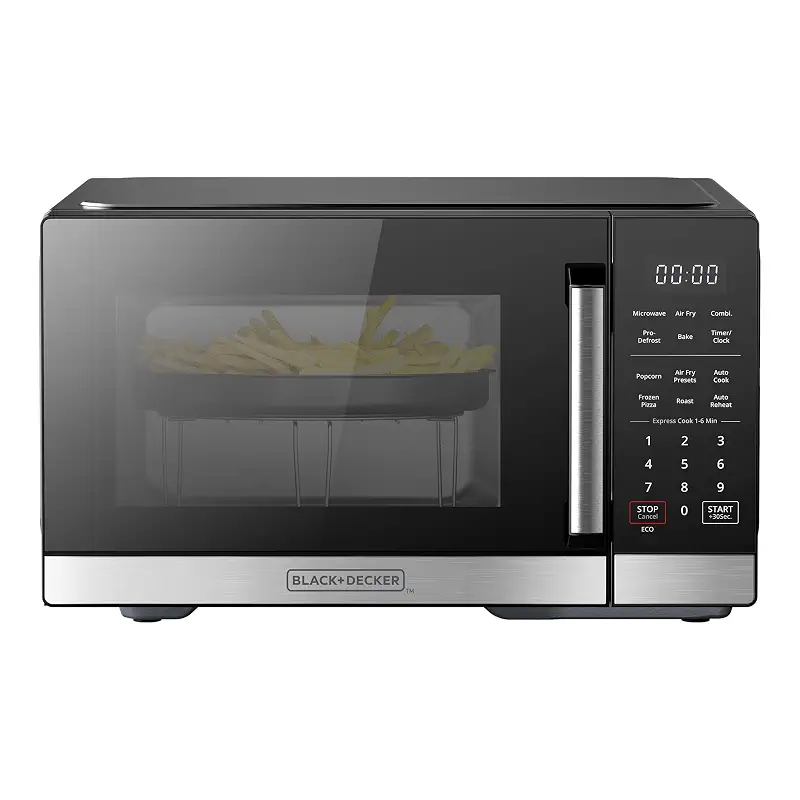
Ideal for: Budget-conscious buyers wanting a compact with air fry for small kitchens.
The Black+Decker hits a sweet spot for buyers who want multiple functions without overthinking the interface. It delivers 900 watts of microwave power, which lands in a practical middle ground: enough speed to reheat dinner without the energy draw of a full-sized unit, yet sufficient for the air fryer presets that matter most (frozen fries, chicken nuggets, fish sticks). The 11 air fry menus and auto-cook settings for staples like pizza and oatmeal mean less guesswork than free-form cooking.
Where this unit earns its place against pricier alternatives is simplicity. The control panel avoids the feature-stacking that frustrates owners of more complex models. Buyers report the speedy cooking button and child lock work as advertised, making it approachable for families and first-time combo-microwave users. That said, the 0.9 cu. ft. cavity is genuinely compact, and some owners note heat distribution unevenness on larger plates, especially when stacking or cramping food near the walls.
One caveat: the unit does slide on smooth countertops if you don't take deliberate steps to stabilize it, and the control-panel text is small and not backlit. These aren't deal-breakers for most kitchens, but they're worth acknowledging if you have poor lighting near your counter or a high-traffic household where things get bumped.
Pros
11 preset air fry menus for common frozen foods
Intuitive controls with minimal learning curve
Speedy 30-second express cook button
Compact 0.9 cu. ft. footprint for tight spaces
Cons
Small non-backlit keypad labels difficult to read in dim light
Uneven heat distribution when cooking larger portions
Key features
900-watt microwave with 10 power levels and 7 auto menus
functions: microwave, air fryer, convection, bake, roast
11 air fry presets including frozen fries, nuggets, wings, fish sticks
Child lock and compact footprint ideal for RVs and small kitchens
Glass turntable with express start for quick 30-second bursts
#2 Pick
Best for Serious Cooking Capacity
Toshiba
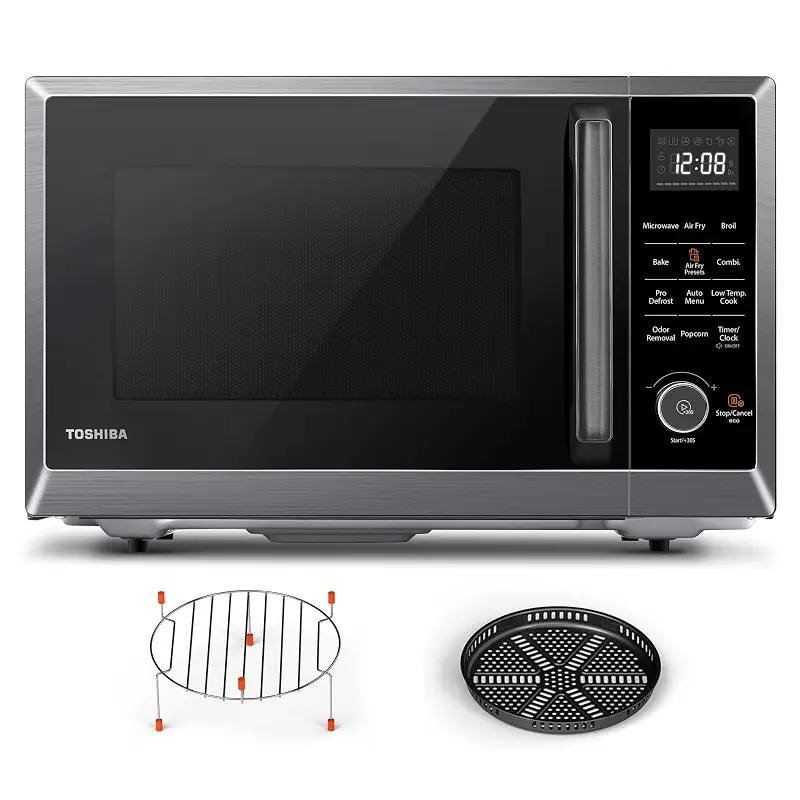
TOSHIBA Air Fryer Combo Microwave, 1.0 Cu.Ft, Black Stainless Steel | 8 in 1 with Convection & Broil, Pro Defrost, 12.4" Turntable
4.0(1,124)
Versatile 8-in-1 with 1000W power and 12.4-inch turntable that handles whole chickens and pizzas.
Ideal for: Home cooks who want air fryer, broil, and convection in one unit and don't mind a learning curve.
The Toshiba 8-in-1 packs meaningful cooking firepower into a design that doesn't feel oversized. At 1000 watts and 1.0 cu. ft., it brings nearly double the microwave power of the Black+Decker while keeping the external footprint reasonable. The 12.4-inch position-memory turntable is the real workhorse here: it genuinely accommodates a whole roasted chicken or 12-inch pizza without rotation drama, and the memory function returns the tray to where you left it, reducing fumbling when you're loading or unloading.
Where this Toshiba shines is breadth. The 8 functions (microwave, air fry, bake, broil, combi, low-temperature, odor removal, defrost) mean you're not boxed into just reheating or frying. Owners who actually experiment with the broil and combi modes report excellent results on roasted lamb and braised dishes. The stainless-steel cavity is genuinely easy to wipe down and resists staining better than some competitors.
The tradeoff is complexity. Navigating the 8 modes requires reading the manual, and incremental timer controls (5-second increments rather than free entry) can feel fiddly when you want to cook for 2 minutes 17 seconds. Also important: Consumer Reports flagged certain Toshiba combo models for safety concerns around unintended heating and sparking between January 2023 and April 2026. While not all units are affected, I'd recommend confirming the exact model number against the CPSC recall list and ensuring you never leave any combo microwave unattended while in use.
Pros
1000-watt power with 12.4-inch memory turntable for larger food
8 cooking functions including broil, convection, and combi modes
Stainless-steel interior resists staining and wipes clean easily
Odor removal and low-temperature defrost modes
Cons
Complex menu navigation requires manual study to use all functions
Some Toshiba combo models have been flagged for safety concerns
Key features
1000-watt microwave with 1.0 cu. ft. capacity and 12.4-inch turntable
Position-memory turntable accommodates whole chickens and 12-inch pizzas
Stainless-steel cavity interior for durability and easy cleaning
Two-step child lock and compact 20.6x16.4x11.8 inch footprint
#3 Pick
Best for Convection Baking
Toshiba
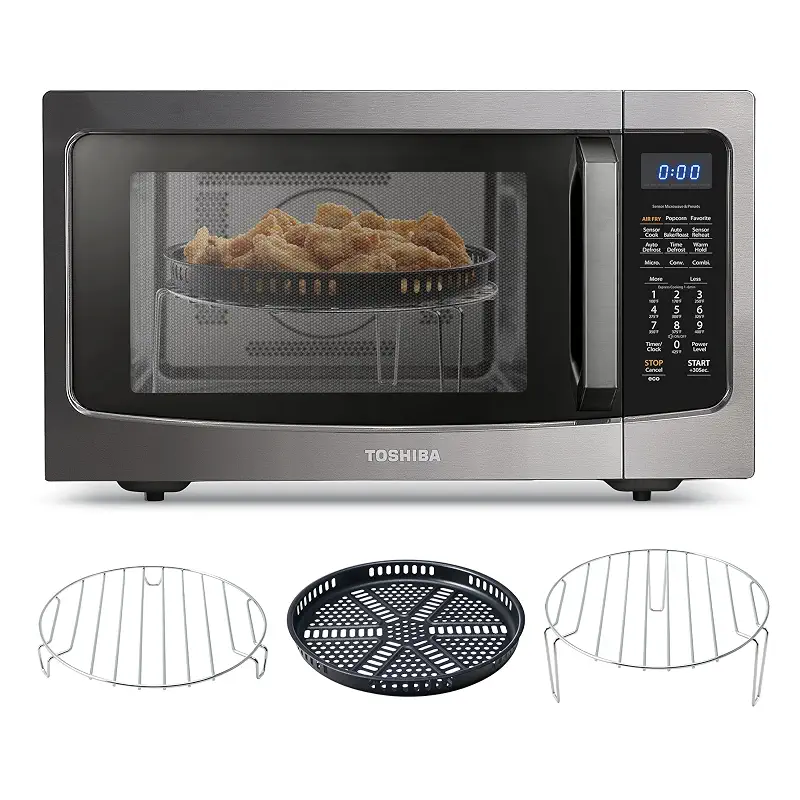
TOSHIBA 4-in-1 Countertop Microwave Oven with Air Fryer, 1.5 Cu.Ft, 1000W | Smart Sensor, Convection, Mute Function, Position Memory Turntable, for Home Kitchen, Black Stainless Steel
4.0(3,514)
Spacious 1.5 cu. ft. with excellent convection for baking cookies, biscuits, and roasted chicken.
Ideal for: Home bakers and apartment dwellers without a functioning oven seeking convection and occasional air frying.
This Toshiba is purpose-built for home cooks who prioritize convection baking as much as air frying. At 1.5 cu. ft. and 1000 watts, it's the roomiest cavity in this lineup, making it the only realistic choice if your apartment oven is broken and you're doing serious batter work. The 13.6-inch turntable and stainless-steel interior paired with convection heat produce what owners consistently describe as perfectly browned cookies, evenly cooked biscuits, and moist roasted chicken: results that validate the investment in a dedicated convection function.
The control panel is sensibly laid out. Unlike some combo units, this one doesn't hide standard microwave operation under layers of menu-diving; you can reheat coffee with a single button press, then pivot to convection baking without interrogating the manual every time. The mute function is genuinely useful in shared spaces, and the LED display is bright enough to read without a flashlight. Many owners who replaced 20-year-old radar ranges find this Toshiba delivers the same footprint and feel with modern efficiency.
The caveat: air fryer performance is notoriously inconsistent on this model. Multiple owners report soggy results, longer cooking times, and food that never achieves the crispiness of a standalone unit. If air frying is your priority, look elsewhere. This unit is best for someone who sees the air fryer as a bonus feature, not the main event, and whose real goal is a convection-equipped microwave that can replace a broken apartment oven.
Pros
Spacious 1.5 cu. ft. cavity with 13.6-inch turntable for large batches
Strong convection function produces evenly browned baked goods
Bright LED display and straightforward microwave controls
Stainless-steel cavity resists scratching and cleans easily
Cons
Air fryer performance is inconsistent and slower than standalone units
Exterior gets very hot during convection and air fry use
Key features
1000-watt microwave with 1.5 cu. ft. capacity and 13.6-inch turntable
functions: microwave, air fry, convection bake/roast, combination cooking
13 sensor menus and 10 power levels for precise microwave control
Mute function and position-memory turntable for quiet, convenient operation
Stainless-steel cavity interior with bright LED lighting
#4 Pick
Best for Quiet, Compact Spaces
GE
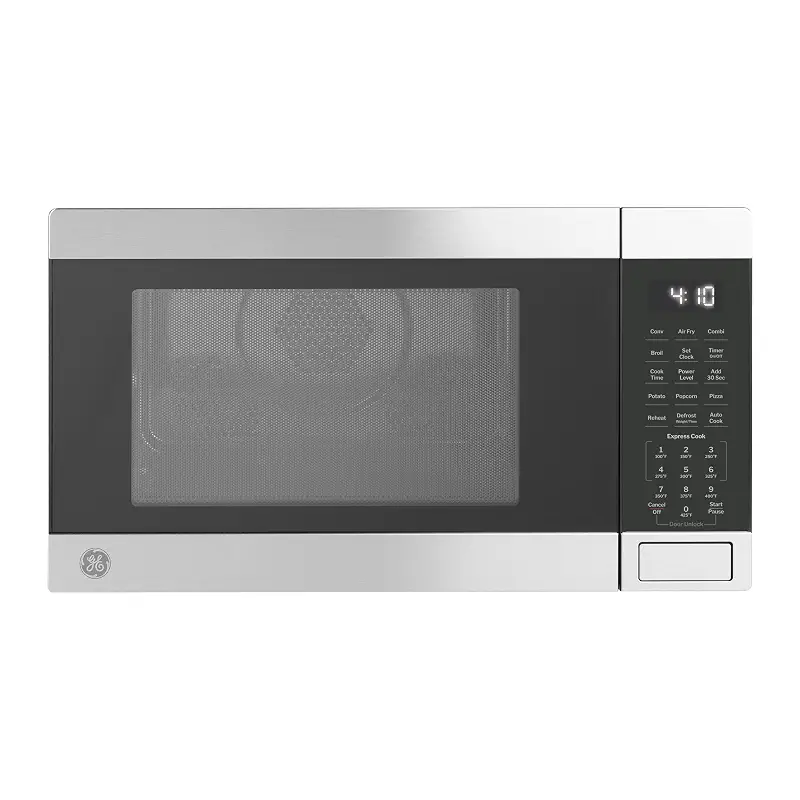
GE GCST10A1WSS Countertop Microwave Oven (Stainless Steel) | Stainless Steel, Combines Microwave, Air Fry, Convection, and Broil, Child Lock Technology, 4 Convenience Cook Settings
3.9(1,550)
Whisper-quiet 1050W with included crisper pan and racks; 1.0 cu. ft. ideal for dorms and offices.
Ideal for: Noise-sensitive spaces like dorms, offices, and apartments where quiet operation matters most.
The GE earns its reputation for quiet operation in a category where noise complaints are routine. During both microwave and convection cycles, owners consistently report significantly lower fan noise compared to similar combos. For dorm rooms, office breakrooms, or apartments with thin walls, this is genuine relief. The 1050-watt power matches other mid-tier units, and it heats adequately without the energy penalty of premium models.
What sets GE apart is the bundled accessories. The stainless-steel crisper pan, short wire rack for convection, and tall rack for broiling arrive ready to use: no hunting for compatible cookware. The broil function, while basic, actually works well for quick searing and caramelizing in ways that many combo units ignore. Compared to the Toshiba 8-in-1, the GE trades some multi-function complexity for focused simplicity: it does what it promises on the box without overwhelming menus.
The real drawbacks are control-panel visibility and durability concerns. The keypad is not backlit, and labels printed in thin white inset against dark plastic are nearly illegible without a bright room or flashlight. Multiple owners report the door latch is fragile plastic that can snap after a year, leaving the microwave inoperable and repair parts priced near replacement cost. Also expect significant interior moisture buildup and occasional rust on vent panels: a design flaw that requires regular wiping to prevent corrosion.
Pros
Exceptionally quiet operation during microwave and convection cycles
Includes stainless crisper pan and two wire racks for immediate use
1050 watts with 1.0 cu. ft. capacity and convenient cook presets
Effective broil function for searing and caramelizing food
Cons
Keypad labels not backlit and difficult to read without bright lighting
Door latch is fragile plastic prone to snapping after one year of use
Key features
1050-watt microwave with 1.0 cu. ft. capacity and quiet operation
functions: microwave, air fry, convection, broil with included accessories
Stainless-steel crisper pan, tall and short wire racks included
Child lock and convenience cook controls for pizza and popcorn
Compact 13.98x13.23x9.49 inch footprint for dorms and offices
#5 Pick
Most Powerful Convection Option
Frigidaire
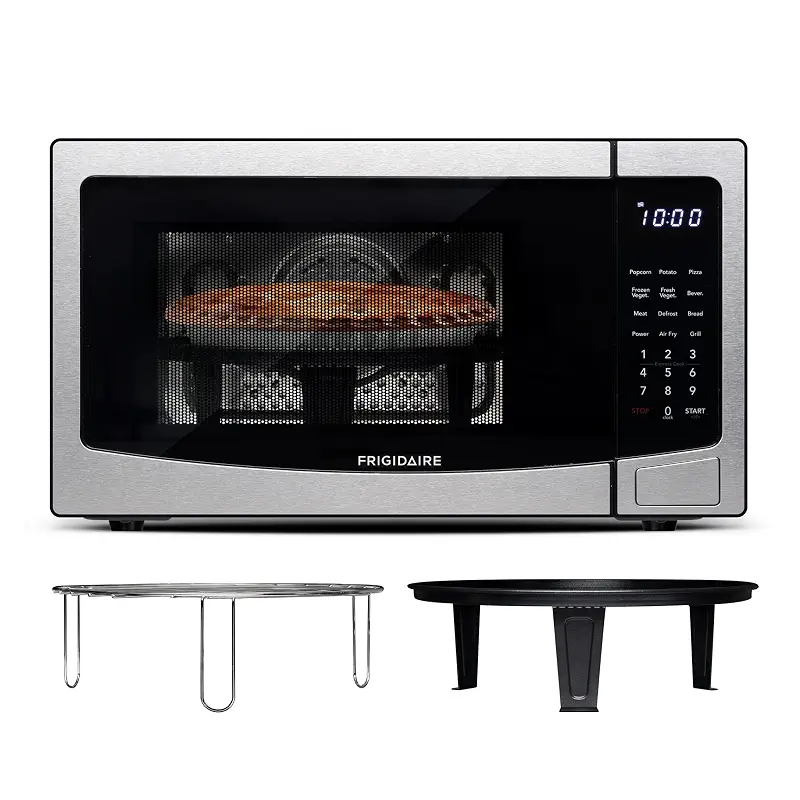
FRIGIDAIRE 1.2 cu ft Microwave, Digital Air Fryer, Convection Oven, Combo-Fry with XL Capacity, Stainless Steel Finish
4.1(368)
XL 1.2 cu. ft. with 1500W convection power and 5 one-touch menus; strong microwave but inconsistent air fryer.
Ideal for: Home cooks prioritizing large-batch convection baking over air frying in a spacious microwave.
The Frigidaire 1.2 cu. ft. is the largest cavity in this comparison and brings the most brute-force convection wattage: 1500W in convection mode versus 900-1000W on most competitors. If you're baking multiple trays of cookies or roasting vegetables for a crowd, that extra thermal muscle is noticeable. The one-touch cook menus (Potato, Popcorn, Beverage, Reheat, Frozen Dinner) are straightforward, and the 1000W oven function genuinely moves heat around faster than lower-wattage units.
Where this unit stumbles is air fryer consistency. Multiple owners report that after 40 minutes of air frying, wings remained pale and warm, requiring a finish in a standalone unit. The issue seems rooted in design trade-offs: prioritizing convection power and cavity size leaves the air fryer function underdeveloped. The manual also fails to specify which accessories pair with which modes (air fry vs. convection vs. combo), forcing buyers to experiment or hunt YouTube tutorials. The fan runs for 3+ minutes after every cycle and registers as very loud to sensitive ears.
Durability is another question mark. A handful of owners report the unit quit functioning after 4 months, and warranty service turned out tedious. For a unit positioned at a premium price, these reliability red flags combined with weak air fry performance make it a harder sell than the best ceramic air fryer as a dedicated appliance might be.
Pros
Largest 1.2 cu. ft. cavity with 1500W convection for fast batch baking
900W microwave with 10 power levels and 5 one-touch cook menus
Up to 70% less fat claimed for air fryer function when it works
Compact and user-friendly for seniors and digital-pad preference
Cons
Air fryer function produces soggy, undercooked results even after extended cook times
Fan extremely loud and runs for 3+ minutes after every cooking cycle
Key features
1.2 cu. ft. capacity with 900W microwave, 1000W oven, 1500W convection power
Multi-function modes: bake, roast, microwave, convection oven, air fryer
XL interior with 10 microwave power levels and defrost by time or weight
Stainless-steel finish with digital controls
How to Choose a Countertop Microwave with Air Fryer
Four trade-offs that actually matter when matching a countertop microwave with air fryer to your kitchen.
Wattage and Heating Speed Matter More Than You Think
Microwave wattage ranges from 700W to 1050W in this category, and it affects daily convenience. A 900-1000W unit reheats coffee in 45 seconds; a 700W unit takes 2+ minutes. For air frying, higher wattage (1000W+) ensures the convection or air-fry heating element has enough power to crisp food without endless cycles. Combo units sacrifice some microwave speed to fit dual functions, so stepping up from a standalone microwave to 1000W here feels right-sized, not unnecessarily powerful.
Cavity Size and Turntable Diameter Set Real Limits
A 0.9 cu. ft. cavity feels cramped once you own it. If you ever heat three pizza slices at once or roast a whole chicken, jump to 1.0-1.5 cu. ft. The turntable diameter matters equally: a 12-13 inch turntable accommodates 12-inch pizzas and large mixing bowls; smaller ones force you to rotate food halfway through. Measure your counter space before buying, because an oversized combo unit defeats the space-saving promise.
Control Panel Visibility and Complexity Are Often Overlooked
Non-backlit keypads are a recurring complaint across all brands. If your kitchen lighting is dim or you're setting time in a hurry, you'll fumble. Similarly, 8-in-1 units require manual study; simpler 4-5 function models let you operate intuitively on day one. Match the control complexity to your patience level. A busy household wants a microwave that works without consulting the manual every week.
Air Fryer Expectations Must Align with Combo Realities
A microwave air fryer combo vs. a standalone air fryer unit are fundamentally different appliances. Combo units excel at reheating, defrosting, and making popcorn, but air fryer performance is often slower, wetter, or less crispy than a dedicated appliance. If crispy air-fried wings are your main use case, reconsider whether a standalone unit makes more sense. Combos shine when you want to replace a broken oven or add air fry as a secondary function, not a primary one.
Noise, Durability, and Warranty Support Are Deal-Breakers
Convection modes generate fan noise; expect 70-80 decibels. If noise bothers you, test before buying or read owner reports carefully. Durability varies widely. Some units fail within a year due to fragile door latches or rust inside vent panels; others run for five years without issue. Check what the manufacturer's warranty covers (parts, labor, shipping) and read support reviews. A cheap unit with poor warranty support can cost more in frustration than a slightly pricier model from a responsive brand.
Frequently asked
Quick answers to the questions readers ask most.
Can I really use the microwave and convection functions interchangeably?
Not quite. Microwave heats food directly; convection circulates hot air, so results differ. Microwaves are fast for reheating; convection bakes and roasts more evenly but takes longer. Many combo units have a 'combi' mode that blends both, useful for reheating pizza so it crisps instead of turning soggy. But you can't swap a microwave setting for a convection one and expect the same result: they're genuinely different cooking methods sharing one appliance.
What's the difference between air fry and convection on a combo microwave?
Convection uses a heating element and fan to circulate hot air, mimicking an oven. Air fry is convection optimized for crispy textures using higher heat and a crisper basket or tray. In combo units, they're often the same underlying tech with different menu presets. The catch: dedicated air fryer appliances use more aggressive heat and airflow, so combo air frying is slower and less reliably crispy. If crispy is your goal, temper expectations or choose a model with strong convection wattage.
Do I really need child lock on a microwave?
If you have young children or live in a shared space, yes. Child lock prevents accidental starts and unintended button presses that could overheat food or create a safety hazard. Most models let you disable it easily when not needed. Some owners find it annoying to toggle repeatedly, so read reviews about how quickly you can lock and unlock: a tedious process defeats the purpose.
Why do some combo microwaves have reliability issues after just a few months?
Combo units pack more components (air fry heater, convection fan, microwave magnetron, more circuit boards) into a compact space, increasing failure points. Poor ventilation, moisture buildup, and fragile plastic parts (like door latches) are common culprits. Also, running convection or air fry modes generates intense heat; if a unit isn't designed to dissipate that heat properly, components can fail prematurely. Buy from brands with responsive warranty support and check owner reviews for long-term reliability before committing.
How much clearance do I actually need around a combo microwave?
Most manufacturers specify 3 inches on the sides and top, 1 inch at the rear, and full clearance at the bottom for airflow. Skimping on clearance causes the unit to overheat, shortening lifespan and potentially creating a fire hazard. Convection and air fry modes generate hot exhaust; that air needs to escape. If your counter space is tight, measure carefully before purchasing, or choose a smaller cavity size that fits your layout safely.