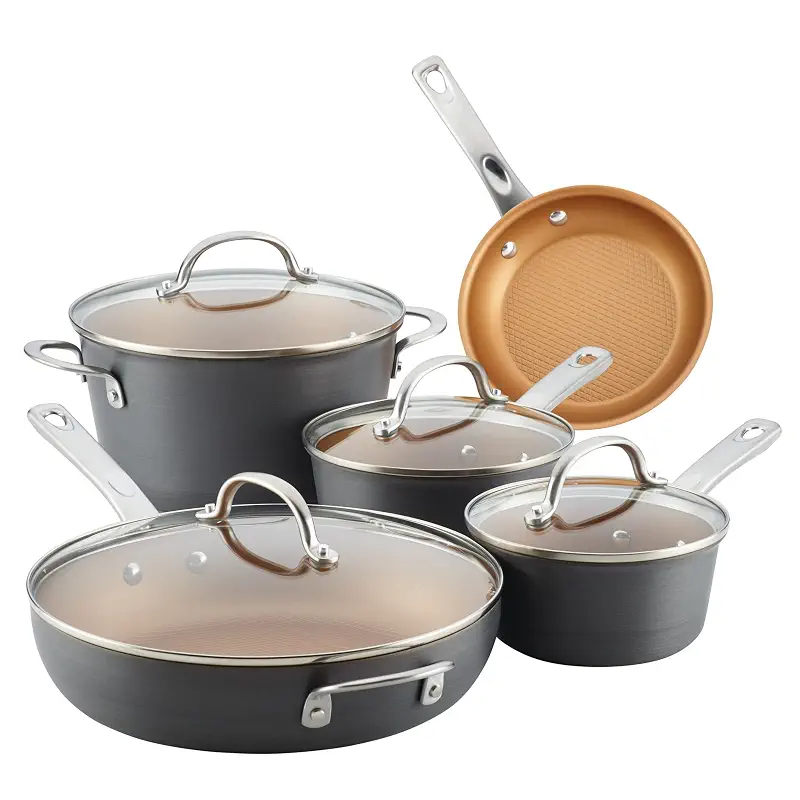
Ideal for: Home cooks building a first kitchen or upgrading from basic nonstick; multi-use everyday cooking.
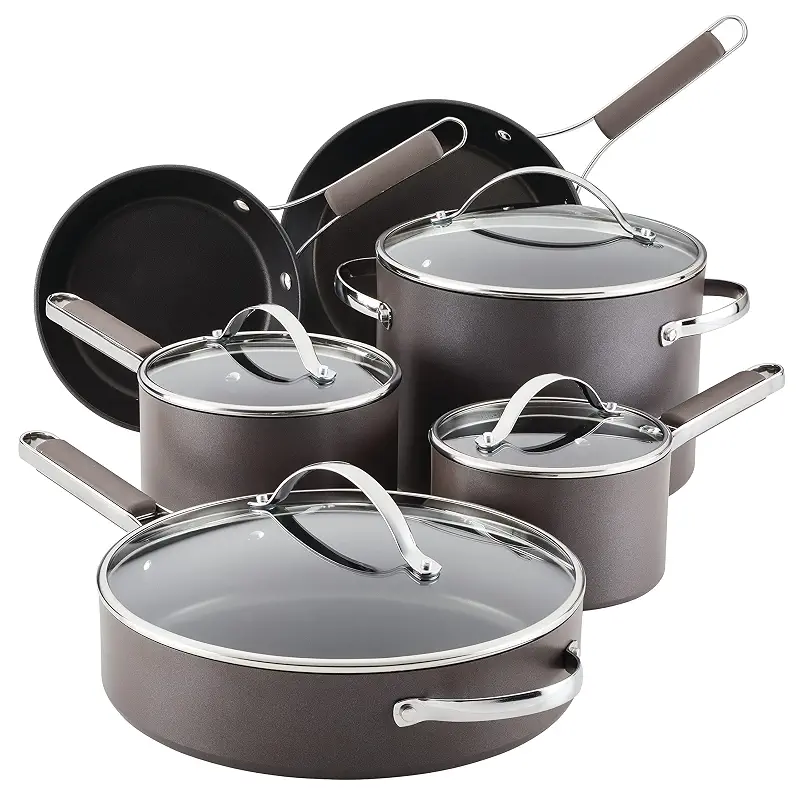
This nine-piece collection covers essentials without the premium price tag. The hard-anodized aluminum heats quickly and evenly, which matters when you're tempering whole spices or building a curry base. The nonstick coating lives up to its promise on everyday curries and sauces, making cleanup straightforward. Buyers consistently praise the performance for the cost.
The main caveat is handle heat. Multiple owners report the stainless steel handles get hot during stovetop cooking, especially on gas burners. This isn't a design flaw so much as a trade-off: thin handles keep weight down and cost low. Using a kitchen towel or grabbing silicone sleeves (sold separately) solves it completely. The lids also lack steam vents, so condensation builds and can pool if you're not attentive.
Compared to the Tramontina Utsava kadai, this set gives you range and flexibility for mixed cooking rather than specializing in one vessel. Where you'd reach for the Tramontina for a single family curry, this set handles your whole kitchen rotation. The nonstick is more forgiving than uncoated stainless, which appeals to cooks who want less fussing and faster cleanup after a full dinner.
Pros
Even heat distribution across pots and pans
Durable hard-anodized construction resists wear
Enhanced nonstick coating food releases easily
Oven safe to 500°F for finishing dishes
Cons
Handles transfer heat; towel or mitt required
Lids lack steam vents, cause condensation buildup
Key features
9-piece hard-anodized aluminum set with saucepans, Dutch oven, frying pans
Enhanced nonstick coating for easy release and cleanup
Double-riveted stainless steel handles; oven safe to 500°F
Shatter-resistant glass lids; sleek flared design
#2 Pick
Best Specialized Kadai for Small Batches
Tramontina
Tramontina Utsava 1.8-Quart Tri-Ply Clad Stainless Steel Kadai with Lid | Small Kadhai Pot for Indian Cooking
4.5(271)
Purpose-built 1.8-quart kadai with precise heat and induction compatibility; smaller size limits volume.
Ideal for: Couple or small family; regular Indian curry cooks; anyone needing precise heat and induction capability.
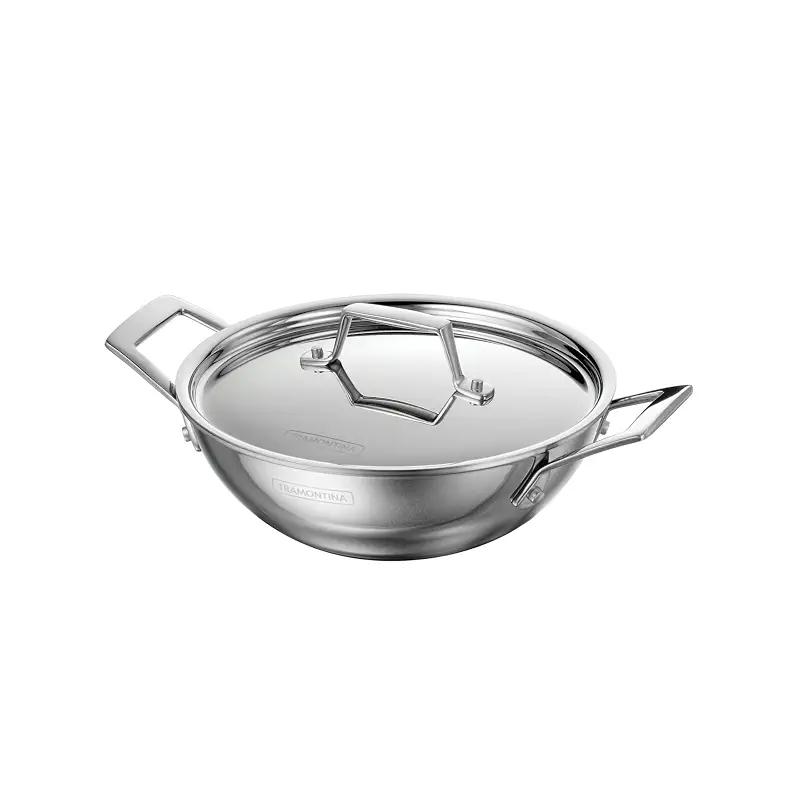
Tramontina built this kadai specifically for Indian cooking, and the design philosophy shows. The tri-ply clad stainless steel creates the even heating Indian cooks depend on for tadka and curry work. At 1.8 quarts, it's sized for a couple or for making single portions of sauce or spiced vegetables, not family-batch cooking. The round bottom with side handles is the traditional shape, though this matters less on an electric or induction cooktop than on gas.
Owners love the build quality, particularly for the price point. The mirror-polished exterior looks refined; the satin interior resists staining over years of use. Induction compatibility is a genuine advantage if you're on that cooktop, and the lid sits properly without rattling. The interior measurement markings are a small but useful touch for precision.
Where this differs from the Ayesha Curry sets is focus. You're not buying a whole kitchen here; you're buying a single workhorse vessel for the job it does best. If you cook curries and Indian sides regularly but need pans for other tasks too, you'd pair this with a basic frying pan or a best pan to cook rice option. For a specialty cook or someone with limited counter space, that focus is an asset.
Pros
Tri-ply construction provides even, responsive heating
Works on all cooktops including induction
Interior measurement markings aid ingredient precision
Lifetime warranty. NSF certified for professional use
Cons
1.8-quart size insufficient for large family portions
Round bottom can be unstable on flat electric cooktops
Key features
1.8-quart tri-ply clad stainless steel kadai with lid
Ideal for: Serious home cooks wanting a complete kitchen; anyone tired of replacing worn nonstick annually.
If the first Ayesha set is the budget entry, this professional version is the step up for serious home cooks. The hard-anodized aluminum is thicker gauge and 6X harder than standard aluminum, translating to cookware that resists wear and dent better over years. The nonstick coating is applied inside and out, which makes exterior cleanup nearly effortless and keeps the finish looking newer longer. Buyers compare it favorably to much pricier Ninja Foodi nonstick cookware.
The standout feature is the silicone grip handles. Unlike bare stainless, these stay cool enough to touch even during active stovetop cooking, eliminating the burn-risk issue that plagued the entry-level Ayesha set. The 10-piece lineup gives you saucepans in two sizes, a stockpot, a saute pan with helper handle, two frying pans, and glass lids for all covered pieces. This covers 90 percent of what a home kitchen needs.
The one trade-off: oven safety maxes at 400°F, not 500°F like the Tramontina Utsava or the entry-level Ayesha set. For everyday stovetop curry making, that's not a practical limitation. Finishing a dish under the broiler or baking sides at 375°F is still well within range. Compared to hard anodized versus stainless steel cookware debates, this collection commits fully to hard anodized, which here means faster heating and no reactive aluminum with acidic ingredients.
Pros
Thicker hard-anodized construction; 6X harder than standard aluminum
Triple-layer nonstick inside and out reduces sticking and cleanup
Silicone grip handles stay cool during stovetop cooking
10-piece set covers most everyday cooking needs
Cons
Oven safe only to 400°F, lower than some alternatives
Larger set requires adequate cabinet or storage space
Key features
10-piece hard-anodized aluminum set with helper-handle saute pan
Ideal for: Indian cooking enthusiasts on gas stoves; home cooks valuing traditional design and nonstick convenience.
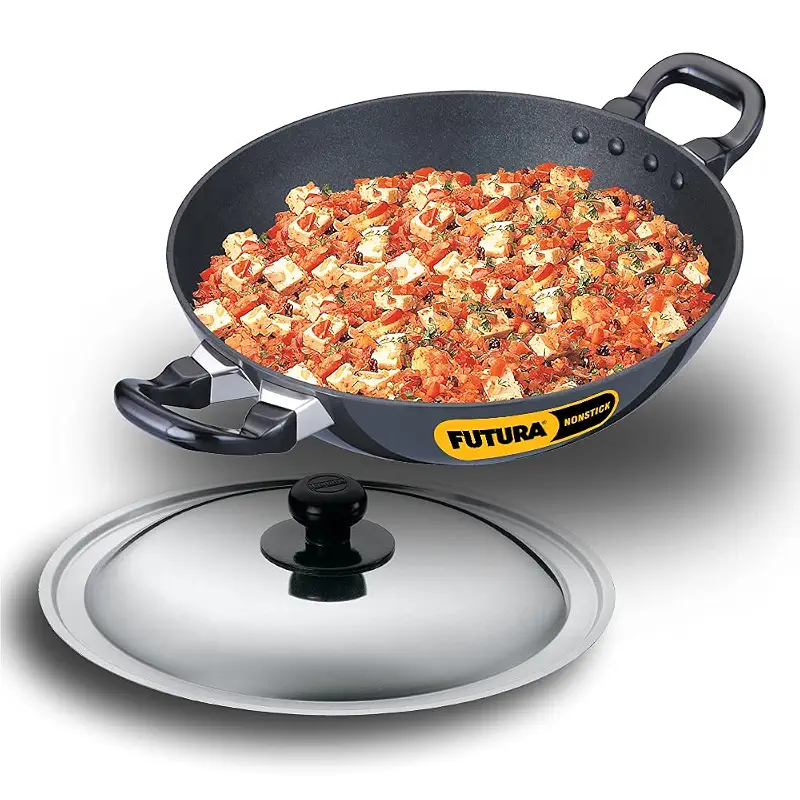
Hawkins is India's established cookware brand, and this kadai represents the formula that made it trusted across decades. The hard-anodized aluminum is locked with a PFOA-free nonstick coating that owners consistently report holds up through repeated use with minimal oil. The 2.5-liter capacity sits between the small Tramontina and family-sized sets, making it practical for 3-4 people or for making batch curries that freeze well.
The traditional round bottom with dual plastic handles is the authentic shape, designed for stir-frying, deep-frying, and simmering curries over medium to high heat. Owners cooking Indian food several times weekly report no scratches after months of use, which speaks to coating durability. The stainless steel lid is solid and useful for covered cooking. The plastic handles stay comfortable and are riveted securely.
Where this diverges from the Lolykitch stainless steel kadai is material choice and heating curve. Stainless steel (Lolykitch) is heavier, more durable long-term, and never reactive with acidic ingredients; nonstick aluminum (Hawkins) heats faster and requires less oil, which suits traditional deep-frying and tadka work. The round bottom does wobble on flat electric cooktops, a known limitation. On gas, it stabilizes fine once you grip the handle. For gas-stove cooks and those doing authentic Indian curry prep regularly, Hawkins' proven formula is hard to beat.
Pros
Authentic round-bottom kadai shape optimized for stir-frying
Hard-anodized PFOA-free nonstick lasts through heavy use
Heats quickly with minimal oil; ideal for tadka and deep-frying
Stainless steel lid included; permanently riveted handles
Cons
Round bottom unstable on flat electric cooktops
Plastic handles warm up during high-heat cooking
Key features
2.5-liter round-bottom kadai with traditional two-handle design
Hard-anodized aluminum with PFOA-free nonstick coating
Suitable for gas and kerosene stoves; stainless steel lid included
Designed for heavy curry, tadka, and deep-fry cooking
#5 Pick
Most Versatile Stainless Steel Kadai
Lolykitch
LOLYKITCH 4-Quart Stainless Steel Kadai with Lid | 12-Inch Hotpot Pot | Tri-Ply Stainless Steel Saute Pan | Everyday Pan | Induction Indian Cooking Pan | Dishwasher and Oven Safe | 3-4 Servings
4.3(268)
Tri-ply stainless 4-quart kadai handles curries and everyday cooking on any cooktop; less forgiving than nonstick initially.
Ideal for: Home cooks wanting long-term durability; anyone cooking on induction; those who cook acidic dishes regularly.
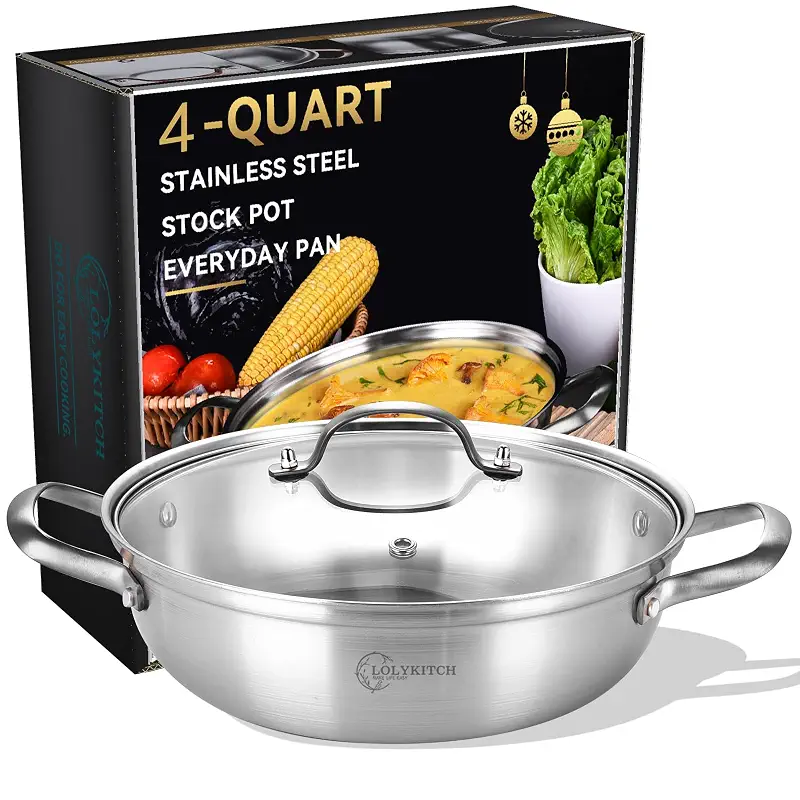
Lolykitch positions this as an everyday pan rather than a specialty kadai, and the design reflects that hybrid purpose. The 4-quart capacity serves a family of 4-5 and works equally well for curries, soups, hot pot, and braising. Tri-ply construction with aluminum core sandwiched between stainless layers ensures even heat without the hot spots that plague thinner cookware. It's induction-compatible and oven-safe to 500°F, making it genuinely universal across kitchens.
The real-world advantage over nonstick options is durability and non-reactivity. Stainless steel never degrades from metal utensils, abrasive scrubbers, or acidic curries. Over a decade, this will look and perform better than any nonstick coating. The hollow-core riveted handles have anti-slip texture and stay relatively cool. The warp-resistant base maintains contact with the cooktop, which matters for induction efficiency.
Owners note that stainless surfaces take more oil and attention than nonstick during the break-in period; some report white spots from mineral deposits after first use, a cosmetic issue resolved with vinegar rinse. Unlike the Hawkins nonstick kadai, you're not getting the effortless food release: you're building seasoning and technique over time. For cooks willing to learn, stainless is the investment that outlasts nonstick by years. Compared to the hard anodized versus stainless steel choice, this Lolykitch commits to stainless, trading speed for permanence.
Pros
Tri-ply construction ensures even heating with no hot spots
Induction compatible; works on all cooktop types
Non-reactive stainless steel safe with acidic ingredients
Oven safe to 500°F; warp-resistant base and riveted handles
Cons
Requires more seasoning and technique than nonstick
Higher maintenance; mineral spotting common on hard water
Key features
4-quart tri-ply stainless steel kadai with lid
Aluminum core for fast, even heat distribution
Induction compatible; works on gas, ceramic, and electric
Cool-grip hollow-core riveted handles. PFOA-free and SGS certified
How to Choose Cookware for Indian Curries
Four trade-offs that actually matter when matching a cookware for indian curries to your kitchen.
Nonstick vs. Stainless Steel
Hard-anodized nonstick cookware like the Hawkins Futura and Ayesha sets heat quickly and demand less oil, which suits traditional tadka and deep-frying. Stainless steel takes longer to preheat but responds precisely to temperature changes and never degrades: ideal for slow-cooked curries where control matters. Hard anodized versus stainless steel isn't a question of which is better, but which matches your cooking style. Nonstick favors speed and convenience; stainless favors longevity and technique. Many home cooks keep both: a nonstick kadai for quick everyday curries and a stainless steel piece for acidic tomato-based gravies or long braises.
Size and Capacity Considerations
The Tramontina Utsava at 1.8 quarts suits couples or single-portion cooking. The Hawkins and Lolykitch at 2.5 and 4 quarts work for families of 3-5. Full cookware sets like Ayesha include multiple sizes for flexibility. Consider how many people you cook for regularly and whether you batch-cook and freeze. A single large piece is simpler to store and maintain than a full set, but a well-chosen set covers your entire kitchen. If you cook curries 3-4 times weekly, a dedicated kadai paired with your everyday cookware is often more practical than replacing your whole collection.
Cooktop Compatibility and Heat Response
Gas stoves work with all five options, though round-bottom traditional kadais (Hawkins) wobble slightly on flat electric or ceramic. Induction cooktops require stainless steel or tri-ply clad construction; the Tramontina, Lolykitch, and some Ayesha pieces offer this. If you kadai versus wok for curries represents your cooking philosophy (using one dedicated vessel for traditional dishes) check induction compatibility before buying. Tri-ply construction heats more slowly than hard-anodized aluminum but responds more precisely and distributes heat more evenly across the bottom, which matters when simmering delicate curries low and slow.
Maintenance and Longevity
Nonstick coatings gradually wear with scrubbing and metal utensils, typically lasting 3-5 years with care. Stainless steel lasts a decade or more with minimal degradation. Hard-anodized aluminum splits the difference: tougher than raw aluminum but still not permanent like stainless. Avoid dishwashers for any curry cookware; hand wash immediately after cooking to prevent staining or buildup. Nonstick cookware profits from seasoning oil applied to the interior after washing, which extends coating life. Stainless benefits from vinegar rinses to remove mineral deposits, keeping the surface bright.
Frequently asked
Quick answers to the questions readers ask most.
Can I use metal utensils in nonstick kadai?
Metal utensils gradually scratch and degrade nonstick coatings. Stick to silicone, wood, or plastic when stirring curries in nonstick cookware. The Hawkins Futura and Ayesha nonstick sets are more durable than basic nonstick, but metal contact still shortens their life. If you prefer unrestricted utensil use, stainless steel like the Lolykitch is the better choice: metal spoons won't harm it at all.
Why do some kadai handles get hot during cooking?
Thin metal handles transfer heat directly from the stovetop. The Ayesha entry-level set and Hawkins feature metal or plastic handles that warm with high-heat cooking, especially on gas burners. The Ayesha Professional set solves this with silicone grip sleeves. The solution is simple: use a kitchen towel, oven mitt, or purchase silicone handle protectors sold separately. This is a minor inconvenience, not a design flaw, and it keeps cookware cost reasonable.
Is a 2.5-quart kadai enough for a family of 4?
A 2.5-quart kadai (like the Hawkins) works for families of 4 if you're not cooking massive single batches. You'll have enough volume for curries, sides, and even some braised dishes. If you regularly cook for 5+ or batch-cook for freezing, step up to the 4-quart Lolykitch. For smaller households or single portions, the 1.8-quart Tramontina is sufficient. Consider your freezer habits and table size when choosing capacity.
Can I use curry cookware in the oven?
Yes, with limits. The Tramontina, Lolykitch, and entry-level Ayesha are oven-safe to 500°F. The Ayesha Professional maxes at 400°F. The Hawkins Futura is designed for stovetop use only. If you finish curries under the broiler or bake side dishes frequently, confirm the product's oven rating before buying. Most everyday curries require only stovetop heat, so this matters mainly for specific recipes or finishing techniques.
What's the difference between a kadai and a regular deep skillet?
A traditional kadai has a round or wok-like bottom, deeper sides than a skillet, and two short handles for stirring and tossing. It's designed for moving ingredients quickly through hot oil during tempering or deep-frying, and for simmering curries gently. A skillet has a flat bottom, shallow sides, and one long handle for sautéing. For authentic Indian cooking, a kadai is more specialized and efficient. Many modern hybrid kadais (like the Lolykitch) have flattened bottoms for electric cooktops while keeping the depth and side handles.