Kitchen & Dining · Cookware
Best Cookware for Indian Cooking in USA
Find the best cookware for Indian cooking in the USA. Compare kadais, pots, and pans designed for curries, stir-fries, and deep-frying with expert reviews.
Affiliate disclosure: As an Amazon Associate I earn from qualifying purchases.
At a glance
1
Best Overall for Daily Indian CookingHawkins
2
Best Value Nesting Set for Small BatchesCraftone
3
Best Premium Kadai for Long-Term InvestmentMade In
4
Best Large-Capacity Kadai for FamiliesTramontina
5
Best Alternative for Large-Batch Cooking with Non-Stick CeramicImusa
Detailed reviews
The Hawkins kadai sits at the heart of what Indian home cooks have relied on for years: solid tri-ply stainless steel that distributes heat evenly without the non-stick coating that eventually wears down. Owners consistently praise its versatility across curries, deep-frying, and everyday sautéing. The glass lid traps moisture and heat, the rosewood handles stay relatively cool, and the no-drip flange helps when transferring food. A few buyers note the pan is heavier than aluminum alternatives, which some find reassuring and others find tiring. One owner reported scratching after gentle use, though this appears rare in the broader feedback.
The depth and curved sides make this genuinely suited to Indian cooking techniques in ways a shallow Western sauté pan isn't. At 2.5 liters, it handles a family meal comfortably but may feel tight if you're cooking for six or more people regularly. Hand-washing is recommended over the dishwasher to preserve the finish.
Compared to the Made In kadai, which prioritizes premium stainless and five-ply construction, the Hawkins trades some refinement for straightforward durability and a lower entry point. It's the workhorse choice if you cook Indian food several times a week and want a pan that won't overthink the job.
Pros
- Even heat distribution prevents hot spots and burning
- Deep, curved sides suit stir-frying and deep-frying techniques
- Induction compatible with flat bottom design
Cons
- Heavier than aluminum pans; requires pot holders when hot
- Learning curve for stainless steel; needs proper oil technique to avoid sticking
Key features (4)
- Tri-ply stainless steel construction with aluminum core for heat distribution
- 2.5-liter capacity with curved sides, ideal for Indian cooking
- Flat induction-compatible bottom; riveted rosewood handles
- Includes tempered glass lid with heat-resistant knob
Craftone's three-piece set targets cooks with tight kitchen storage and a preference for smaller, portioned meals. The nesting design means three separate pots live in less cabinet space than one large piece of traditional cookware. Owners find them handy for dips, gravies, reheating components, and small-batch cooking, and they appreciate the ease of hand-washing and the elegant hammered finish that transitions from stovetop to table. One reviewer noted the pots heated quickly over a flame and worked well for warming prepared dishes.
The trade-off is capacity: these are compact pots, and a buyer who needs to simmer a large curry or deep-fry samosas in volume will find them undersized. The stainless steel is relatively thin compared to tri-ply options, so heat can be less forgiving and more prone to hotspots if you're not careful. One user noted the pots arrived with minor scratches, and dishwasher-safe claims don't account for spotting that benefits from hand-drying.
Where the Tramontina Utsava emphasizes a single large-capacity pot for family meals, the Craftone set works best in smaller households or as a supplement to a primary kadai. The aesthetic appeal and nesting convenience suit cooks who value kitchen organization and dual-duty serving pieces. If you're also seeking a best pan to cook rice, these smaller pots excel at portioning and reheating grains without wasting energy on oversized cookware.
Pros
- Stackable nesting design saves significant cabinet space
- Beautiful hammered finish works for serving at table
- Fast heating over gas flame for quick reheating
Cons
- Small capacity unsuitable for large family curries or deep-frying
- Thinner stainless steel than tri-ply; less forgiving heat distribution
Key features (4)
- Three graduated sizes (33, 47, 60 oz) in food-grade stainless steel
- Nesting design minimizes storage footprint; includes fitted lids
- Induction and gas compatible with flat bottom
- Mirror-polished hammered texture for serving and table appeal
Made In's 10-inch kadai positions itself as the premium option in this category, using five-ply stainless clad construction to achieve the kind of even heating you'd expect from professional cookware costing significantly more elsewhere. Owners consistently note the difference: beautiful stir-fries without hotspots, no burning despite medium-high heat, and a sense of craftsmanship that justifies a higher investment. The ergonomic handles and moderate weight make it comfortable to use daily, and one long-time wok enthusiast who owns carbon steel and cast iron pieces calls this the best she's ever used.
The catch is size. At 10 inches, this is a single-serving to two-person vessel. Buyers comfortable cooking smaller portions or plating from a separate batch pot won't mind, but anyone expecting to feed four directly from the pan will find it tight. The five-ply construction and premium feel come at a step up in price relative to the Hawkins or Tramontina options. A few owners note it performs best on stovetop and less optimally in the oven, so if you're planning to braise whole fish or finish dishes in high heat, this isn't the most versatile choice.
Compared to the Hawkins, this is the refinement upgrade: better heat control, lighter weight, and professional durability. For cooks who view this as their primary wok or kadai and plan to use it for years, the premium feels earned.
Pros
- Five-ply construction delivers professional-grade even heating
- Lightweight and ergonomic compared to heavier stainless options
- Induction compatible; works beautifully on gas and electric
Cons
- 10-inch size limits batch capacity; not ideal for cooking family portions at once
- Premium price point; less budget-friendly than entry-level alternatives
Key features (4)
- Five-ply stainless clad construction with 430 stainless exterior
- 10-inch diameter with sloping curved sides for tossing and stir-frying
- Ergonomic handles riveted for durability; oven safe to 800°F
- Induction ready; works on all cooktop types
Tramontina's Utsava prioritizes volume and family-scale cooking. At four quarts, it handles a full curry for 4-5 people, deep-fries generous batches of pakoras or samosas without overflow risk, and gives you room to toss without spilling. The tri-ply clad construction ensures even heating, and owners consistently note that meat and vegetables don't burn or stick when you use proper technique (a little oil, proper preheating). The interior volume markings in quarts and liters are a practical touch for recipe scaling, and the 500°F oven-safe rating opens possibilities beyond stovetop work.
The beauty here is versatility. Owners report using this for ramen, shabu-shabu, rice cooking, and even marinara sauce, proving it's not limited to Indian cooking despite its kadai design. The handles do get hot under sustained high-heat cooking, so pot holders are non-negotiable. One buyer observed tiny cracks forming at the bottom after a year of heavy use, which is worth watching; another noted it's truly three-ply, not five-ply as some may assume, so heat distribution is good but not premium-tier.
Where the Made In kadai serves singles and duos, the Tramontina is built for larger tables. If you entertain, cook for a family, or want to batch-prep and freeze, this depth and capacity justify the choice. Compared to the Hawkins 2.5-liter, you gain meaningful cooking volume without proportional weight increase.
Pros
- Spacious four-quart capacity handles family meals and deep-frying batches
- Tri-ply clad construction with even heating and no hot spots
- Oven-safe to 500°F and works on all cooktop types including induction
Cons
- Handles become very hot during extended cooking; pot holders essential
- Some long-term users report hairline cracks at the base after heavy use
Key features (4)
- Four-quart tri-ply clad construction for even, quick heating
- Deep bowl shape with curved sides suited to stir-frying and deep-frying
- Interior quart and liter markings for easy recipe measurement
- Includes stainless steel lid; oven safe to 500°F without lid
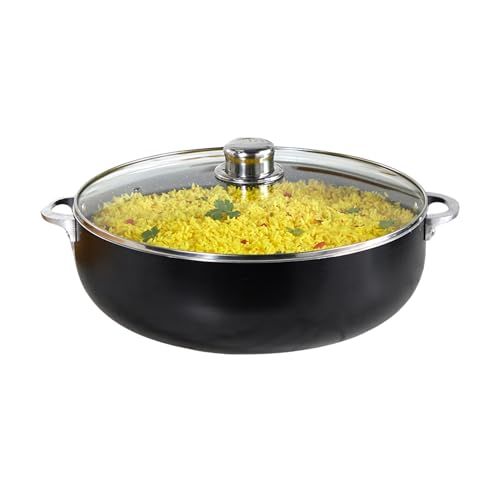
The Imusa Bistro Cera takes a different approach: aluminum base with black speckled ceramic non-stick coating rather than stainless steel. If your priority is effortless food release and minimal scrubbing, this delivers on that front. Owners love the non-stick performance for rice, beans, soups, and sauces, and the 6.9-quart capacity is genuinely cavernous for large family meals or batch cooking. The exterior is attractive, the glass lid locks heat and moisture, and the price sits favorably for the volume offered.
But there are real trade-offs to weigh. The handles get dangerously hot under any sustained cooking and lack protective sleeves, which makes this riskier in homes with children or if you're the type to work without pot holders. Ceramic non-stick coatings are less durable than stainless steel and can chip or wear; one buyer received a pot with rim damage, and the coating won't last as long as tri-ply stainless. Aluminum is also reactive to acidic foods, so long simmering of tomato-based curries or dishes with citrus can affect taste and discolor the pot. If you're a purist about traditional Indian cooking techniques that rely on steel's non-reactive surface, this is a step backward.
Compared to the Tramontina Utsava, you gain a quart of capacity and lose durability and cooking versatility. Choose this if you cook large batches of non-acidic dishes (rice, dal, stews) and prioritize the non-stick convenience over the long-term investment quality that stainless provides.
Pros
- Massive 6.9-quart capacity for large family meals and batch cooking
- Excellent non-stick ceramic coating; food releases cleanly without sticking
- Even heat distribution; attractive speckled black finish
Cons
- Handles get very hot and lack protective covering; poses burn risk
- Ceramic non-stick coating less durable than stainless; prone to chipping
Key features (4)
- 6.9-quart capacity with durable aluminum and ceramic non-stick coating
- Riveted handles and tight-fitting glass lid with steam vent
- Oven safe (without lid); works on all stovetop types
- Non-reactive ceramic interior; easy cleanup and food release
How to Choose the Best Cookware for Indian Cooking
Capacity and Household Size
A 2.5-liter kadai works for one to three people; a four-quart pot (roughly three liters) scales up to families of four or more. Indian cooking often involves simmering and tossing, so depth matters more than a typical Western pot. Oversized pans make small portions awkward; undersized ones force you into multiple batches. Think about your most common cooking scenario (weeknight for two, weekend for six) and size accordingly. If you entertain regularly, a larger capacity with nesting or stacking options saves space.
Material: Stainless Steel vs. Ceramic-Coated Aluminum
Stainless steel is non-reactive, durable for decades, and works beautifully with acidic curries or tomato-based dishes without affecting flavor or color. Ceramic-coated aluminum is lighter and naturally non-stick but less durable and reactive to acids. For traditional Indian cooking where spices and acidic ingredients are common, stainless steel (especially tri-ply for even heat) is the more reliable choice. Tri-ply or five-ply construction spreads heat evenly and prevents hot spots; single-layer stainless requires more attention to heat control.
Cooktop Compatibility and Induction Readiness
All pots in this guide work on gas and electric; most are induction compatible if they have a ferromagnetic stainless steel base. Test with a magnet before buying if induction is essential. Flat-bottomed kadais transfer heat better than curved bottoms on electric and induction cooktops, though curved sides are ideal for tossing stir-fries. If you're locked into one cooktop type, verify the product's compatibility first.
Heat Management and Learning Curve
Stainless steel requires proper preheating and a thin oil layer to prevent sticking, which has a learning curve if you're used to non-stick pans. Ceramic non-stick removes this barrier but sacrifices longevity. Understand that kadai versus western cookware represents different heat expectations. Consider starting with the beginner guide to kadai selection if you're new to the style, as technique (medium-high heat, patience with oil) affects results as much as the pan itself.
Handle Heat and Durability
Stainless steel handles warm under sustained cooking; ceramic-coated pots heat up faster and more intensely. All require pot holders for safety, though some designs (riveted stainless handles, insulated wood grips) stay cooler longer. Check reviews for long-term durability: tri-ply stainless shows minimal wear after years, while ceramic coatings can chip or fade. Riveted handles (no loose bolts) and solid construction signal longevity.
Our picks at a glance
1
Best Overall for Daily Indian CookingHawkins
2
Best Value Nesting Set for Small BatchesCraftone
3
Best Premium Kadai for Long-Term InvestmentMade In
4
Best Large-Capacity Kadai for FamiliesTramontina
5
Best Alternative for Large-Batch Cooking with Non-Stick CeramicImusa
Frequently asked
What size kadai should I buy if I'm cooking for two people?
A 2.5-liter or three-quart kadai is ideal for two people. It's large enough for a full curry with sides but small enough to heat efficiently and avoid excess leftovers. If you batch-cook and freeze, a larger four-quart pot may still make sense so you can prepare a double batch at once. Single-person households can go smaller, but most Indian recipes benefit from a little extra room for tossing and stirring.
Can I use a regular stainless steel pot instead of a kadai?
A regular saucepan works for simmering curries, but a kadai's curved, deep shape is engineered for stir-frying, tossing, and oil retention during deep-frying. The sloped sides make it easier to scoop food and control heat in ways a straight-sided pot doesn't allow. If you're only simmering dal or curries, a pot is fine; if you want to stir-fry vegetables or deep-fry snacks, a kadai's geometry makes a measurable difference.
How do I prevent sticking in a stainless steel kadai?
Preheat the kadai on medium-high heat for 1-2 minutes, then add enough oil to coat the bottom. Let the oil heat until it shimmers. Food should release naturally when it's developed a light crust. Avoid moving food too early; let proteins sear before stirring. If food sticks, a small splash of water helps lift it. Cleaning with Bar Keepers Friend or a soft sponge keeps the surface in good condition for continued non-stick performance.
Are ceramic non-stick coatings safe for Indian cooking?
Ceramic non-stick is safe and PFOA-free, but it's less durable than stainless steel and can chip over time. For Indian cooking, especially with acidic spices, tomatoes, or long simmering, stainless steel is the more durable choice. Ceramic non-stick works well for rice, beans, and non-acidic gravies but may not last as long under heavy use. If non-stick convenience is your priority and durability is secondary, ceramic is acceptable.
Do I need an oven-safe kadai?
It's not essential, but it's useful. An oven-safe kadai lets you braise, finish dishes under the broiler, or transfer directly from stovetop to oven without changing cookware. Many traditional Indian recipes don't call for oven use, but if you plan to bake biryani, finish a curry with a heat-and-hold step, or make modern fusion dishes, oven-safe capability adds flexibility. Most quality kadais are oven-safe to at least 500°F.