Best Coffee Grinder for Cold Brew: Burr Precision & Consistency
Find the best coffee grinder for cold brew. Compare top burr grinders with 40-70 grind settings, anti-static technology, and consistent grinding for smooth cold brew extraction.
Ideal for: Home brewers who make cold brew weekly and want reliable performance without a learning curve.
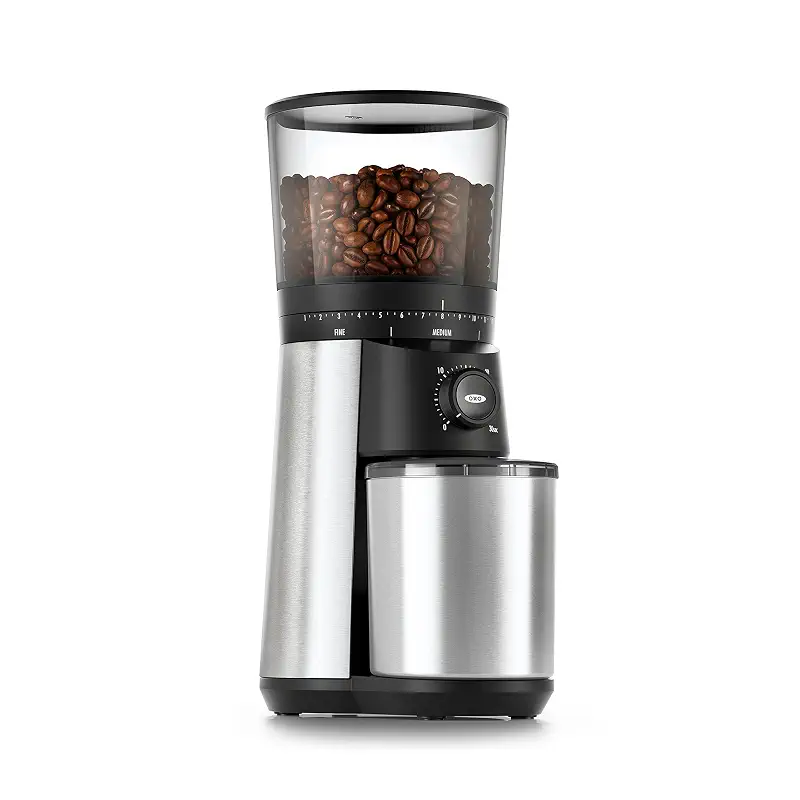
The OXO Brew sits at the intersection of affordability and genuine competence. With 43 micro-adjustments nestled within 15 broader grind settings, I think this grinder gives you the control cold brew demands without the complexity or price tag of entry-level specialty models. The 40mm stainless steel conical burrs deliver uniform grounds, and the large 12-ounce hopper means fewer refills during the week. The motor is engineered for low vibration, which matters if your kitchen doubles as a morning refuge before the household wakes up.
I'd note that reviewers flag occasional jamming and inconsistent build quality: some units perform flawlessly for years, while others develop grinding resistance within weeks. The bottom burr cannot be removed for deep cleaning, a genuine limitation if you're particular about maintenance. That said, the overwhelming majority of owners report a year or more of trouble-free daily use, and customer support has historically offered refunds when units fail early. Compared to the Tuni G2, which trades some simplicity for espresso precision, the OXO is the pragmatic pick for households that rotate between cold brew one day and French press the next.
For cold brew specifically, the coarse grind range is ample, and the grind consistency owners report suggests you'll spend less time stirring sediment from the bottom of your carafe. The one-touch memory function means you set it once for cold brew and it remembers: a small convenience that adds up over weeks of mornings.
Pros
43 micro-adjustments for precise coarse-grind dialing
Large 12-ounce hopper reduces refilling frequency
Quiet, low-vibration motor engineered for early mornings
One-touch memory recalls your last setting
Cons
Occasional jamming reported; inconsistent build quality across batches
Ideal for: Espresso enthusiasts who also brew cold brew and appreciate digital programming and low-speed grinding.
The Tuni G2 brings substantially more grind granularity than the OXO (70 settings versus 43) which appeals to coffee enthusiasts who alternate between espresso and cold brew and demand repeatability across all of them. The patented 40mm conical burr system runs at a lower 400 RPM, minimizing heat and static, and that engineering shows up in how consistently owners report fine grinds for espresso without the dust-cloud mess. The digital touchscreen, though initially intimidating, lets you program single and double-shot defaults, so your espresso doses are one button away.
Where it diverges from the OXO is compactness and control. The Tuni's smaller footprint suits tight counters, and the 250-gram hopper (larger than it sounds for a compact design) covers a few days of mixed brewing. Reviewers emphasize how quiet it is relative to older flat-burr grinders. One mild caveat: a few owners report that the touchscreen's display markings for grind size misalign by two notches with the actual grind produced, though this matters only if you're numbering settings. For cold brew, you've got the coarse range covered, but the G2 feels like a grinder that's really singing when dialing espresso, not when you're grinding for immersion brew. If espresso is also on your roster, the best espresso grinder under 200 category offers grinders with even finer tuning, but the Tuni handles both methods admirably within a compact form.
Compared to the Iagreea below, the Tuni costs more but gains that espresso-specialist calibration and the low-speed motor that heat-conscious brewers appreciate. If your cold brew is occasional rather than routine, the Tuni is the smarter long-term investment.
Pros
70 grind settings with 0.5-second timer increments for micro-adjustments
400 RPM low-speed motor reduces heat and static buildup
Programmable single and double-shot defaults for espresso repeatability
Detachable portafilter holder (51-58mm compatible) for direct grinding
Cons
Digital display markings may misalign with actual grind size by two notches
Smaller hopper (250g) requires more frequent refilling than OXO
Key features
70 precision grind settings from Turkish-fine to French-press coarse
400 RPM conical burr system minimizes heat and static electricity
LED touchscreen with programmable single/double cup and 0.5s timer precision
Compact 250-gram hopper with included cleaning brush and bellow pump
Stainless steel housing with fingerprint-resistant finish
#3 Pick
Best Budget-Friendly
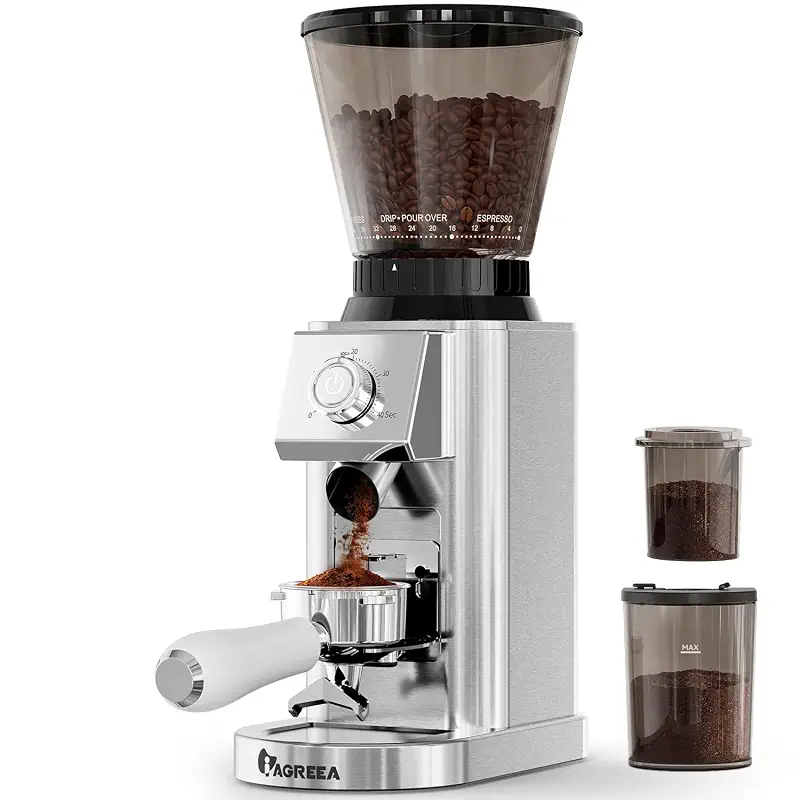
Iagreea
IAGREEA Coffee Grinder for Home Use, Conical Burr Espresso Grinder 48 Grind | 450RPM Low-Speed Anti-Static, Precision Timer For Drip, French Press, Cold Brew, No Mess, Metallic Silver
4.5(229)
A capable mid-range option balancing affordability with the features serious home brewers actually need, ideal for cold brew on a budget.
Ideal for: Budget-conscious home brewers prioritizing coarse-grind consistency and minimal mess.
The Iagreea targets the $100-range sweet spot with 48 grind settings, a 150-watt high-torque motor, and anti-static stainless steel construction. I think this grinder does what matters: delivers consistent coarse grinds for cold brew without the noise penalty of higher-speed motors. The 450 RPM speed generates less heat than typical blade grinders, preserving bean aromatics, and reviewers note minimal static cling: a practical advantage when you're dumping grounds into a cold brew vessel. The 300-gram hopper is generous for the footprint, and the magnetic dosing cup is a small detail that pays dividends if you ever switch to espresso.
There's a trade-off worth mentioning: a few owners report the grind dial can shift when you tap the burr chamber to clear retained grounds, requiring adjustment. This is more an annoyance than a dealbreaker, but it means cold brew batches might require a moment to dial back in if you tap mid-grind. The included portafilter holder, while practical, has limitations and some owners bent the arms to fit wider baskets. The stainless steel burr quality feels solid based on owner feedback, though it's early to call long-term durability versus the OXO's decade-old track record.
Where the Iagreea shines against the Amzchef (another $100-ish option) is motor control and the simpler rotary dial: no digital interface to learn or troubleshoot. For cold brew specifically, the coarse range is ample, and the anti-static design means less cleanup when grinding larger batches.
Pros
450 RPM low-speed motor preserves bean flavor and reduces heat
48 grind settings from espresso-fine to French-press coarse
Anti-static stainless steel design reduces grounds cling and mess
300-gram hopper and magnetic dosing cup for stable, convenient use
Cons
Grind dial can shift when tapping burr chamber, requiring re-adjustment
Portafilter holder requires manual bending to fit some basket sizes
Key features
48 grind settings with 450 RPM low-speed motor for flavor preservation
40mm stainless steel conical burr with high-torque 150-watt motor
Anti-static technology and stainless steel grounds outlet for minimal mess
300-gram bean hopper and magnetic dosing cup for espresso or batch grinding
Simple rotary knob timer with up to 40-second max grind time
#4 Pick
Best Digital Control
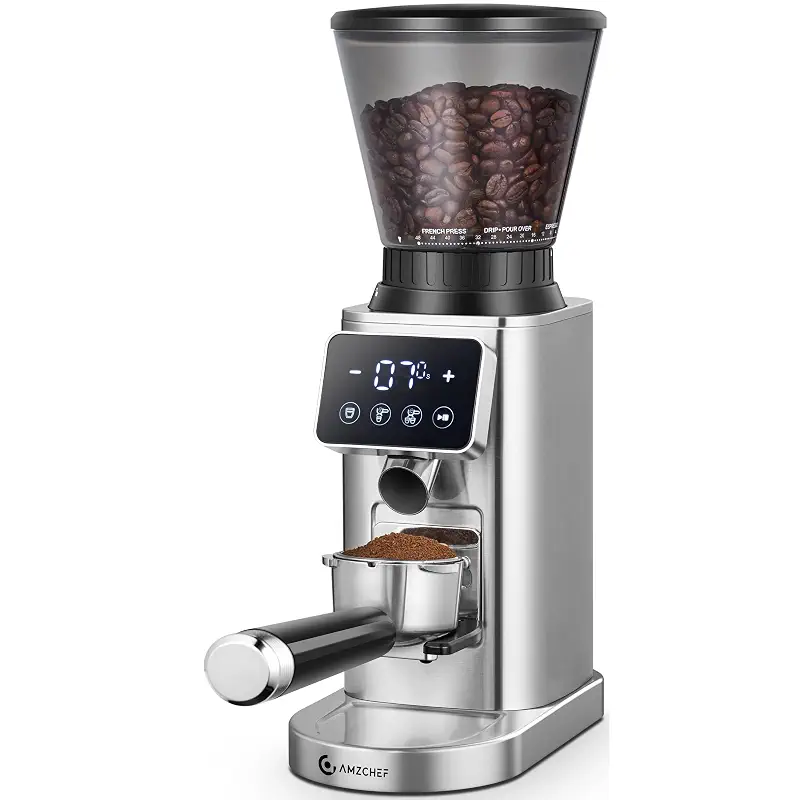
Amzchef
AMZCHEF Conical Burr Coffee Grinder, 48 Grind Settings, Anti-Static Burr Mill with Precision Timer & LED Touchscreen, for Espresso, Drip, Pour Over, Cold Brew & French Press, Stainless Steel, Silver
4.5(1,336)
A touchscreen-driven grinder offering granular digital control and portafilter capability, best for brewers who value interface sophistication and versatility.
Ideal for: Home brewers who brew across multiple methods and appreciate digital programming for consistency and convenience.
The Amzchef packages 48 grind settings, an LED touchscreen, and anti-static burr engineering in a sleek, compact footprint. I find the digital interface appealing if you rotate frequently between cold brew, espresso, and pour-over: you can label and store settings for each method, eliminating the guesswork of returning to "that setting I used last Thursday." The 40mm stainless steel conical burrs and built-in anti-static technology mean grounds cling far less than older models, a genuine convenience when grinding fine for espresso. Reviewers consistently praise how quiet it runs and how the detachable portafilter holder (compatible with standard 51mm and 58mm baskets) simplifies espresso workflow.
The touchscreen is intuitive and responsive according to owners, with clear cup-count and time selection. One nuance: while the interface is approachable, it does require reading the manual to fully leverage features like the brewing-method guidance system some units offer. The 10.6-ounce hopper is large enough for daily cold brew prep without constant refilling. Where I'd note a difference from the Iagreea is simplicity: the Amzchef's digital layer adds features but also potential points of failure if the electronics age. For cold brew, the grind consistency is strong, and the anti-static performance means your weekly cold brew ritual stays tidy. If you're also considering a top home nitro cold brew system for weekend entertaining, a grinder with clear timing control like this one ensures consistent grounds for nitrogen-infused batches too.
Compared to the Tuni G2, the Amzchef prioritizes versatility and user-friendly controls over espresso specialist tuning, making it the pick for households with diverse brewing interests rather than espresso-first operations.
Pros
LED touchscreen with 48 settings and 0.5-second timer precision for repeatability
Anti-static burr system significantly reduces grounds cling and mess
Detachable portafilter holder for convenient direct grinding into espresso baskets
10.6-ounce hopper with UV-blocking tint preserves bean freshness
Cons
Digital interface requires manual review for full feature access
Touchscreen adds potential failure points compared to purely mechanical grinders
Key features
48 grind settings from espresso-fine to French-press coarse with digital precision
40mm stainless steel conical burr for uniform particle size and consistent extraction
LED touchscreen with 2–12 cup selection and up to 40-second timer (0.5s increments)
Anti-static technology and stainless steel grounds container minimize mess
10.6-ounce hopper with UV-blocking tint and trap-door design for easy refilling
#5 Pick
Best Budget Blade Option
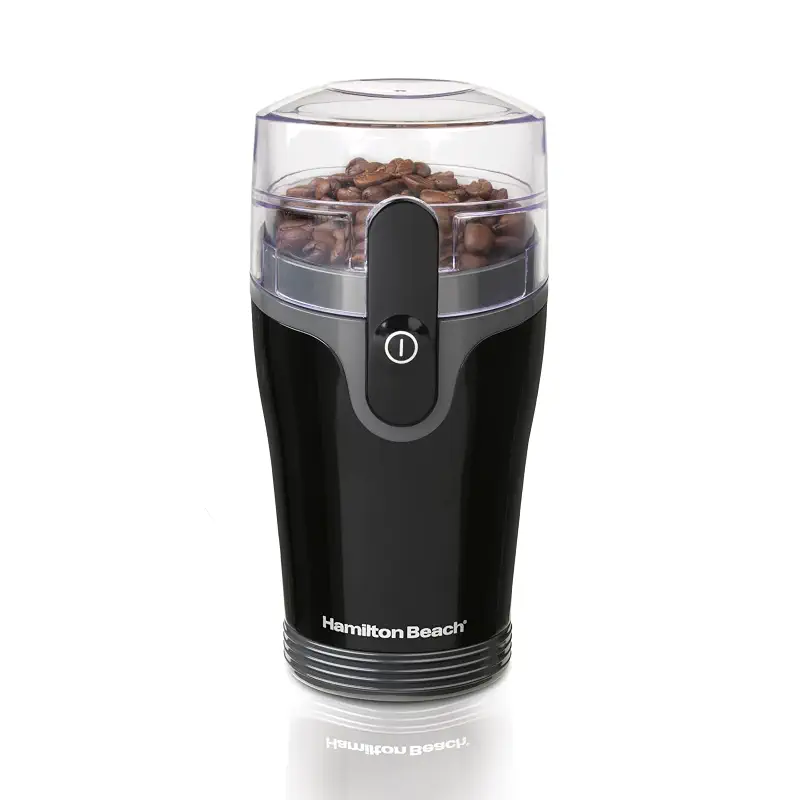
Hamilton Beach
Hamilton Beach Fresh Grind Electric Coffee Grinder For Up To 12 Cups | Grinds Coffee Beans, Spices & More | Stainless Steel Blades | Easy-Clean Removable Chamber | Black | 80335RG
4.5(63,888)
A simple, affordable blade grinder suitable for coarse cold brew grinding, but sacrifice consistency for lower price.
Ideal for: Casual cold brew makers on tight budgets who prioritize simplicity and dishwasher-safe cleanup over grind consistency.
The Hamilton Beach Fresh Grind is the outlier in this lineup: a blade grinder, not a burr grinder. I include it because cold brew's large, forgiving grind means blade inconsistency matters less than it does for espresso, and some budget households genuinely prefer the simplicity and lower cost. The stainless steel blades spin at one speed, so grind fineness is purely a function of pulse duration. For cold brew, a 20–30 second hold produces a coarse, usable particle size, and many owners confirm it works adequately for immersion brewing. The removable grinding bowl is dishwasher-safe, cleanup is trivial, and the footprint is tiny.
The trade-off is real: blade grinders produce inconsistent particle sizes (some fine dust, some chunks) which is fine for cold brew's slow extraction but creates sediment in the cup. The motor is loud (owners compare it to a blender), and holding the button down for 30 seconds is less pleasant than pressing a timer and walking away. Durability is uncertain; one owner reported motor burnout after a year of twice-weekly use, though others have run them for years. For cold brew specifically, the Hamilton Beach is a utilitarian tool, not a precision instrument.
Compared to the Iagreea or Amzchef, this grinder trades the consistent coarse grind cold brew ideally deserves for lower cost and mechanical simplicity. If you're brewing cold brew weekly and care about the final cup, save the extra $30 for a burr model. If you're casual or on a strict budget, the Hamilton Beach handles cold brew adequately.
Pros
Simple pulse operation with no settings to adjust or learn
Removable bowl and lid are dishwasher-safe for effortless cleanup
Compact footprint takes minimal counter space
Low cost makes replacement low-stakes if durability falters
Loud motor and manual pulse operation less convenient than timer-driven burr grinders
Key features
Stainless steel blades with one-speed operation controlled by pulse duration
Removable, dishwasher-safe grinding bowl and lid for simple cleaning
Grinds up to 12 cups of coffee beans plus herbs, spices, and seeds
Compact size with hideaway cord storage beneath the base
Durable stainless steel base and straightforward push-button design
How to Choose a Coffee Grinder for Cold Brew
Burr Type and Consistency Matter Most
Cold brew's long soak demands a uniform, coarse grind: uneven particles mean some coffee over-extracts while finer bits under-extract, muddying the cup. Conical burr grinders (all five top picks use this design) outperform blade grinders because they shear beans at consistent sizes rather than shattering them into random fragments. When evaluating burr versus blade grinders, look for 40mm burr diameter as a baseline; it's a solid middle ground between compact grinders and commercial equipment. The consistency difference is straightforward for cold brew: if you can stretch the budget to even an entry-level burr model, the cold brew result justifies the difference.
Grind Settings: More Isn't Always Necessary
A burr grinder needs enough range to cover espresso-fine through French-press coarse, and for cold brew specifically, you'll live in the coarse end. OXO's 43 settings, Iagreea's 48, and Amzchef's 48 all offer sufficient granularity to dial in the ideal coarse grind once and return to it reliably. Tuni's 70 settings appeal if you're rotating between espresso and cold brew, but the added clicks are a convenience, not a necessity. For pure cold brew focus, three-digit setting counts feel like marketing rather than practical benefit: what matters is how cleanly you can nail that one setting every brew day.
Motor Speed and Heat Preservation
Lower RPM motors (400–450) generate less heat during grinding, which preserves volatile aromatic oils in the beans. This is especially valuable if you're grinding specialty, single-origin cold brew beans where flavor subtlety counts. OXO and Hamilton Beach don't specify RPM but are noted as quiet, suggesting moderate speeds. Iagreea and Tuni explicitly highlight low-speed designs and reviewers confirm less heat. For cold brew, this matters less than for espresso, but if you're investing in quality beans, a cooler grind is worth seeking.
Hopper Size and Static Reduction
Cold brew batches are large: often 12–24 ounces of beans for a week's brewing. The OXO's 12-ounce hopper and Amzchef's 10.6-ounce require two fills for a full batch. Tuni's 250 grams and Iagreea's 300 grams sit in the middle. Anti-static technology (stainless steel burrs and containers) matters if you're grinding fine for espresso, but for cold brew's coarse particles, static cling is minimal. Still, if the grinder ever doubles as an espresso or pour-over tool, anti-static design keeps cleanup pleasant across all methods.
Frequently asked
Why does grind consistency matter more for cold brew than blade grinders?
Cold brew steeps for 12–24 hours in contact with all particles. Inconsistent sizes mean finer grounds over-extract into bitter acidity while larger chunks under-extract, resulting in muddy, unbalanced flavor. Burr grinders produce uniform particle size, so extraction is even across the batch. Blade grinders shatter beans randomly; sediment and sourness result. For espresso, this inconsistency ruins the shot; for cold brew, it just ruins the cup over hours of steeping.
Can I use a coarse grind setting on any burr grinder for cold brew?
Yes, any conical burr grinder listed here reaches coarse settings suitable for cold brew. The OXO, Tuni, Iagreea, and Amzchef all span espresso-fine to French-press coarse, so cold brew's 8–12 setting (on a 1–48 scale, for example) is easily accessible. The Hamilton Beach blade grinder also produces a usable cold brew grind via pulse timing. The difference is repeatability: burr grinders let you dial in day one and grind the same size every week; blade grinders require you to count seconds and hope.
How much coffee should I grind for a batch of cold brew?
Cold brew typically uses a 1-part coffee to 5-part water ratio, though some prefer 1:4 for stronger concentrate. A gallon of cold brew (64 ounces water) calls for roughly 12 ounces of whole beans. All five grinders handle 12 ounces without dramatic refilling except Hamilton Beach, which fits 0.5 ounces per chamber. For weekly cold brew batches, hopper capacity of 10+ ounces saves multiple refill cycles: the OXO (12 oz) and Amzchef (10.6 oz) are most convenient.
Is a burr grinder worth the extra cost over a blade grinder for cold brew?
If you brew cold brew weekly or more, yes: the $30–80 premium is justified by months or years of superior consistency and flavor. Burr grinders produce uniform coarse grinds, reducing sediment and bitterness. Blade grinders require constant timing adjustment and still deliver uneven extraction. If you're cold-brewing occasionally or on a strict budget, the Hamilton Beach works, but cold brew deserves the grind consistency a burr offers.
Do I need a grinder with espresso settings if I only make cold brew?
No. The OXO and Hamilton Beach focus on coarse ranges and both excel at cold brew. Tuni and Amzchef's broader settings (48–70) are useful if you also brew espresso or pour-over, but they add cost and complexity you won't use. If cold brew is your sole method, the OXO's simpler dial and large hopper offer better value than a fully featured espresso grinder.