Kitchen & Dining · Gadgets
Best Ceramic Honing Rod
Weigh grit, reach, angle guides and handle design to match a knife-maintenance tool to your blades and your kitchen habits.
Affiliate disclosure: As an Amazon Associate I earn from qualifying purchases.
At a glance
2
Most DurableGreen Elephant
3
Best for BeginnersWork Sharp
4
Best Fine-Grit PickSharpal
6
Hard-Steel SpecialistDalstrong
Detailed reviews
We'd point anyone who wants a straightforward, fine-finish rod toward the Kimura Ceramic Honing Rod 10 Inch. It is a single piece of white ceramic smoothed to a 1200 grit finish, fine enough to realign a bent edge without grinding away much metal, and the full tang bolstered into the polypropylene handle gives it a sturdy, balanced feel. The hanging loop makes storage easy, a lifetime warranty backs it, and the Japanese gift box turns it into a ready-made present.
Owners report that it handles expensive knives well, tidies up torn or uneven edges on well-worn blades, and is simple to use; the method is to draw the blade down the rod at 15 to 20 degrees, one to three passes per side. A common complaint is cosmetic: the white surface darkens with grey metal residue after heavy use, though a damp sponge with a little baking soda is reported to lift most of it. It is a honing tool, so a blade that is truly dull still needs a stone.
Pros
- Fine 1200 grit realigns edges gently
- Non-slip polypropylene handle with full tang
- Hanging loop and lifetime warranty included
Cons
- Darkens with metal residue needing cleanup
Key features (4)
- Single piece of white ceramic with full tang bolstered into the handle
- Layered ceramic smoothed to a 1200 grit finish
- Ten-inch rod length suited to chef knives of various sizes
- Presentation box with a traditional Japanese Kanji design
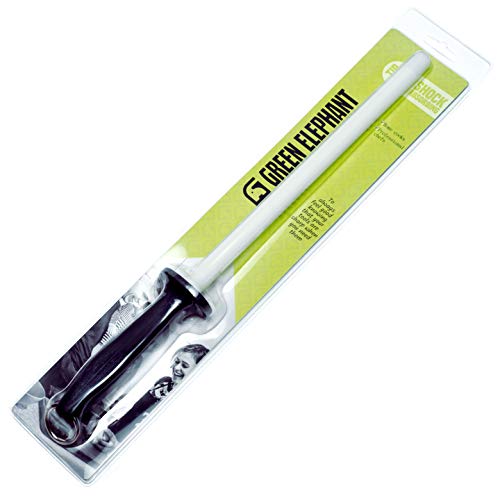
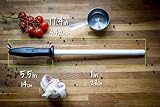
Ceramic's reputation for shattering is what this rod is built to answer. The Green Elephant Ceramic Honing Rod uses ceramic listed at 9 on the Mohs scale and over 100 Rockwell, with a silicone seal between handle and rod and a plastic end cap meant to soak up the shock of a fall. At 1500 grit it is slightly finer than the 1200-grit Kimura Ceramic Honing Rod 10 Inch, so it leans a bit further toward polishing.
Owners report that it keeps knives keen, works better than old steel rods, and copes with hard Japanese and super steels. They describe it as sturdy in the hand rather than a hollow tube, with a diameter that suits both small and large hands, and say it evens the edge from base to tip as an in-between maintenance tool. Expect a slightly toothy edge, which suits cutting raw fish but can be softened with a quick strop if you slice a lot of tomatoes or peppers. Care is simple but not dishwasher-friendly: hand wash with regular detergent and air dry.
Pros
- Silicone seal and end cap absorb shock
- Handles hard Japanese and super steels well
- Fine 1500 grit evens the whole edge
Cons
- Hand wash and air dry only
Key features (4)
- Ceramic rated 9 on the Mohs scale with Rockwell hardness over 100
- Silicone seal between handle and ceramic plus plastic end cap
- Lightweight handle meant for comfortable, safe honing sessions
- Eleven-inch rod long enough for larger blades
Built-in angle guidance is the selling point of the Work Sharp Kitchen Ceramic Honing Rod, and it is why we'd hand it to someone who has never honed before. The guide in the handle gives a repeatable hold on each pass, so you skip the shaky freehand habit of a traditional steel. It is listed for chef, santoku, paring and utility knives, and a hanging hole keeps it within reach.
Owners report that a few light passes bring slicing performance back, that it works on pocket knives as well as kitchen blades, and that the ceramic feels better than a steel rod; the handle is described as solid without being heavy. Expect it to hone, not rescue: it refines an edge that has gone slightly dull, and a really dull blade needs a stone first. A common complaint is the single 20-degree setting. Owners wishing for a shallower hold will find the adjustable-guide Sharpal Ceramic Honing Rod covers 14 to 25 degrees. The ceramic also wants careful storage, since a crowded utensil drawer risks cracks.
Pros
- Built-in 20-degree guide for repeatable passes
- Easy to use for beginners
- Hanging hole for convenient storage
Cons
- Only a fixed 20-degree angle guide
- Needs careful storage to avoid cracking
Key features (4)
- Angle guide molded into the handle for consistent blade position
- Fine ceramic rod that refines and realigns slightly dull edges
- Rubber tip that steadies the rod on a board or bench
- Plastic handle with a hole for hanging
The 3000-grit surface is what sets the fixed-guide Sharpal Ceramic Honing Rod apart, an extra-fine finish meant to polish and refine an edge rather than reshape it. Built-in 20-degree angle guides keep the hold consistent, a hexagonal hand guard stops the rod rolling off the counter, and a removable rubber cap protects surfaces and helps limit chipping if it is dropped. The ceramic is non-toxic, odorless and rust-free, and the brand backs it with after-sale service.
Owners report that it works well as a final touch after regular sharpening, that it suits utility knives and even oddly shaped blades, and that the honing is quick and effortless. The 20-degree reference faces on the handle are a favorite, giving a visual cue for blade position. Cleaning draws two sorts of report: it is described as easy to clean, and a common complaint is that it needs more frequent upkeep.
The sharpeak Ceramic Sharpening Steel shares this rod's 3000-grit surface and 20-degree guides, so the choice between them comes down to size; this one is somewhat shorter overall, while the sharpeak reaches 17.5 inches with its handle.
Pros
- Extra-fine 3000-grit ceramic surface
- Built-in 20-degree angle guides
- Hexagonal guard stops the rod rolling
Cons
- May need more frequent cleaning
Key features (4)
- Fine 3000 grit ceramic that polishes and refines blade edges
- Removable rubber cap that protects counters and limits chipping
- Non-toxic, odorless ceramic that does not rust
- Three-year commitment with after-sale service
This is the adjustable choice. The Sharpal Ceramic Honing Rod with the 14 to 25 degree guide lets you set the hold to the knife in your hand, which matters when shallow-edged Japanese knives and steeper Western ones share a block. Locked to a single 20-degree setting, the Work Sharp Kitchen Ceramic Honing Rod cannot follow suit; this one can.
The rod rotates, so the working surface can be turned to spread wear more evenly and stretch its service life, and the 11.3-inch rod length covers everything from small paring knives to large butcher knives. A removable anti-slip rubber cap steadies the rod and cushions it against chips if it is knocked. It hones and realigns without removing much metal, which suits regular maintenance. It is the guide, not the grit, that makes the case for it.
Pros
- Adjustable angle guide from 14 to 25 degrees
- Rotating rod spreads wear evenly
- Removable anti-slip rubber base
Key features (4)
- Built-in guide that adjusts to suit different knife edge geometries
- Rotatable rod so the whole surface wears evenly
- Eleven-inch ceramic rod for paring through butcher knives
- Rubber cap protecting the rod against chipping when dropped
The Dalstrong 10 Inch Ceramic Honing Rod takes a different route from the solid-ceramic rods here: a high-carbon stainless core finished in a scratch-free black ceramic coating, with a triple-riveted black G10 handle and a bolster that protects your hand. The coating is slightly abrasive and aimed at hard, high-Rockwell steels of the kind found in Japanese cutlery, and a silicone-covered tip anchors it on the counter. Ten inches suits most knives without poking out of a block.
Owners report that it does what it should, feels high quality, and even sharpens rather than only hones. The caution is build: a common complaint is that the handle works loose and that the rod comes apart after limited use.
Buyers who rank longevity first should look at the Green Elephant Ceramic Honing Rod, whose shock-absorbing seal and sturdy build draw positive reports.
Pros
- Black ceramic coating suits hard steels
- Triple-riveted G10 handle with non-slip grip
- Silicone tip anchors the rod while honing
Cons
- Handle reportedly loosens over time
- Reports of coming apart after limited use
Key features (4)
- High-carbon stainless steel core under a scratch-free ceramic coating
- Ten-inch length that fits most knife sizes and blocks
- Bolster that protects the hand along the full rod length
- Military-grade G10 handle resistant to heat, cold and moisture
For a longer reach than the Kimura Ceramic Honing Rod 10 Inch, the sharpeak Ceramic Sharpening Steel offers a 12-inch rod, excluding the handle, for 17.5 inches overall, enough for cleavers and large butchering knives as well as small chef knives. Its 3000-grit ceramic polishes the edge, built-in 20-degree guides keep the angle steady, and a hexagonal guard keeps the rod from rolling. The ceramic is non-toxic, odorless and never rusts, and a three-year warranty comes with it.
Owners report that it hones kitchen blades in just a few passes, keeps edges sharp between stone sessions, and suits Japanese knives especially well; the 20-degree guide is described as accurate for European knives. Its hard surface removes a little metal, so it behaves more like a light sharpener than a pure honing steel. Owners also report that it holds up well with extended use, though it can take on color from a carbon blade.
Pros
- 12-inch rod handles large knives
- 3000-grit surface refines a razor edge
- Three-year warranty and removable rubber cap
Cons
- Can pick up color from carbon blades
Key features (4)
- Twelve-inch rod length with 17.5 inches overall including the handle
- Built-in 20-degree angle guides on the handle faces
- Hexagonal hand guard that prevents rolling and protects fingers
- Removable rubber cap that shields surfaces and reduces chipping
Side by side
| Pick | Item weight | Grit |
|---|
#1 Best Overall
Kimura | 0.18 pounds | 1200 Grit |
#2 Most Durable
Green Elephant | 0.45 pounds | Grit #1500 |
#3 Best for Beginners
Work Sharp | 1 pounds | — |
#4 Best Fine-Grit Pick
Sharpal | 0.5 pounds | 3000 Grit |
#5 Most Adjustable
Sharpal | 0.53 pounds | — |
#6 Hard-Steel Specialist
Dalstrong | 1 pounds | — |
#7 Longest Reach
sharpeak | 0.5 pounds | 3000-Grit |
How to Choose a Ceramic Honing Rod
Does a ceramic rod sharpen, or only hone?
Honing straightens an edge that has bent out of line with use; sharpening grinds metal away to make a new one. A ceramic rod sits closer to the honing end, though its hard surface does take off a trace of metal, which is why owners of the sharpeak Ceramic Sharpening Steel describe it as part honing rod, part light sharpener. Expect it to revive a knife that has lost its bite, not to rescue a very dull or chipped blade; that job belongs to a stone.
Ceramic is harder than steel, so it can work on tough knife steels that a plain steel rod barely touches, and it does not rust. These rods are aimed at steel kitchen knives, so if your blades are ceramic, see the ceramic knife picks instead.
How fine a grit do you want?
Grit describes how coarse the surface is, and a rod used between sharpenings should be fine. Surfaces around 1200 to 1500 grit realign and lightly polish, while 3000 grit leaves a more refined, polished edge. Coarser surfaces bite harder and suit damaged edges, which is a different job from routine upkeep.
The Kimura Ceramic Honing Rod 10 Inch (1200) and the Green Elephant Ceramic Honing Rod (1500) sit in the middle of that range, and the sharpeak Ceramic Sharpening Steel is the pick for the finest finish. Not every rod here lists a grit, so match the finish you want to the ones that do.
How long should the rod be?
Choose a rod at least as long as your longest blade so the whole edge travels along it in one stroke. A length between 10 and 12 inches suits most kitchen knives; longer rods are easier to use but harder to store, while short ones fit tight drawers.
The sharpeak Ceramic Sharpening Steel, with a 12-inch rod, is the one for cleavers and large butchering knives. For compact storage, the Kimura Ceramic Honing Rod 10 Inch has a hanging loop. Whatever the length, look for a non-slip handle and a guard so a slip does not reach your fingers.
Do built-in angle guides help?
Guides take the guesswork out of holding the blade at the right angle, and consistency matters more than speed. Western knives usually sit around 20 degrees, while Japanese knives are often shallower, near 15, so a fixed 20-degree guide fits some blades better than others.
For a first rod, the Work Sharp Kitchen Ceramic Honing Rod makes the hold easy to repeat. If your block mixes edge angles, the adjustable-guide Sharpal Ceramic Honing Rod, which spans 14 to 25 degrees, settles the problem.
How fragile is ceramic, and how do you care for it?
Ceramic can chip or break if it is dropped, so rubber caps, silicone seals and careful storage matter. The Green Elephant Ceramic Honing Rod is built around shock absorption for that reason. If you want a rod that shrugs off drops outright, the best honing steel is a better place to look than any ceramic option.
Wash a ceramic rod by hand with mild detergent and let it air dry. Grey metal residue builds up with use, and a damp sponge with a little baking soda lifts it, so the surface stays effective instead of clogging.
Our picks at a glance
2
Most DurableGreen Elephant
3
Best for BeginnersWork Sharp
4
Best Fine-Grit PickSharpal
6
Hard-Steel SpecialistDalstrong
Frequently asked
How often should I hone with a ceramic rod?
A few light passes every couple of uses keeps an edge aligned, and once a week is plenty for a cook who uses knives often. Regular touch-ups mean the proper sharpening on a stone is needed far less often.
Can a ceramic rod fix a chipped or very dull blade?
No. A ceramic rod realigns and lightly refines an edge, but it cannot repair chips or rebuild a blunt edge. Those jobs need a sharpening stone or a professional service, after which a rod such as the Kimura Ceramic Honing Rod 10 Inch keeps the result fresh.
Which rod suits Japanese knives?
Hard Japanese steels pair well with a harder ceramic surface. The Green Elephant Ceramic Honing Rod is reported to work well on hard steels, and the sharpeak Ceramic Sharpening Steel is reported to suit Japanese knives particularly well. Because Japanese edges are often shallower than Western ones, an adjustable guide helps too.
Is ceramic or diamond better for a honing rod?
Ceramic is the gentler choice for routine maintenance, because it removes little metal. Diamond works faster and also sharpens, but it is more aggressive and best left to experienced users. For everyday upkeep, a ceramic pick such as the Work Sharp Kitchen Ceramic Honing Rod is the easier route.