Kitchen & Dining · Espresso
Best Brewing Kettle for Home Beer & Coffee Brewing
Find the best brewing kettle for your needs. Compare stainless steel brew pots with thermometers, ball valves, and filtration systems for beer and coffee brewing.
Affiliate disclosure: As an Amazon Associate I earn from qualifying purchases.
At a glance
2
Best for Scaling UpGas One
3
Best for Easy CleaningConcord Cookware
4
Best for Larger BatchesBrewsie
5
Best All-in-One SystemVevor
Detailed reviews
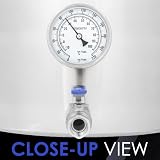
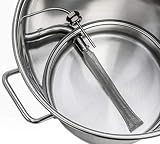
This 5-gallon kettle hits a sweet spot for home brewers moving beyond beginner kits. The stainless steel construction is solid: owners report it heats evenly on propane and induction burners alike, and the tri-ply bottom resists scorching. The dual-filtration setup (mesh tube and filter tray) pulls out grain and hop debris in one step, saving the cleanup work you'd otherwise do by hand or cheesecloth. The thermometer feels precise once you account for the fact that temperatures in a large pot vary by zone; stir occasionally and you'll get reliable readings within a few degrees.
What holds some buyers back is assembly detail. The ball valve arrives packed with automotive grease, which taints your first few batches if you don't disassemble and soak it in isopropyl alcohol beforehand. A handful of users also report stripped bolts on arrival, though most find the pot solid once assembled. The thermometer isn't perfectly calibrated across its full range (a few degrees off at one end), but it's adjustable. If you're comparing this to the Gas One 10-gallon, you're trading volume for a more manageable pot that's easier to stir and fits standard stovetop heights.
For a brewer doing 5-gallon all-grain batches or testing recipes before scaling up, this pot punches well above its cost. The false bottom and valve work reliably after cleaning, and the handle design keeps your hands clear of splashes.
Pros
- Dual filtration system reduces prep and cleanup
- Heats evenly on propane and induction cooktops
- Manageable 5-gallon size and weight for stirring
Cons
- Valve packed with automotive grease requiring disassembly before use
- Thermometer calibration varies across temperature range
Key features (4)
- 5-gallon capacity with tri-ply aluminum bottom for even heat distribution
- Dual-filtration design (mesh tube and filter tray) eliminates manual straining
- Stainless steel construction with exposed thermometer readable without opening lid
- Ball valve with ultra-tight seal and waterproof adhesive tape for leak prevention
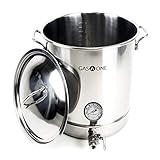
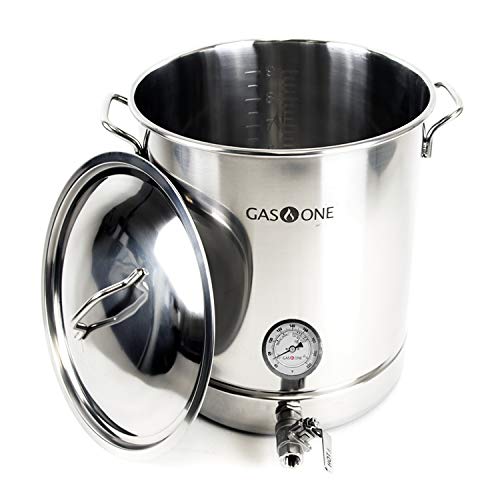
The Gas One 10-gallon is the volume pick for serious home brewers. At roughly double the capacity of starter kettles, it lets you brew 5-gallon batches with more headroom for grain absorption and boil-off, or handle 10-gallon all-grain recipes without stress. The tri-ply bottom distributes heat fast and evenly: owners on propane burners report it comes to boil quickly without scorching. Scale markings etched inside the pot are genuinely useful for measuring strike water, mash volumes, and final wort volume without hunting for a separate graduated pitcher.
The valve assembly requires a specific trick on arrival: the threaded coupler ships inside the valve itself, and you must extract and reverse-thread it if the handle points the wrong way. Once you understand this (and the detailed assembly video in reviews makes it clear), installation takes 15 minutes. The silicone O-rings are soft, so some users report the kettle wall flexes slightly when opening or closing the valve under pressure: a metal nipple on the discharge side transfers that stress safely. The thin sidewalls mean the pot is light, but they also mean slow heating on a low burner is wise to avoid cracks from thermal shock.
Compared to the Concord 7.5-gallon model, this Gas One trades slightly more volume for a marginally thinner wall and a lower entry price. If you're committed to stepping up from 5-gallon batches and have a decent heat source, the Gas One scales reliably.
Pros
- Scale markings inside pot track water, mash, and wort volumes
- Tri-ply bottom heats fast and evenly on propane and induction
- Welded handles rated for full-weight lifting
Cons
- Thin sidewalls require gentle heating to avoid thermal stress cracking
- Valve assembly involves reversed threading; instructions lack clarity
Key features (4)
- 10-gallon capacity with internal scale markings for volume tracking
- Tri-ply aluminum bottom for fast, even heat distribution
- Stainless steel thermometer and ball valve spigot with sealing tape included
- Ergonomic welded handles rated for handling full kettle weight
Concord's weldless design is the standout feature here. Every connection (valve, thermometer, inlet) uses stainless couplers with silicone gaskets that you can unscrew and pull apart for a thorough scrub. After a brew day, you're not stuck scrubbing sticky grain residue out of tight corners; you disassemble, soak, and reassemble in minutes. The 7.5-gallon volume sits between the 5-gallon and 10-gallon tier, making it a practical size for 5-gallon batches with margin for foam and absorption without overshooting into bulky 10-gallon territory.
The assembly learning curve is real. Getting the silicone gaskets to seal without tape squirting them out sideways takes practice and proper torque: too loose and you leak, too tight and you damage the gasket. Owners who've solved it suggest using PTFE washers instead of the standard ones, or a thin bead of RTV silicone to hold the washer in place. Once sealed, the pot holds temperature and doesn't leak. The thermometer probe is 2.75 inches deep, which is fine for measuring strike water but can snag a brew-in-a-bag if you're not careful. No internal volume markings, so you'll want to etch your own or keep a separate measure on hand.
If you plan to modify your kettle (add a sight gauge, swap in a different heating element, or run it through frequent boil cycles), the weldless approach gives you flexibility the Gas One doesn't. Where the best turkish coffee maker offers convenience through design, this kettle offers control through modularity.
Pros
- Fully weldless fittings allow complete disassembly for thorough cleaning
- Commercial-grade stainless steel with polished finish resists corrosion
- 7.5-gallon size balances capacity and manageability
Cons
- Silicone gasket assembly requires proper torque and learning curve to seal
- No internal volume markings; must measure separately or mark yourself
Key features (4)
- Fully weldless construction with stainless couplers and silicone gaskets for easy disassembly
- Commercial-grade 304 stainless steel, fully polished for durable, corrosion-resistant finish
- 7.5-gallon capacity with hangable lid and firmly riveted handles
- Includes ball valve, thermometer, and all fasteners; assembly takes under 10 minutes
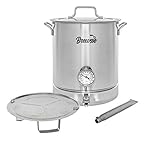
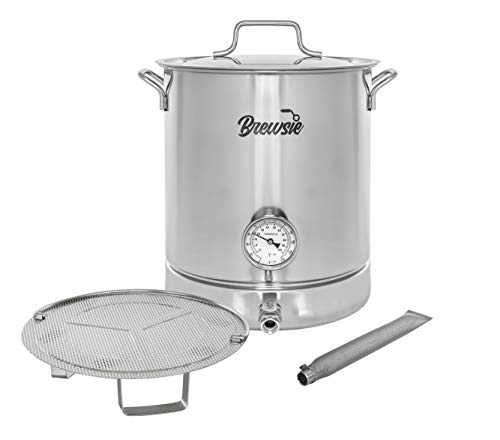
The Brewsie 16-gallon is built for brewers who've committed to 10-gallon batches or want a hot liquor tank (HLT) to complement a smaller mash kettle. The false bottom sits on a rolled bead 3 inches from the pot floor, and the bazooka screen nests inside to catch grain and hop solids. Volume is marked in one-gallon intervals stamped before the bead was formed, so the markings above the bead read slightly shallow: account for that when measuring.
Owners consistently report needing to clean the kettle thoroughly before first use. It arrives with polishing compound residue on all surfaces and machine oil packed inside the ball valve; a few hours with degreaser, dish detergent, and isopropyl alcohol removes both. The bazooka screen works during mash, but when sparging or boiling with it in place, it jams with hop matter; most users switch to a stainless-steel hop spider for clarity. The thermometer probe sits in the center, which is convenient for measuring strike water but can snag a brew bag during grain removal.
The welds on the handles are described as "fair" rather than robust, and a few owners report handle concerns under full weight; for a 16-gallon pot, consider using a brew belt or racking into smaller vessels rather than lifting by handles alone. Unlike the Concord weldless design, these fittings are permanently soldered (or in this case, pressed and sealed), so you can't disassemble for a full clean without risking leaks. If you're scaling from smaller batches and need the volume, this pot delivers solid performance at a price well below commercial-grade alternatives.
Pros
- False bottom and bazooka screen included for integrated grain filtration
- 16-gallon volume with gallon markers for recipe scaling
- Tri-ply bottom and induction-compatible construction
Cons
- Arrives with polishing compound and machine oil; requires thorough cleaning
- Bazooka screen jams with hops; most users switch to external hop spider
Key features (4)
- 16-gallon capacity with false bottom seated on rolled bead 3 inches from pot floor
- Dual filtration: bazooka screen and false bottom for grain and solids separation
- Gallon-marked volume indicators for recipe measurement and brew process tracking
- Stainless steel construction with polished finish, induction-compatible tri-ply bottom
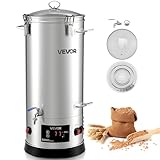
The Vevor electric kettle reimagines what a brew pot can do. Instead of a passive vessel, you get a 1500-watt heating element wired to an electronic control panel that heats to temperature, holds it during the mash step, then maintains the boil. The pump circulates wort throughout mashing for even extraction. Dual screens keep grain confined, and a hops screen prevents particulate in the finished wort. A cooling coil integrated into the design lets you run garden-hose water through it and drop 212°F wort to 70°F in 20 minutes: the fastest chill in this lineup.
This is the only electric kettle here, which makes it fundamentally different. You don't need a dedicated high-BTU propane burner or stovetop real estate; plug it into a 15–20 amp household circuit and brew. The learning curve is minimal: fill, set temperature, press start. For beginners or apartment brewers, that's transformative. The catch: you'll need to buy silicone tubing (3/8-inch ID) and a garden-hose barb adapter separately to connect the cooling coil and drain. Amazon has both, but they're not included.
Owners report the 8-gallon capacity reliably produces 5–6 gallon batches after boil-off, making it a true stepping stone from homebrew starter kits to all-grain brewing without oversizing into unwieldy 10–16-gallon territory. The power draw is substantial (up to 1800 watts), so circuit planning matters; a shared garage outlet might trip if a light or fan is on the same line. Compared to passive kettles in this lineup, you're paying for automation and speed, not just size: a meaningful trade for brewers who value consistency and want to reclaim garage burner space.
Pros
- Electronic temperature control maintains mash and boil precisely
- Integrated pump circulates wort; cooling coil chills to 70°F in 20 minutes
- Compact footprint fits kitchens, garages, and basements
Cons
- Requires 15–20 amp dedicated circuit; shared outlets risk tripping breaker
- Silicone tubing and garden-hose adapter sold separately, not included
Key features (4)
- 8-gallon capacity with 1500-watt electric heating element and electronic temperature control
- Integrated mash pump, dual grain screens, and hops filter for complete all-grain brewing
- Cooling coil with garden-hose connection for rapid wort chilling
- 304 stainless steel body with 0.5 mm walls, glass lid for visibility
How to Choose a Brewing Kettle
Capacity: Match Your Batch Size
A brewing kettle capacity guide shows why gallon size matters more than it seems. If you're doing 5-gallon all-grain batches, a 5–7.5 gallon kettle gives you just enough headroom for grain absorption and boil-off without leaving you staring at a towering 16-gallon pot. Jump to 10–16 gallons only if you're ready for 10-gallon batches or running multiple systems. Too much capacity means slow heating and wasted energy; too little means spill-over and stress.
Heat Source and Power
Most kettles here work on stovetop or propane burners, but the Vevor electric model rewrites the rules. If your garage or basement lacks a high-BTU burner and you don't want to buy one, electric heating eliminates that bottleneck. Stovetop kettles need a flat, heavy bottom (tri-ply aluminum) to make good contact and heat evenly. Check the wattage if you choose electric; 1500–1800 watts demands a dedicated 15–20 amp circuit, not a shared outlet.
Filtration and Assembly
Passive kettles (Gas One, Vevor 5-gal, Concord, Brewsie) come with a ball valve, thermometer, and either welded or weldless fittings. Weldless designs (Concord) disassemble fully for deep cleaning but require patience to seal gaskets properly. Welded designs (Gas One, Brewsie) are faster to assemble but trap debris in crevices. The Vevor electric unit includes a pump and screen, so filtration is active during brewing rather than passive after.
Budget and Longevity
A brew kettle setup guide clarifies the trade-off: budget models ($200–$400) use thinner steel and simpler welds but heat adequately and last years with care. Premium kettles cost $500+ and offer thicker walls and tighter tolerances. Most home brewers find mid-range kettles (Gas One, Concord, Brewsie) offer the best durability-to-cost ratio. Expect to spend $50–$150 on modifying or fixing fittings, so factor that into your initial budget.
Our picks at a glance
2
Best for Scaling UpGas One
3
Best for Easy CleaningConcord Cookware
4
Best for Larger BatchesBrewsie
5
Best All-in-One SystemVevor
Frequently asked
Do I need a thermometer in my brewing kettle?
Yes. Mashing grains requires holding a specific temperature (usually 150–158°F) for 60 minutes. Without a thermometer, you're guessing and risking under- or over-extraction. Most kettles in this lineup include one; if yours doesn't, an external dial or digital thermometer costs $20–$50 and pays for itself in better beer.
What's the difference between welded and weldless fittings?
Welded fittings (Gas One, Brewsie) are permanently attached and sealed at the factory; they're faster to assemble but you can't easily take them apart for cleaning. Weldless fittings (Concord) use stainless couplers and silicone gaskets you can unscrew; they're modular and ideal for modifications, but require care to seal without leaking. Choose welded if simplicity matters; choose weldless if you plan frequent teardowns or upgrades.
Can I use a brewing kettle on an induction cooktop?
Yes, if the bottom is magnetic. All the kettles here have tri-ply bottoms with aluminum cores sandwiched between stainless layers; as long as the outer layer is ferromagnetic stainless, a magnet sticks and induction works. Test with a magnet before buying if you're uncertain. Induction heats faster and more evenly than gas, but the thin sidewalls on budget kettles can crack under thermal stress, so avoid rapid temperature swings.
How do I prevent leaks at the ball valve and thermometer?
Most leaks come from under-tightening or using poor-quality thread tape. Wrap 3–5 layers of plumber's thread seal tape (PTFE) around all threaded connections before assembly. Tighten firmly but not aggressively; over-tightening crushes silicone gaskets. If leaks persist, disassemble, dry the threads completely, re-tape, and reassemble. Some owners use RTV silicone or PTFE washers for permanent seals if they don't plan to disassemble.
What size brewing kettle should I buy if I'm a beginner?
Start with a 5–7.5 gallon kettle if you're doing 2.5–5 gallon batches. A 10-gallon feels overwhelming and takes longer to manage your first time. Once you've completed three to five brew days and understand your process, scaling to 10–16 gallons makes sense. Brewers who rush to oversized pots often find them awkward and energy-intensive for small batches.