Verdict, analysis, and key features for each pick.
#1 Pick
Best Overall
Akia Collection
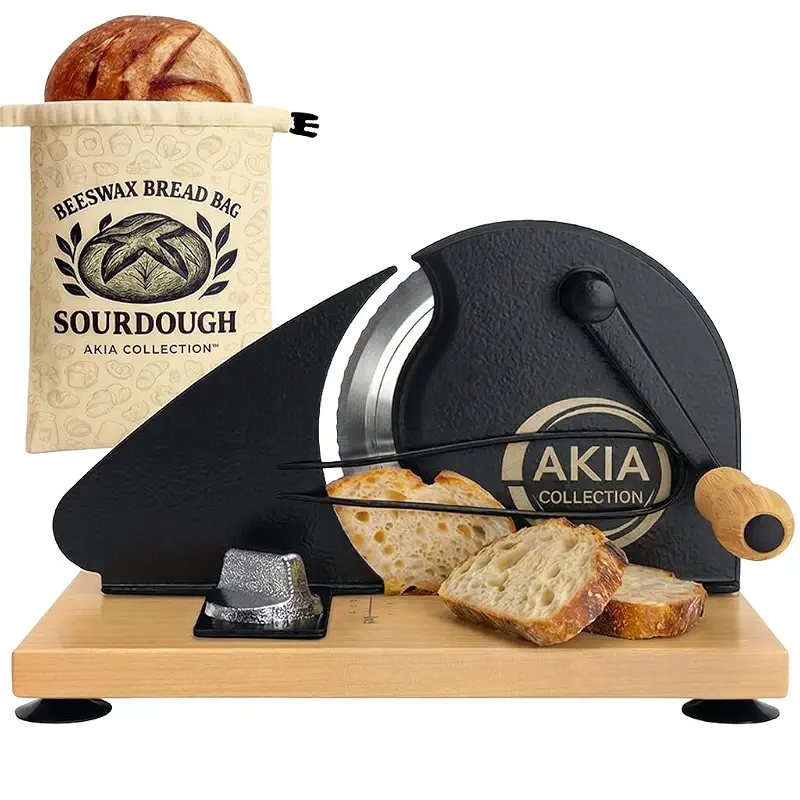
Manual Bread Slicer for Homemade Bread, Sourdough, Adjustable Thickness | beeswax storage bag included, Stainless steel blade, suction cup base, even slices up to 0.8 in, handles large round loaves
4.9(25)
Premium hand-crank slicer that handles crusty boules and soft loaves with equal ease, backed by near-universal 5-star owner enthusiasm.
Ideal for: Frequent home bakers and sourdough enthusiasts who want hassle-free, consistent results.
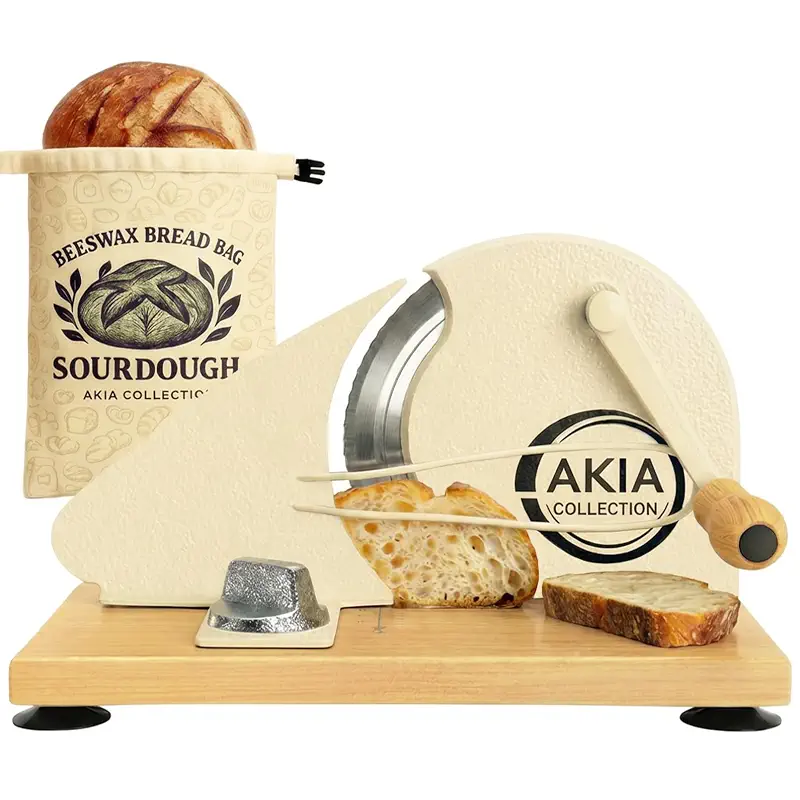
This is the slicer serious home bakers reach for when they're tired of wrestling with knives. The hand-crank mechanism gives you full control over cutting speed, the stainless steel blade stays sharp through daily use, and the suction-cup base grips your countertop firmly enough that you can slice one-handed without the whole unit shifting. Owners consistently praise the smooth, quiet operation and how it delivers bakery-style slices from dense sourdough boules without crushing the crumb. The included beeswax bread bag is a thoughtful touch for plastic-free storage, and the guide rail keeps slices moving cleanly away from the handle.
The main trade-off is counter space and the fact that it takes up more room than a good bread knife. There's also a learning curve to feeding the loaf and turning the crank in sync, though most users report getting the rhythm down by the second or third slice. Where the Syokami cutting board set (which we cover below) relies on your hand and knife skill, this machine does the heavy lifting for you.
This slicer shines for anyone baking multiple loaves per week or who has hand fatigue from manual cutting. The enameled steel construction feels built to last, and the maintenance is minimal: just a damp cloth and the included brush to clear crumbs.
Pros
Smooth, quiet hand-crank mechanism
Slices thick sourdough rounds without crushing
Strong suction-cup base stays firmly planted
Cons
Larger footprint requires dedicated counter or storage space
Learning curve to coordinate crank speed with bread feed
Key features
Adjustable thickness from 0.3 to 0.8 inches for all loaf types
Stainless steel blade resists rust and maintains edge between uses
Hand-crank operation with no electricity required for quiet, controlled cuts
Suction-cup base grips formica, granite, and laminate countertops securely
Ideal for: Home bakers who value design, want a dual-purpose board, and don't mind some hand technique in slicing.
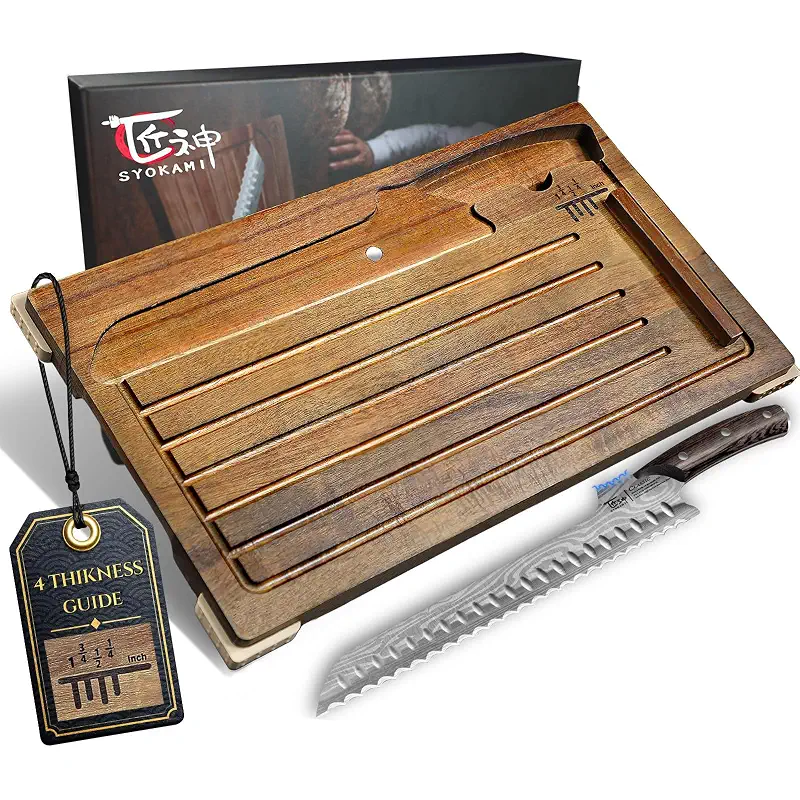
This set trades mechanical precision for design and versatility. The acacia board is genuinely beautiful: the wood grain and warm tones look intentional on any countertop, not like a gadget you're hiding away. The 10.5-inch serrated knife is sharp enough to slice through crusty baguettes and soft sandwich loaves without much pressure, and the magnetic slot keeps the blade secure and always visible. Four thickness markings (1/4", 1/2", 3/4", 1") guide your cuts without dictating every slice the way a machine would.
Unlike manual slicers, this board stores flat against a wall or in a cabinet with minimal footprint. Owners appreciate the reversible design: one side has a crumb groove for cutting, the flip side is flat for serving cheese, charcuterie, or fruit. The silicone feet protect your counter and raise the board slightly to let wood breathe and avoid moisture damage. The serrated knife itself is a faux damascus (etched details, not folded steel), so while it looks elegant, it's not a high-end chef's knife, but it cuts bread consistently well.
The trade-off compared to the Akia manual slicer is that your hand still controls thickness, so you need decent knife technique for truly uniform slices. This board is better for occasional bakers or kitchens where counter space is at a premium. Owners do recommend oiling the acacia a few times after purchase to protect the grain from moisture.
Pros
Reversible board for cutting and serving without extra items
Beautiful natural acacia wood that complements any kitchen
Flat storage saves counter and cabinet space
Cons
Requires good knife technique for perfectly even slices
Acacia wood needs occasional oiling to prevent drying and cracking
Key features
16 by 9 inch acacia wood board with crumb-catching groove on one side
10.5 inch serrated bread knife with wenge wood offset handle
Four thickness guide marks (1/4", 1/2", 3/4", 1") etched into board
Magnetic slot keeps knife secure and attached between uses
#3 Pick
Best Budget Manual Slicer
Akia Collection
Manual Bread Slicer for Homemade Bread, Sourdough, Adjustable Thickness | beeswax storage bag included, Stainless steel blade, suction cup base, even slices up to 0.8 in, handles large round loaves
4.4(126)
Capable hand-crank slicer that delivers even, tear-free slices on a tighter budget than premium models.
Ideal for: Regular bread bakers seeking consistent results and willing to accept moderate counter footprint.
This is an earlier-generation Akia slicer that still commands strong ratings from owners despite serving a broader audience (126 reviews versus 25 for the newest model above). The core mechanism is identical to the top pick: stainless steel blade, adjustable thickness up to 0.8 inches, suction-cup base, and hand-crank operation. Owners report it works just as well for dense sourdough, bagels, and soft breads. One recurring theme is relief: buyers who've struggled with inconsistent knife cuts or hand fatigue find this slicer saves both time and frustration.
The differences between this and the newer version are subtle but worth noting. Buyers mention the older model made a creaky, grinding sound during operation (which newer iterations have reportedly smoothed out), and some users received units with cracks in shipment (a manufacturing or shipping variation, not a design flaw). A handful of owners wished for a blade guard to prevent accidental cuts when the slicer sits on the counter. Despite these minor notes, the consistency of positive feedback suggests this slicer is genuinely reliable for daily use.
Compared to the Syokami knife set, this removes hand fatigue and variability from the equation entirely. It occupies more counter space, but if your kitchen already has room, the trade-off is worth it for repeatability. This is the smart choice if you bake weekly and want a proven mechanical solution without paying top-tier pricing.
Pros
Adjustable slice thickness from thin to thick without guesswork
Smooth crank action that feels controlled and stable
Works equally well on crusty artisan and soft sandwich loaves
Cons
Earlier models reported creaky crank noise during operation
No integrated blade guard, leaving sharp edge exposed on counter
Key features
Hand-crank mechanism with stainless steel blade up to 0.8 inch thickness
Suction-cup base anchors firmly to formica and granite countertops
Includes beeswax bread storage bag and cleaning brush for maintenance
Handles round boules, batards, and pan loaves without crushing crumb
#4 Pick
Best Premium Bread Knife
Syokami
SYOKAMI 2026 Upgrade Bread Knife for Homemade Bread, World's 1st Bow-Design | Razor-Sharp Bread Slicer for Crusty Sourdough & Baguette, 4 Thickness Scale Marks Cutter, Offset Handle, Ideal for Gift
4.3(690)
Professional-grade serrated knife with precision scale markings and stainless steel frame that cuts like a surgical instrument.
Ideal for: Experienced knife users and dedicated bakers who prioritize cutting quality and don't mind a steep learning curve.
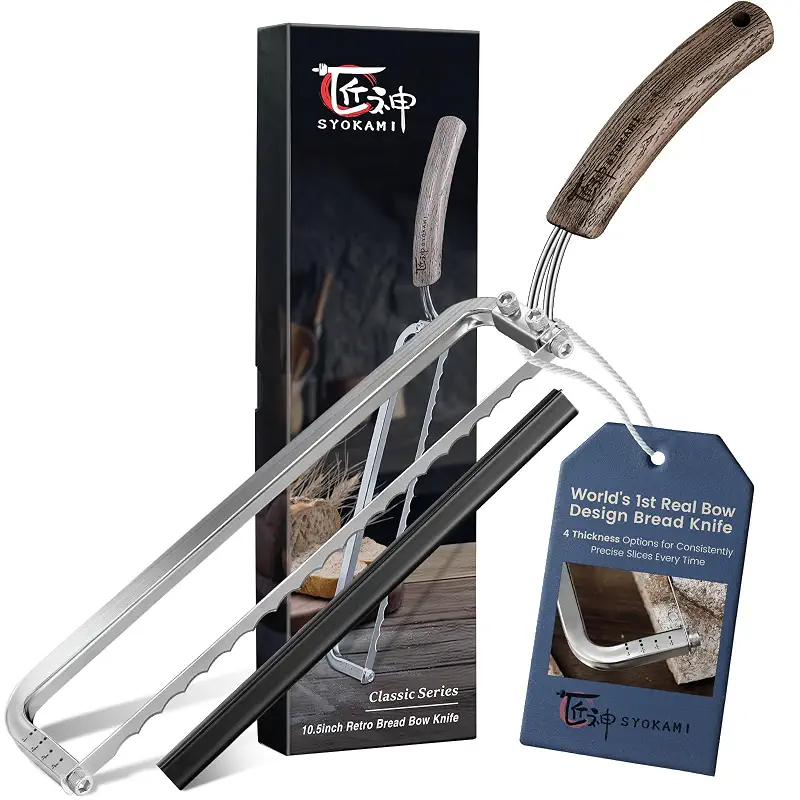
This is where knife enthusiasts and serious bakers find a tool that goes beyond basic slicing. The 420J2 stainless steel blade (used in surgical cutlery) holds a razor edge and slices through thick crusts without crushing the soft interior or scattering crumbs across your board. The unique bow-design frame includes four scale markings (1/4", 1/2", 3/4", 1") that guide your hand to uniform thickness, and the blade extends 0.5mm below the frame so you can finish cuts cleanly all the way to the bottom, something cheaper bread knives struggle with.
The offset handle keeps your knuckles clear of the cutting surface, and the blade stays tightly tensioned without wobble. Owners emphasize the sharpness: multiple reviewers mention it requires respect and has drawn blood through careless handling (it comes with a protective cover and mounting option for good reason). You can resharpen it with standard household rods thanks to the engineered serrations, though this is a knife that arrives sharp and likely won't need touching up for months of regular use. The stainless steel frame is food-safe and won't chip like painted wood.
The trade-off versus manual slicers is that you're back to hand technique. This knife won't suit someone with arthritis or hand fatigue, and it demands a steady hand to hit your chosen thickness consistently. Where the Syokami board set is decorative and versatile, this knife is purpose-built for bread. It's also more expensive than a typical bread knife, but owners who bake regularly say the cutting experience justifies the investment.
Scale markings guide hand to uniform slice thickness
Offset handle and frame design enables clean bottom-to-top cuts
Cons
Extremely sharp blade requires careful handling and storage discipline
Hand technique still matters; uniform slices depend on your skill
Key features
420J2 stainless steel blade with engineered serrations for easy resharpening
Stainless steel bow frame with four thickness scale marks etched on
Blade extends 0.5mm below frame for complete cuts without rocking
Protective cover included and wall-mountable to prevent accidental contact
#5 Pick
Best Compact & Budget Option
Kiss Core
Kiss Core New Upgrade Bread Slicer for Homemade Bread with Adjustable Width | Bread Slicing Guide Foldable and Compact Cutting Guide with Crumb Tray Suitability for Homemade Bread Bagel Cakes
4.2(2,617)
Lightweight plastic guide slicer with foldable design and crumb tray that fits small kitchens and light baking schedules.
Ideal for: Casual home bakers with limited storage space and smaller loaves.
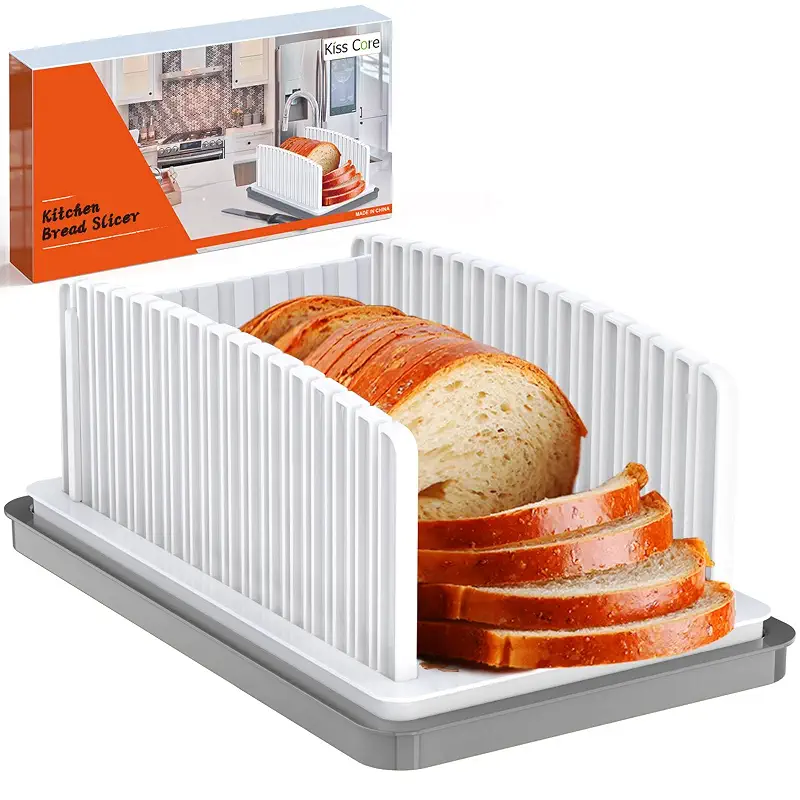
This slicer targets a different kitchen than the mechanical hand-crank models. It's a plastic frame with adjustable width slots that guide your bread knife straight down, plus a crumb-catching tray underneath. You provide the knife and the hand pressure; the slicer just ensures your blade stays vertical and your loaf doesn't shift during cutting. Six different width positions accommodate everything from baguettes to tall machine-made loaves, and the whole frame disassembles and folds flat for drawer storage.
Owners with smaller loaves and regular knife skills report good results. The crumb tray is genuinely useful for keeping countertops clean, and the adjustable width is handy if you bake different sizes. However, feedback reveals meaningful limitations: the guide only holds shorter loaves snugly; tall round sourdough boules can tower above the guides and require cutting by feel after the first third of the loaf. Some buyers complain the plastic feels flimsy compared to manual slicers, and a few noted knife marks in the plastic bottom after use with sharper blades. The design also means you're doing all the work: there's no mechanical advantage like a hand crank.
This is honest competition for the Syokami acacia board if your kitchen has minimal storage and you bake occasionally. Just as a best tomato dicer simplifies produce prep and guides your cuts to consistent sizes, this guide works fine for rectangular sandwich breads and lighter tasks. Where manual slicers handle dense round loaves better, this version saves space and affords true flexibility. The trade-off is sturdiness and hand fatigue versus compact footprint and affordability.
Pros
Folds flat for easy storage in drawers or small cabinets
Crumb tray catches debris without cluttering the counter
Six width adjustments fit different loaf shapes and sizes
Cons
Guide height inadequate for tall round boules and large artisan loaves
Plastic construction feels lighter and less durable than wood or metal
Key features
Adjustable width slots to guide knife for 6 different loaf sizes
Crumb-catching tray underneath keeps counter clean during cutting
Foldable and disassembles flat for compact pantry storage
Food-grade plastic throughout with non-slip rubber feet
How to Choose a Bread Slicer
Four trade-offs that actually matter when matching a bread slicer guide to your kitchen.
Mechanical vs. Hand-Guided Tools
The core split is between manual slicers that do the work for you (hand-crank machines with fixed blades) and guides that rely on your knife skill and hand steadiness. Manual slicers eliminate variables: every slice comes out the same thickness if you crank at a consistent pace. Guides and knives put control in your hands, which means more uniform results if you have good technique, but also more fatigue on baking days. If hand arthritis or repetitive strain is a concern, a mechanical slicer is worth the counter space. For kitchens where minimalism matters, a quality knife or board guide does the job with setup and cleanup taking seconds.
Loaf Size and Shape Matter
Round boules and tall sandwich loaves require different slicer heights and widths. Manual slicers handle crusty rounds beautifully because the blade does the cutting work; your job is just feeding the loaf straight. Bread knives and guide boards work best with rectangular pan loaves where the knife can slice lengthwise without awkward angles. If you bake mostly round artisan loaves, a mechanical slicer pays for itself in fewer torn crusts and consistent presentation. If you're a sandwich-bread baker, a good knife or guide board is plenty.
Storage and Counter Real Estate
Manual slicers are permanent residents: they're too heavy and awkward to stash and pull out. If your kitchen is tight, this is a serious drawback. Bread knives hang or sit in a block. Guide boards fold flat or lean against the wall. If you have counter space and bake weekly, a mechanical slicer's footprint is an investment in consistency. If you're working in a small kitchen or baking occasionally, a compact guide or knife keeps things nimble. Many bakers solve this by keeping a manual slicer in a cabinet and accepting the setup time, but that defeats some of the convenience.
Maintenance and Edge Retention
Stainless steel blades hold an edge longer than carbon steel but are harder to sharpen at home. Most quality bread knives and slicers come ready to use and need little maintenance beyond wiping and an occasional honing. Manual slicers are low-touch: rinse the blade, clear crumbs with a brush. Wood boards need occasional oiling to prevent drying and cracking, especially if you wash by hand. Acacia and other hardwoods resist bacteria and moisture better than bamboo, but they do require care. Factor in whether you want a tool that's truly set-and-forget or one that benefits from seasonal TLC.
Manual slicers versus bread knives
When choosing between these two categories, consider your baking frequency and physical comfort. Manual slicers remove operator variability entirely: you get consistent thickness regardless of technique. Bread knives offer more versatility (they slice fruit, cheese, and cakes too) and take up minimal storage. If hand fatigue is real or you value ease of use over equipment cost, go mechanical. If you enjoy knife work or bake occasionally, a quality knife and a good guide board is often enough. Most serious home bakers end up with both in different rotation depending on what they're slicing.
Frequently asked
Quick answers to the questions readers ask most.
Can a bread slicer handle both crusty sourdough and soft sandwich bread?
Yes, the best slicers handle both. Mechanical hand-crank slicers are especially good because the blade does the work, not hand pressure: this means crusty boules won't crumble and soft sandwich loaves won't compress. Quality serrated bread knives also work well on both types, though soft bread requires lighter, steadier hand pressure. Avoid cheap guides with dull knives; they tend to crush soft loaves instead of slicing them cleanly.
What thickness should I aim for when slicing bread?
It depends on your use. For sandwiches and toast, 1/4 to 3/8 inch works best; thick enough to hold toppings without falling apart, thin enough to fit toasters. For serving with butter or preserves, 1/2 inch is a nice medium. For open-faced sandwiches or hors d'oeuvres, thin slices (1/4 inch) look elegant. Most slicers let you dial this in, and guides include thickness markings. Start with 1/2 inch and adjust based on what feels right for your bread type.
Do I need to let bread cool completely before slicing?
Ideally, yes. Hot bread is steamy and crumbly; the structure sets as it cools. A fully cooled loaf (usually 1 to 2 hours after coming out of the oven) slices cleanly with minimal crumbs. That said, some bakers slice warm bread with sharp knives or mechanical slicers if they're willing to accept a slightly messier result. If you're using a manual slicer, waiting for cool bread gives you the best outcome and keeps the blade cleaner.
How do I keep my bread slicer sharp and clean?
For mechanical slicers, wipe the blade with a damp cloth after each use and use the included brush to clear crumbs from grooves. Avoid putting them in the dishwasher. For bread knives, hand-wash and dry immediately; moisture accelerates dulling. Many serrated bread knives can be resharpened with a household sharpening rod if they're made from softer stainless steel like 420J2. Avoid cutting hard objects like frozen bread or seeds, which dull blades fast. Store knives safely in a block or sheath to prevent edge damage.
What's the difference between a bread slicer and a regular cutting board?
A regular cutting board is a flat surface; a bread slicer includes built-in features to guide your knife straight and consistent. Slicing boards have grooves to catch crumbs and juices, thickness markings to guide your hand, or a knife slot to keep the blade secure. Some mechanical slicers are entirely different devices with hand cranks and fixed blades. The key is that a slicer gives you tools to hit your target thickness repeatedly, whereas a cutting board is just a surface and success depends on your knife skill alone.