Kitchen & Dining · Gadgets
Best Bread Cutter: Manual Slicers & Serrated Knives Compared
Find your ideal bread cutter. Compare manual slicers, serrated knives & guides for even slices. Expert reviews of top bread cutters for sourdough, bagels & homemade loaves.
Affiliate disclosure: As an Amazon Associate I earn from qualifying purchases.
At a glance
2
Best Serrated KnifeOrblue
3
Best for Small KitchensKiss Core
4
Best Premium Manual SlicerCawiu
5
Best Professional-Grade KnifeMercer Culinary
Detailed reviews
We find the Brvclon stands out because owners consistently report that it delivers the uniform slices they couldn't achieve with knives, and the solid wood base with strong suction cups keeps it planted on the counter even during heavy use. The adjustable thickness dial (0 to 0.9 inches) gives you flexibility from thin sandwich cuts to thick toast, and the stainless steel blade is removable for cleaning. This is the kind of tool that earns permanent counter space next to a stand mixer for anyone baking multiple loaves each week.
The main trade-off is that manual slicers demand proper technique. Buyers who feed bread straight and crank smoothly get beautiful results; those who angle the loaf or rush the motion report uneven thickness or tearing. It's not complicated, but there's a learning curve that a guide like the Kiss Core avoids through passive support.
For sourdough enthusiasts and regular bread makers, the investment pays off quickly. Compared to the Cawiu, this model has a slightly lower price and equally strong reviews, though both deliver excellent consistency. The Brvclon's 3-year warranty and solid user feedback make it a reliable daily tool.
Pros
- Powerful suction cups hold slicer firmly without slipping
- Adjustable thickness from thin to thick slices
- Sharp stainless steel blade stays keen through regular use
Cons
- Requires proper feeding technique for even results
- Takes up permanent counter space or requires storage
Key features (4)
- Adjustable blade thickness from 0 to 0.9 inches for any loaf type
- Solid wood base with four strong suction cups for stable cutting
- Removable, replaceable stainless steel blade for easy maintenance
- Included brush and adjustment tool for quick setup and cleanup
The wavy serration pattern cuts differently than traditional serrated knives. Instead of the rough, tearing cuts some bread knives produce, this edge grips and slices cleanly without crushing soft crumb. The one-piece stainless steel construction (blade and handle molded as a single unit) eliminates the weak points where cheaper knives fail.
What makes this knife stand out from the Mercer Culinary is the wave geometry. Buyers report it handles crusty sourdough and bagels beautifully while still being sharp enough for tomatoes and pastries. The 8-inch blade length and 5-inch handle balance reach with control, and the included safety sheath is practical. You're paying for sharpness that holds up, which means less frequent honing than traditional serrations.
The catch is that serrated blades are notoriously hard to sharpen at home if the edge eventually dulls. Orblue's wavy design holds sharpness longer than standard serrations, but once it does need attention, you'll need specialty tools or professional service. For bakers who slice occasionally rather than daily, this knife is a no-fuss solution.
Pros
- Razor-sharp wavy serration cuts cleanly without crushing
- One-piece construction is durable and never loosens
- Handles both hard crusts and soft interiors with ease
Cons
- Serrated edge dulls over time and is difficult to sharpen at home
- Requires careful hand washing; not dishwasher safe
Key features (4)
- 8-inch blade with wavy serration that grips without tearing
- One-piece high-quality stainless steel construction
- Ergonomic handle designed for comfortable, controlled slicing
- Includes protective sheath for safe storage and transport
The Kiss Core appeals to bakers with tight counter space because it collapses and nests into its own crumb tray for flat storage. The adjustable width guides (six settings) let you fit different loaf sizes without needing multiple tools. Buyers praise the crumb tray for keeping cleanup off the counter, and the design is simple enough that assembly takes seconds.
However, the plastic construction feels lighter than the Brvclon or Cawiu, and some owners report that taller homemade loaves exceed the guide height, forcing you to free-hand the top third of the cut. The plastic can also develop knife marks over time if you slice all the way through the bottom. This trade-off means it works beautifully for smaller, standard loaves but may frustrate anyone baking tall sandwich or artisan breads regularly.
Compared to the Brvclon's permanence, the Kiss Core is a grab-and-go tool for occasional use or for bakers who value storage flexibility. It's not flimsy, but it's not the heavy-duty workhorse either.
Pros
- Folds flat for storage in drawers or cabinets
- Adjustable width guides fit various loaf sizes
- Crumb tray built in eliminates counter mess
Cons
- Plastic construction lighter than metal alternatives
- Guide height too low for very tall loaves
Key features (4)
- Foldable design stores flat in crumb tray for compact storage
- Six width adjustments to accommodate different bread shapes
- Built-in crumb tray with easy dishwasher-safe parts
- Lightweight plastic construction, non-toxic and heat-resistant
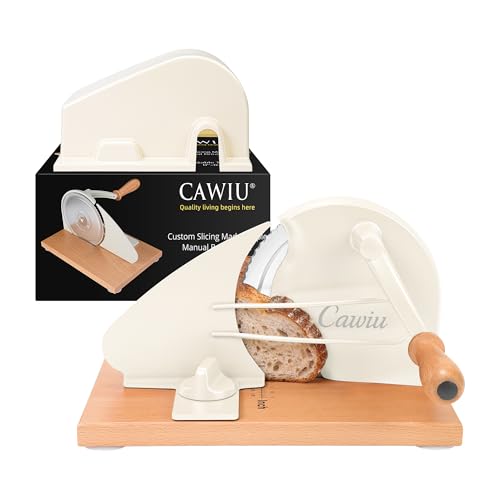
The Cawiu represents a step up in engineering from the Brvclon, with a metal slicing guide (not just a thickness dial) that keeps bread angle consistent throughout the cut. This detail matters: owners report that even softer, more delicate loaves slice without crushing because the metal guide supports the already-cut portion. The included cover is a nice touch for storage and hygiene, and the 0.8-inch thick wood base feels substantial without being unwieldy.
The suction cups are equally strong, and the rotary knob adjustment (0 to 0.9 inches) offers the same range as the Brvclon. What you're paying extra for is that metal guide architecture and the cover. For bakers who've already committed to a crank slicer and want the most polished version, this delivers. Compared to the Brvclon, it's a refinement rather than a revolution.
One practical note from reviews: if a crusty sourdough slice gets stuck, don't pull it backward; simply start slicing the next piece, which pushes the stuck slice forward. It's a small technique that makes operation smoother.
Pros
- Metal guide keeps bread stable and angle consistent
- Included protective cover for hygienic storage
- Thick wooden base and strong suction for rock-solid stability
Cons
- Higher price point than basic manual slicers
- Still requires proper feeding technique for best results
Key features (4)
- Adjustable thickness from 0 to 0.9 inches via precision rotary knob
- Metal slicing guide prevents crushing and ensures consistent angles
- Solid 0.8-inch thick wood base with four suction cups
- Removable protective cover and blade for easy cleaning
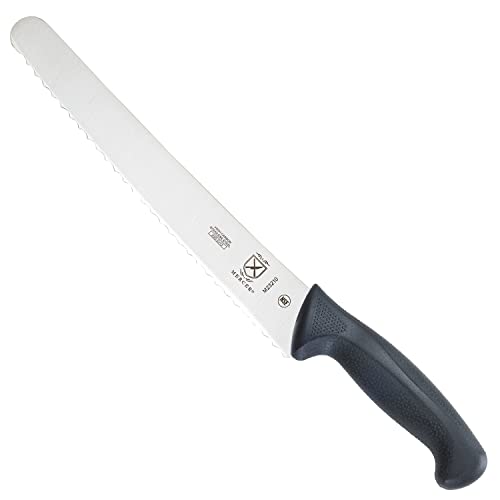
The Mercer Culinary Millennia is the professional's choice because it's NSF-certified (meeting restaurant standards), one-piece high-carbon Japanese steel, and engineered to hold an edge through hundreds of cuts. The wavy serration on the 10-inch blade bites cleanly into crusty loaves without the crushing or tearing that plagues cheaper serrated knives. The textured handle feels substantial in your hand and gives you confidence even when slicing delicate angel food cake.
Where the Mercer differs from the Orblue is its larger blade and its reputation in professional kitchens. If you're slicing full loaves or production quantities, the extra reach and heft matter. The one downside is that like all serrated knives, sharpening requires either specialty honing tools or a professional service, and that's not trivial. Mercer's steel holds an edge longer than budget alternatives, but nothing lasts forever.
For home bakers who want a single knife that handles bread, produce, and baked goods with equal finesse, and who don't mind hand washing, the Mercer is the investment piece. It won't take up counter space, and it never needs batteries or charging. The 10-inch profile does demand care in storage and handling, but that's the trade for professional performance.
Pros
- Commercial-grade steel holds edge through extensive use
- Wide 10-inch blade provides stability and reach
- Textured grip and excellent balance reduce hand fatigue
Cons
- Serrated edge requires specialty tools or professional sharpening
- Larger blade requires more careful storage than smaller knives
Key features (4)
- One-piece high-carbon Japanese steel with NSF certification
- 10-inch wavy serrated blade for clean cuts without crushing
- Ergonomic textured handle with non-slip grip and balance tang
- Professional-grade durability rated for restaurant and home use
How to Choose a Bread Cutter
Manual Slicer or Serrated Knife?
Manual crank slicers shine if you bake regularly and want uniform thickness with minimal effort. They handle thick crusts and soft centers equally well, and the adjustable settings give you flexibility. Serrated knives require more skill but take up no counter space and work on bread, produce, and pastries alike. If you slice bread weekly and have space, a manual slicer is the faster, more consistent choice. If you slice occasionally or need a multi-purpose blade, a good serrated knife is more practical. A bread slicer vs knife comparison explores both approaches in depth.
Thickness Adjustment and Flexibility
Most manual slicers offer adjustable thickness from roughly 0.2 to 0.9 inches, which covers everything from thin sandwich cuts to thick toast. Guides like the Kiss Core don't adjust thickness; they only guide your knife, so thickness depends on your hand pressure. If consistent thickness matters to you (and it should for presentation and even toasting), look for adjustable manual slicers. Serrated knives require manual control, so expect variation slice to slice unless you're highly skilled.
Stability and Safety
Counter stability is non-negotiable. Manual slicers with suction cups hold firm and don't shift during cranking, which is essential for safe operation. Guide systems rely on your grip to hold the bread steady, which means fewer fingers to brace the loaf. Serrated knives place the responsibility on your hand and posture. If you have limited hand strength or dexterity, a stable manual slicer is the safer choice. All tools have sharp blades; the difference is how much the equipment does to prevent slips.
Storage and Daily Use
Manual slicers with solid wood bases are substantial and either need permanent counter real estate or cabinet storage. Foldable guides like the Kiss Core collapse and nest flat. Serrated knives fit in a knife block or drawer. If counter space is precious, a collapsible guide or a sharp knife wins. If you slice daily and have space, a manual slicer's consistency and ease of use justify the footprint. For slicing bread without crushing guide, proper technique and tool fit together; the right combination depends on your kitchen and routine.
Our picks at a glance
2
Best Serrated KnifeOrblue
3
Best for Small KitchensKiss Core
4
Best Premium Manual SlicerCawiu
5
Best Professional-Grade KnifeMercer Culinary
Frequently asked
Can a manual bread slicer cut through very hard crusts?
Yes, if the blade is sharp and the slicer is well-built. Owners report that manual slicers with stainless steel blades handle crusty sourdough, baguettes, and artisan loaves easily. The key is feeding the bread straight and turning the crank at a steady pace. Cheap plastic slicers may flex or bind on hard crusts, but solid wood and metal designs cut through without issue. A dull blade is the main culprit if cutting feels tough.
How do I keep bread from tearing or crushing during slicing?
The bread must be cool and dry. Fresh, warm bread tears easily; let loaves cool completely before slicing. Use a sharp blade (serrated knives or manual slicer blades dull over time). Manual slicers produce the most consistent results because the thickness and blade angle are controlled. Serrated knives require steady, smooth sawing motions with light pressure. Knife technique matters; rapid back-and-forth sawing often crushes soft crumb, while smooth, purposeful strokes cut cleanly.
Are serrated knives hard to sharpen?
Yes, home sharpening is difficult. Serrated blades require specialty files and honing tools to sharpen each scallop individually. Many home cooks send them to professionals or replace them when dull. Wavy or scalloped serrations hold their edge longer than traditional serrations, reducing how often you need sharpening. If you prefer to maintain your own knives, a manual slicer's straight blade is much easier to hone.
What's the difference between a bread slicer and a bread knife?
A bread slicer is equipment: it holds the bread steady and guides the blade for you, producing consistent results with minimal skill. A bread knife is a tool you control. Slicers excel at uniform thickness and heavy use; knives offer versatility and portability. Slicers take up space but remove guesswork. Knives fit any kitchen but demand technique. Choose a slicer if you bake weekly; choose a knife if you value simplicity and multi-purpose use.
Which bread cutter is best for sourdough specifically?
Manual crank slicers with metal guides or sharp serrated knives both work well. Sourdough's thick, tough crust requires a sharp blade and proper technique. Manual slicers with adjustable thickness are popular because they cut through crust without crushing the soft crumb inside. Serrated knives work too, but the learning curve is steeper. Cool your sourdough completely before slicing; warm loaves tear more easily, no matter what tool you use.