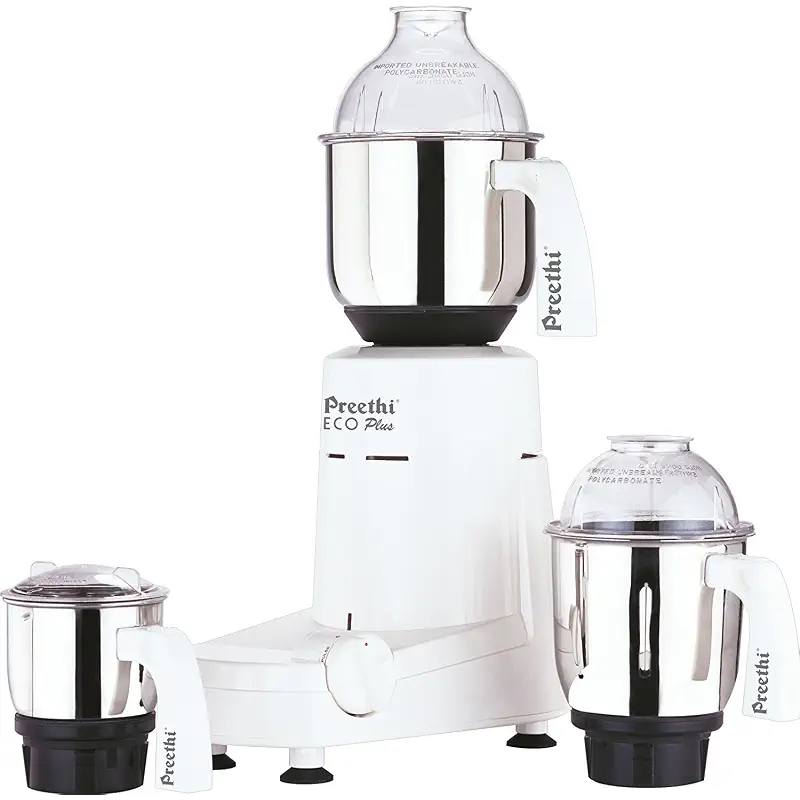
Ideal for: Indian households in the USA or Canada making idli, dosa, vada, and chutneys regularly.
The Preethi Eco Plus is built on decades of the Preethi brand's reputation in India, and owners consistently praise it for idli and dosa batter. The 550-watt motor is modest by Western blender standards, but that's actually an advantage here: lower heat generation means the batter stays cool during grinding, a critical factor for fermentation. The three jar system is what sets this apart. The largest 1.5-liter jar handles batter volume efficiently; the middle jar works for chutney without cross-contamination; the small chutney jar is perfect for spice powders and masala grinding. Users report the batter comes out fluffy and well-ground, with the wet-blade design delivering finer consistency than standard blender blades.
The trade-off is processing speed. Multiple owners note they run it longer than Western blenders and need patience: sometimes 2–3 minutes for a single batch. But this isn't a weakness; it's the nature of proper grinding. The nylon couplers are durable, and replacement parts are inexpensive and widely available (crucial for long-term ownership in the US where service centers are rare). The unit does make noise and the lids don't latch, so you'll stand by while it runs. Compared to the Ninja options, which excel at frozen drinks, the Preethi is quieter and leaves less residual heat in your batter.
One genuine concern: a small number of buyers report defective units that don't grind properly. Amazon's return window is standard, so test it immediately. But owners who get a good unit typically keep it for years.
Pros
Three stainless steel jars for batter, chutney, and spice grinding
Low motor speed reduces heat, preserving fermentation quality
ISI-certified and designed specifically for Indian cooking
Replacement parts readily available and inexpensive
Cons
Slower grinding process requires patience and longer run times
Limited power compared to Western blenders, struggles with very hard ingredients
Key features
550-watt motor with 100% stainless steel jars and electro-polished blades
Wet and dry grinding, churning, grating, mincing, and chopping capabilities
Three jar sizes: 1.5L, 1.0L, and 0.4L for different tasks
High-grade nylon couplers and polycarbonate lids for durability
#2 Pick
Best for Smoothie-First Households
Ninja
Ninja Professional Blender, 1000W, Total Crushing Tech, 72oz Pitcher, BL610 | 1000W Total Crushing blades crush ice & blend smoothies, sauces. XL 72-oz pitcher for family batches. Dishwasher-safe parts.
4.6(57,120)
Powerful Western blender excels at frozen drinks and general blending; acceptable but not ideal for idli batter.
Ideal for: Households prioritizing smoothies, frozen drinks, and sauces, with occasional idli batter needs.
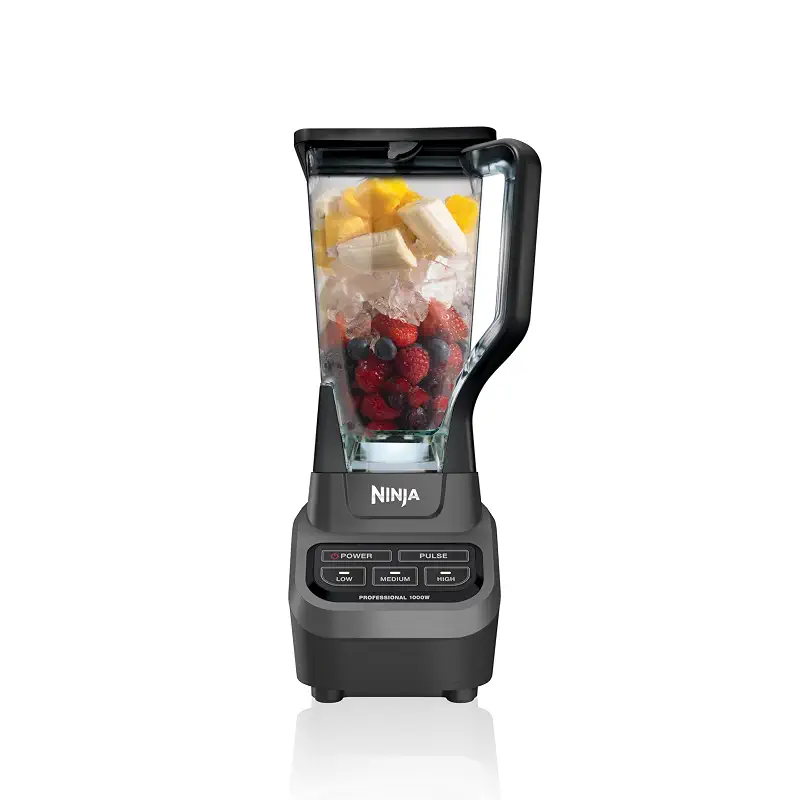
The Ninja Professional is the category workhorse: 1000 watts of raw power, a 72-ounce pitcher, and proven performance across tens of thousands of owners. It crushes ice into snow in seconds and blends frozen fruit to silky consistency, which is what most North American households actually use a blender for daily. Where the Preethi Eco Plus is a specialist, the Ninja is a generalist, and it's genuinely good at what it does.
For idli batter specifically, it has real limitations. Owners report two problems. First, the motor generates heat quickly; extended grinding warms the batter, which affects fermentation. Second, the sharp blades dull with regular use, especially when grinding rice and urad dal (harder than fruit), and once they dull, the batter texture becomes grainy rather than creamy. One long-term user noticed this decline after about 25 blends. The Ninja also produces one large batch only; there's no separate chutney jar, so you're constantly cleaning and refitting the pitcher. If you're making idli every day or several times a week, this becomes tedious.
That said, if your household makes smoothies most days and idli batter occasionally, the Ninja is a more versatile investment. It's quieter than its hype suggests, easy to clean, and the motor base is sturdy. Compare it to the Preethi: the Ninja wins for everyday blending; the Preethi wins for batter consistency and longevity in batter-focused kitchens.
Pros
1000-watt motor crushes ice and frozen ingredients instantly
Large 72-ounce pitcher ideal for family smoothie batches
Simple controls and dishwasher-safe parts for easy cleanup
Cons
Blades dull over time, reducing batter fineness after frequent use
Motor heat affects batter fermentation quality during grinding
Key features
1000-watt professional motor with Total Crushing blade technology
XL 72-ounce pitcher with 64-ounce max liquid capacity
Single pitcher design limits multitasking without cleaning between jobs
BPA-free plastic pitcher with dishwasher-safe components
Ideal for: Meal-prep and entertaining-focused kitchens that also make idli occasionally.
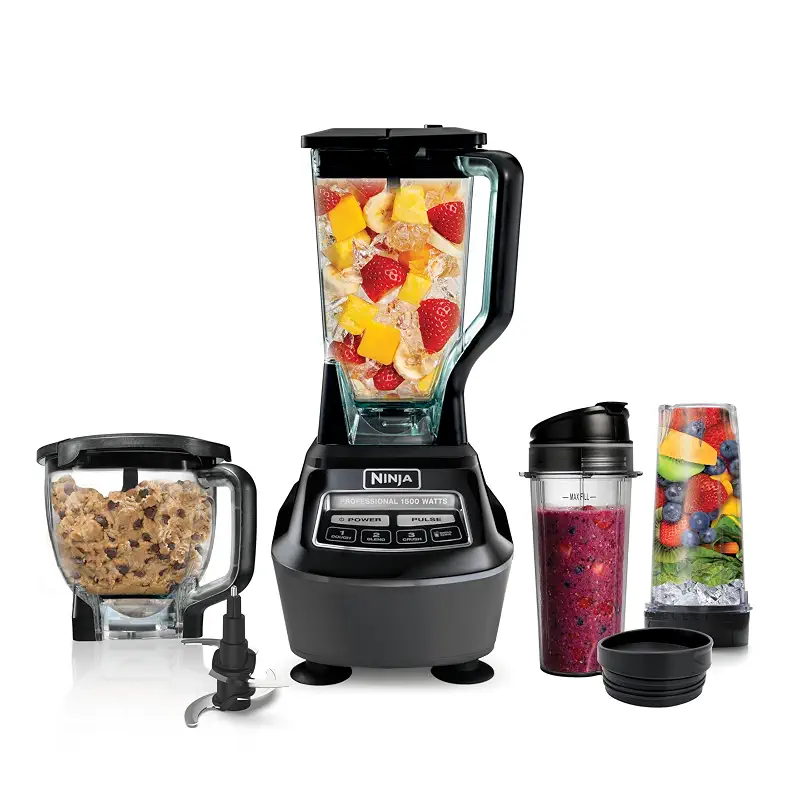
The Ninja Mega system represents the premium all-in-one approach: 1500 watts, a 72-ounce pitcher for blending, an 8-cup food processor bowl for chopping and dough, plus two 16-ounce individual cups for quick smoothies. It's a kitchen-space solution, not a batter specialist. Owners absolutely love its versatility and power; a few report making oat flour, nut butters, and pizza dough in the processor bowl while using the pitcher for soups and smoothies: all from one motor base.
For idli batter, the Mega system faces the same heat and blade-dulling challenges as the standard Ninja Professional, just with more options. The 1500-watt motor is actually overkill for gentle batter grinding; it generates more heat than the Preethi's 550 watts. The food processor bowl is excellent for chopping onions or mincing garlic for sambar, but grinding batter is still a single-pitcher job. Owners consistently mention one issue: it's loud: very loud. Some describe it like a V8 engine. If you grind early morning or late evening, you'll know about it.
Where it shines is if your household does meal prep (processor dough, chop vegetables, blend soups) alongside occasional batter needs. The stainless-steel blades in the pitcher and sharper processor blade give longer life than the single-blade Ninja Professional, though batter still isn't the focus. If you're choosing between this and the Preethi purely for idli, choose the Preethi. If you want one machine for three jobs, the Mega system delivers.
Pros
1500-watt motor handles blending, processing, and dough mixing without switching appliances
8-cup processor bowl excellent for vegetable prep and dough kneading
Two individual smoothie cups with to-go lids for quick personal blends
Cons
Very loud operation, not suitable for early morning or noise-sensitive environments
Overkill power for batter grinding; still generates excess heat affecting fermentation
Key features
1500-watt motor with Total Crushing blades for pitcher and Pro Extractor blades for cups
72-ounce pitcher plus 8-cup food processor bowl for dual functionality
Four unique blade sets optimized for blending, crushing, chopping, and dough mixing
Includes two 16-ounce Nutri Ninja cups with to-go lids for portability
Ideal for: Households mixing weekly smoothies, occasional idli batter, and nut butters without excessive noise.
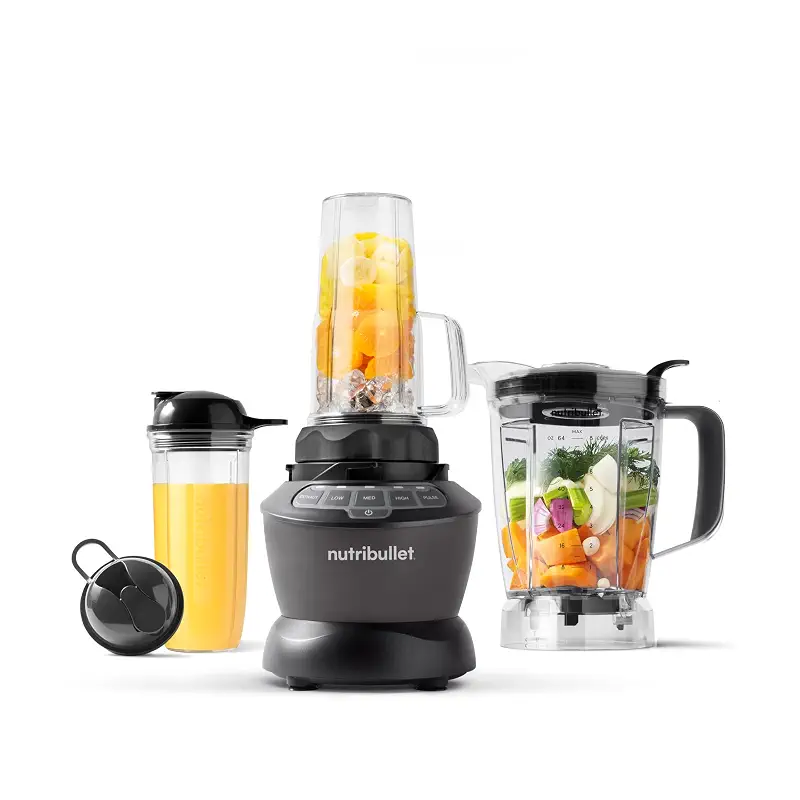
The NutriBullet Full-Size Blender Combo sits between the specialist and the generalist. At 1200 watts, it has more power than the Preethi Eco Plus but less hype and heat than the full-size Ninjas. It comes with a 64-ounce pitcher for family batches, two individual cups for personal smoothies, and a stainless-steel extractor blade. Owners praise it for being quieter than Ninja models while still handling frozen fruit and ice efficiently. Multiple reviewers note it's noticeably less noisy than competitive high-power blenders.
For idli batter, the NutriBullet is a compromise. It's more powerful than you need for gentle grinding, which means faster processing but also more heat buildup, not ideal for fermentation. However, one genuine advantage: the extractor blade is designed differently than Ninja's total-crushing blades. It's slower to dull and maintains consistency longer through repeated use. If you make batter weekly rather than daily, this matters. The pitcher-and-cups design is practical for households making both smoothies and batter; you can dedicate one cup to batter, avoiding constant cleaning. Owners report smooth results and reliable performance over months of use.
The main trade-off versus the Preethi: the NutriBullet lacks the three-jar system, so chutney and spice grinding require pitcher cleanup. Where the NutriBullet wins is overall reliability and quieter operation. It's not a batter-specialist machine, but it's a more thoughtful middle ground than either pure Ninja model for households juggling multiple blending tasks.
Pros
1200-watt motor quieter than Ninja, stronger than Preethi for mixed-use households
Stainless-steel extractor blade resists dulling better than sharp-blade designs
Large pitcher plus two individual cups minimize cleaning between tasks
Cons
Single pitcher requires cleaning between batter and chutney grinding
1200 watts still generates more heat than optimal for batter fermentation
Key features
1200-watt motor with Easy-Twist stainless-steel extractor blade and cyclonic action
64-ounce pitcher plus two individual smoothie cups (32oz and 24oz) with to-go lids
Three precision speeds, pulse function, and dedicated Extract program for full control
BPA-free plastic pitcher and cups, all components dishwasher-safe
#5 Pick
Best Wet Grinder for Serious Batter Makers
Premier
Premier Small Wonder Table Top Wet Rice and Lentils Grinder 1.5 Liter,110 volts with coconut scrapper and atta kneader
4.5(1,598)
Dedicated stone-drum wet grinder; slow, cool, and perfect for fluffy idli and dosa: the traditional choice.
Ideal for: Serious idli and dosa makers prioritizing batter quality over speed and blending versatility.
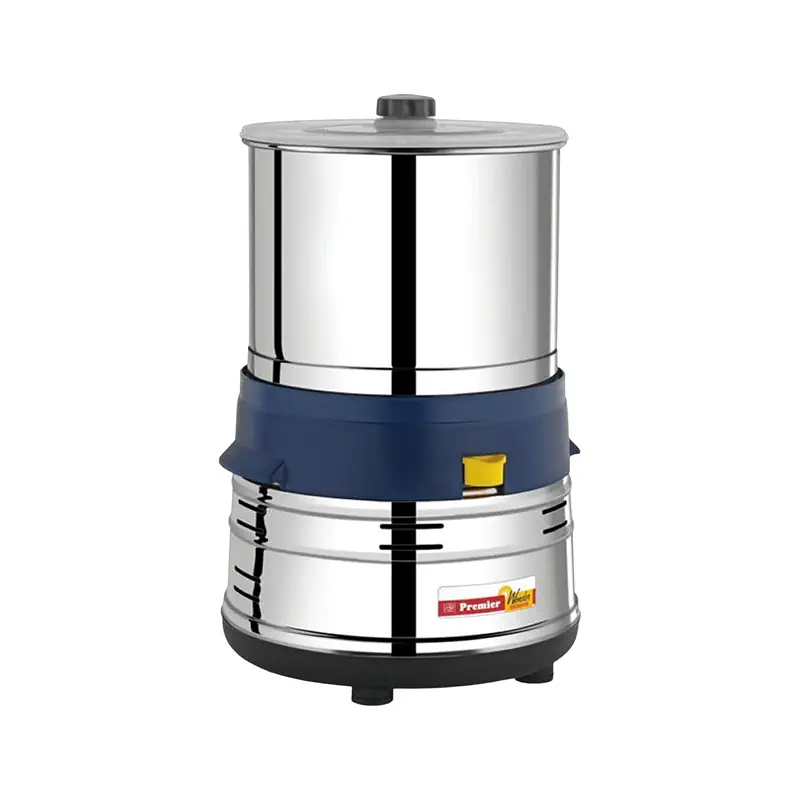
The Premier Small Wonder is not a blender in the Western sense. It's a wet grinder: a category-defining machine built exclusively for the grinding that idli, dosa, and vada batters demand. Instead of rotating blades, it uses a slow-turning stone drum inside a matching stone bowl. The 200-watt motor is deliberately small. Water or milk circulates through the drum as it grinds, keeping the batter cool and adding just enough moisture for fermentation. The entire design is thermal engineering: slow grinding plus water circulation equals zero heat buildup.
Owners who have switched from mixer grinders or blenders report a dramatic difference in idli quality. The batter emerges fluffy, light, and perfectly ground: they describe it as whisked butter. One user noted that after decades using a Vitamix for batter, switching to this wet grinder transformed their idlis and dosas into something their kids actually loved. The 1.5-liter capacity is ideal for a family of 4–5. The compact drum takes up less counter space than larger wet grinders, and it fits inside a kitchen sink for easy hand-washing.
The trade-off is speed and versatility. Wet grinding takes 30–45 minutes for a single batch; you're not rushing. The noise is moderate but noticeable (stone-on-stone grinding). It won't chop vegetables or make nut butter. If batter is 90% of your grinding, this is worth the specialization. If you also need a workhorse for smoothies, sauces, and snacks, pair this with a small blender or choose the mixer grinder vs. high-speed blender comparison that the category demands. Many Indian households in the USA keep both: a wet grinder for batter and a mixer grinder for daily spices and chutneys.
Pros
Stone-drum design eliminates heat, preserving fermentation and batter lightness
Water circulation during grinding keeps batter cool and properly textured
Compact 1.5-liter capacity fits small kitchens and kitchen sink for easy cleaning
Dedicated design means batter texture never degrades from blade dulling
Cons
30–45 minute grinding time per batch is much slower than blenders
Cannot handle dry grinding, chopping, or general-purpose blending tasks
Key features
200-watt motor with slow stone-drum-and-bowl grinding mechanism
Stainless steel drum and food-grade plastic housing, all BPA-free
1.5-liter capacity with water circulation for cool, consistent grinding
Includes coconut scraper and atta kneader for roti and dough preparation
How to Choose the Right Blender for Idli Batter
Four trade-offs that actually matter when matching a blender for idli batter to your kitchen.
Grinding Speed vs. Batter Heat
The fundamental choice in idli-batter grinding is managing motor temperature. Fast Western blenders (Ninja, NutriBullet) grind quickly but generate heat, which can affect how batter ferments and rise. Dedicated wet grinders and low-watt mixer grinders are slow but keep batter cool. For daily batter makers, a dedicated wet grinder is worth the time investment. For occasional batter plus frequent smoothies, a moderate-watt mixer grinder like the Preethi balances both needs. If you're choosing between a mixer grinder vs. high-speed blender purely for batter, the mixer grinder wins on consistency but the blender wins on speed and versatility.
Motor Wattage and Blade Design
Wattage matters differently for batter than for smoothies. A 550-watt mixer grinder with proper wet blades is ideal for rice and urad dal; a 1000+ watt blender with sharp chopping blades is overkill and duller faster. Look for machines with dedicated wet-grinding blades (designed to crush and break down, not cut) rather than total-crushing blades optimized for ice. Premium models use stainless-steel extractor blades that resist dulling better than sharp flat blades, extending the lifespan of texture consistency.
Multi-Jar Systems vs. Single-Pitcher Design
Mixer grinders with three jars (large for batter, medium for chutney, small for spices) eliminate constant cleaning and prevent flavor cross-contamination. High-powered blenders typically offer one pitcher, so you wash and refill for each task. If your household grinds batter, chutney, and spices multiple times weekly, a three-jar system like the Preethi saves time and effort. If you make batter occasionally and smoothies most days, a single pitcher with efficient cleanup (dishwasher-safe components) may be worth the trade-off.
Durability and Replacement Parts
Blades dull with repeated use, especially when grinding hard ingredients like rice and lentils. Cheaper blenders may require blade replacement every 1–2 years; quality designs last longer. For machines sold in the USA or Canada, verify that replacement blades, jars, and motor components are available without international shipping delays. Mixer grinder brands like Preethi have established US distribution, making repairs and replacements fast and affordable. Stone wet grinders avoid blade dulling entirely, making them a long-term investment for serious batter makers.
Noise and Counter Space
Wet grinding idli batter takes 30–45 minutes; running a 1500-watt blender for three minutes is louder but shorter. Consider your household schedule: if you grind early morning or late evening, a quieter option (dedicated wet grinder or low-watt mixer grinder) is more considerate. Wet grinders and compact mixer grinders fit standard kitchen counters; large blenders with food processor bowls may require dedicated space. Measure your counter and storage before committing.
Frequently asked
Quick answers to the questions readers ask most.
Can I use a regular blender to make idli batter?
You can, but the results often disappoint. Regular blenders prioritize speed and sharpness: they grind quickly and generate heat. Idli batter needs slow, gentle grinding that keeps the mixture cool for proper fermentation and creates a fluffy, airy texture. High-speed blenders tend to produce thick paste rather than the light, whipped consistency that ferments well. A mixer grinder or dedicated wet grinder delivers superior idli and dosa results, though with longer processing time.
What is the difference between a wet grinder and a mixer grinder?
A wet grinder uses a slow-turning stone drum cooled by water circulation; it grinds for 30–45 minutes and produces exceptionally light batter ideal for idli and dosa. A mixer grinder uses rotating blades, grinds in 5–10 minutes, and can handle wet, dry, and spice tasks. Wet grinders are specialty machines; mixer grinders are versatile workhorses. For batter quality alone, wet grinders excel. For a kitchen that grinds batter, spices, and chutneys regularly, a mixer grinder is the practical choice.
Why does my idli batter come out thick and paste-like instead of fluffy?
This usually indicates the grinding method is too fast and hot. High-speed blenders and food processors grind quickly but generate heat, which affects how the batter ferments and aerate. Thick paste often means the batter was over-processed or the motor heated it. Slow, cool grinding (wet grinder or low-watt mixer grinder) keeps the batter airy. Also check your ingredient ratio: too much urad dal or not enough water produces paste. The grinding equipment matters, but fermentation time and ingredient balance matter equally.
How often should I replace the blades in my mixer grinder or blender?
High-quality stainless-steel wet-grinding blades last 2–3 years with daily use. Sharp flat blades (typical in Western blenders) dull faster, especially when grinding hard ingredients like rice and lentils, and may need replacement after 1–2 years of regular batter grinding. Dedicated wet grinders with stone drums don't have blades to replace. Check the manufacturer's warranty and availability of replacement parts before purchasing; some brands ship replacements slowly, while others (like Preethi) have quick US distribution.
Is a wet grinder worth the extra cost and counter space?
Yes, if idli and dosa batter are regular household staples. Wet grinders produce noticeably lighter, fluffier batter that ferments better and tastes superior. They require no blade replacement and last decades with proper care. The trade-off is time: 30–45 minutes of grinding versus 5–10 minutes with a mixer grinder. If your household makes batter 2–3 times weekly, a wet grinder pays for itself in batter quality and zero maintenance. If you make batter occasionally or need versatility for other grinding tasks, a quality mixer grinder is the practical choice.