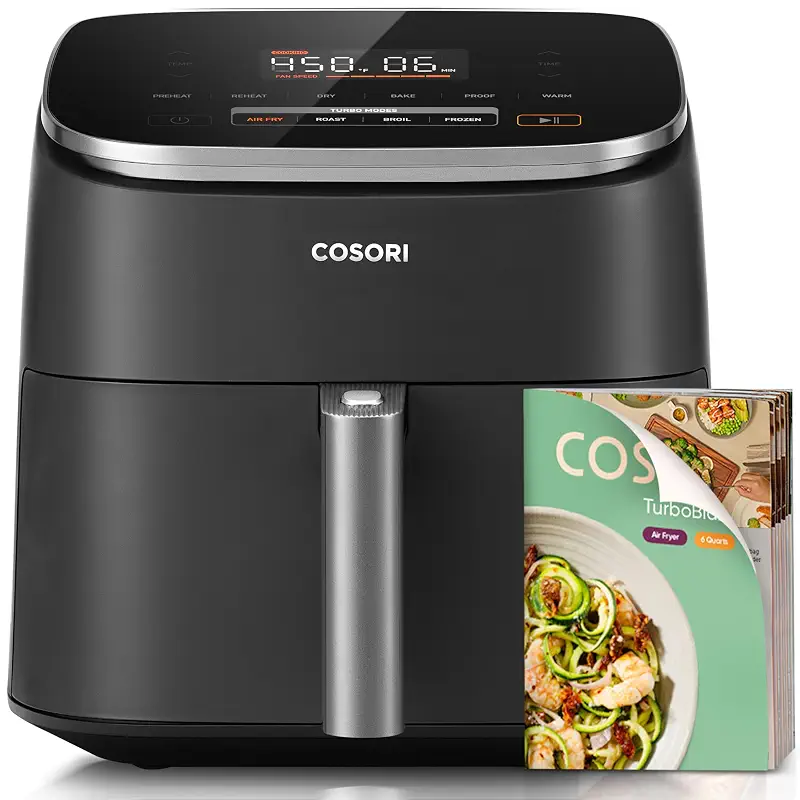
Ideal for: Family cooks who use air fryers multiple times per week and value durability and versatility.
The Cosori TurboBlaze delivers real performance that shows up on the plate. Its 5-speed fan system and precision temperature range (90°–450°F) mean you can proof dough one minute and crisp chicken at full heat the next. Owners report remarkably consistent browning and a quieter operation than most competitors, which matters when you're running this several times a week. The 6-quart square basket is genuinely spacious: you fit more without crowding, which means better air circulation and fewer batches.
The PFAS-free ceramic coating is a meaningful upgrade over standard nonstick. It resists wear better over time, and cleanup is genuinely effortless; melted cheese and grease wipe right off. The included recipe book and cooking charts save you from guessing on frozen foods, and the preheat function is smart enough to adjust timing based on temperature rather than forcing a fixed countdown.
One thing to know: small items like fries can slip through the crisper tray grates. Paper liners (sold separately or included in some bundles) solve this cleanly. If you're cooking for a family and want a model that handles roasting, baking, dehydrating, and everyday air frying without compromise, this is where I'd start.
Pros
PFAS-free ceramic coating resists wear and cleans easily
5-speed fan system delivers even, crispy results
6-quart square basket fits more without stacking
Quiet operation at under 53dB
Cons
Small food items may slip between crisper plate grates
Ideal for: Apartment dwellers, small households, and anyone prioritizing easy cleanup and portability over maximum capacity.
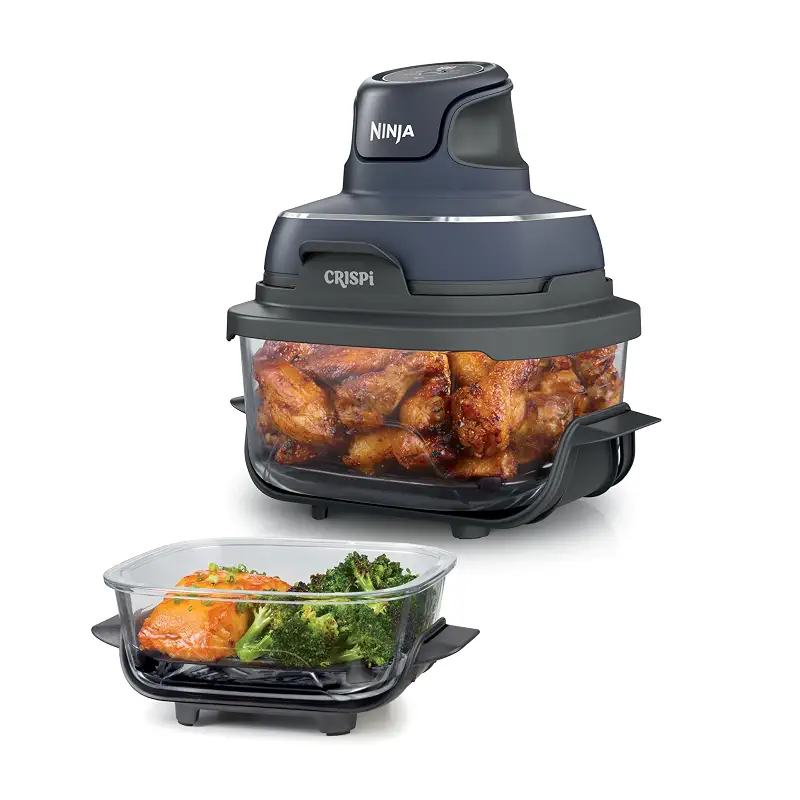
The Ninja Crispi Glass rethinks the air fryer entirely. Instead of a drawer-style basket, you get a removable heating pod that sits atop your choice of two glass containers: a 6-cup for singles and a 4-quart for families. This design eliminates the cramped interior that makes most drawer fryers difficult to clean; the glass bowl slides off and goes straight to the dishwasher or sink. Owners who've owned traditional air fryers often note this is a revelation for maintenance.
The PFAS-free, PTFE-free borosilicate glass is food-safe and toxin-free, which matters if you care about forever chemicals. You can see food cooking in real time, and the snap-lock lids turn the containers into leak-proof meal-prep vessels. For renters, travelers, or anyone with limited counter space, the nested storage (pod fits inside the containers) is a genuine space-saver. Compared to the Cosori TurboBlaze, which focuses on raw power and nine functions, the Crispi trades some versatility for portability and ease of cleaning.
One trade-off: the heating pod doesn't allow custom temperature settings; each mode has a fixed temperature range. For most everyday cooking (air frying, baking, crisping), this isn't a limitation. If you need precision down to 5-degree increments, look elsewhere. The smaller 6-cup container is best for one or two people; the 4-quart can handle a chicken, but it's snug.
Pros
Glass containers are toxin-free and visible during cooking
Compact nested storage fits in tight spaces
Pod removes easily for dishwasher-safe cleaning
Dual container sizes for flexible portion control
Cons
Fixed temperature ranges per mode; no custom temperature control
Glass containers require cooling before washing after hot use
Key features
Palm-sized heating pod with 1500W power delivers full air fryer functionality
Two PFAS-free borosilicate glass containers: 6-cup and 4-quart with crisper plates
Four cooking modes: Max Crisp, Air Fry, Bake, and Recrisp
Snap-lock leak-proof lids double as meal-prep storage containers
Nested design collapses for cabinet-friendly storage
Ideal for: Busy families and meal-prep enthusiasts who cook large batches and value speed and simplicity.
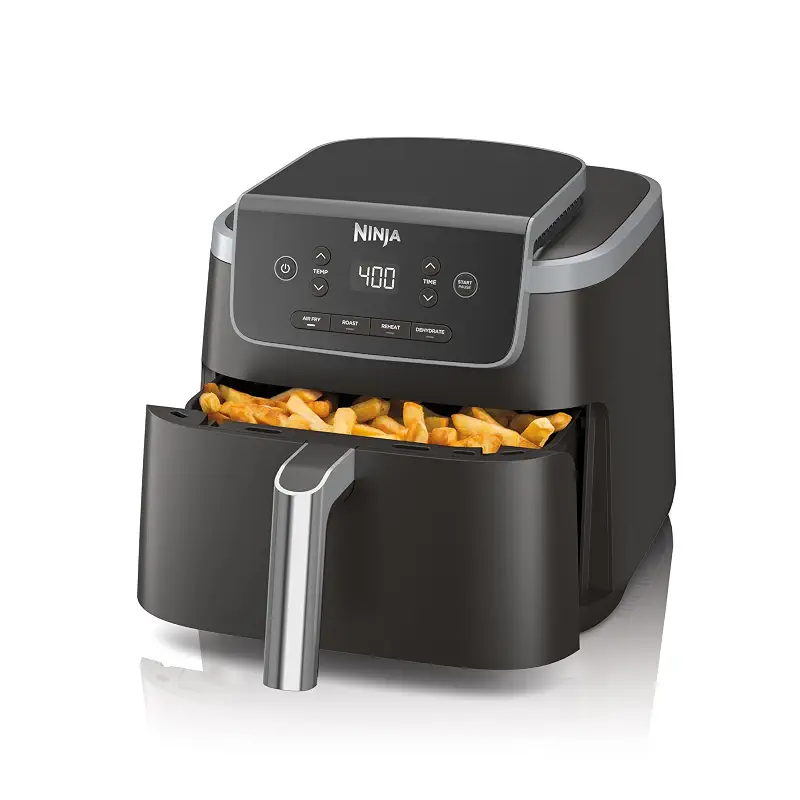
The Ninja Air Fryer Pro is built for cooks who want to set it and forget it, with minimal fuss. The 5-quart nonstick basket is genuinely spacious (it holds 4 pounds of fries or 5 pounds of wings) so you're not batch-cooking for a family of four. Heating is fast; frozen items cook to crispy perfection in the time other fryers are still climbing to temperature. Owners love it for that speed and for how evenly it crisps without constant flipping.
The four functions (Air Fry, Roast, Reheat, Dehydrate) are straightforward and well-designed. The nonstick basket and crisper plate wipe clean in seconds, and both go in the dishwasher. Controls are simple (temperature in 15-degree increments, adjustable time) so there's no learning curve. Compared to the Ninja Crispi Glass, which focuses on portability and glass safety, this model prioritizes raw capacity and throughput. Where the Crispi shines for small households, the Pro is the workhorse for families who air-fry several times a week.
Two minor notes: there's no automatic shutoff when you open the drawer, so you'll need to pause manually. And the heating element sits above, so the interior top can accumulate splatter over time; regular light wiping prevents buildup. For everyday family cooking without frills, this hits a sweet spot between price and performance.
Pros
5-quart capacity handles family meals and large batches efficiently
Fast heating and consistent, even crisping across batches
Simple controls with four straightforward cooking modes
Nonstick basket and crisper plate clean easily
Cons
No automatic shutoff; basket must be paused manually when opened
Interior heating element can accumulate splatter requiring periodic wipe-down
Key features
1750W Air Crisp Technology circulates superheated air up to 400°F
Five-quart nonstick basket and removable crisper plate for even cooking
Four customizable functions: Air Fry, Roast, Reheat, and Dehydrate
Fits 4 lbs French fries or 5 lbs chicken wings in single batch
Compact space-saving design without compromising capacity
#4 Pick
Best Premium & Versatile
Ninja Crispi Pro Glass Air Fryer, 6-in-1, Cyberspace, AS101CY | Max crisp, air fry, bake, roast, recrisp, dehydrate, 1800W, 450F max, 6Qt, 2.5Qt containers
4.6(1,252)
Most powerful glass air fryer with six functions, modular sizing, and thermal-shock glass for serious home cooks.
Ideal for: Home cooks who entertain, value health-conscious toxin-free cookware, and want maximum versatility in one modular system.
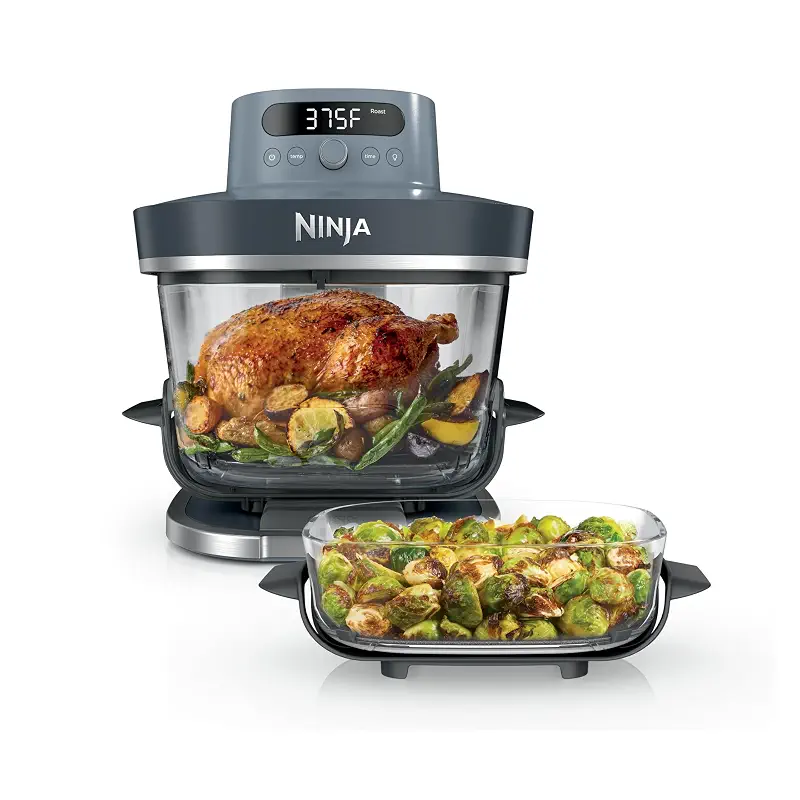
The Ninja Crispi Pro steps up the game with 1800 watts of power (the strongest in the Crispi line) and a modular base that adapts to three different glass container sizes (2.5-quart, 4-quart, 6-quart). This flexibility is genuinely useful if your household size or cooking needs shift; you buy one base and swap containers rather than replace the whole unit. The 6-quart capacity easily feeds ten people, and the thermal-shock-resistant glass means you can load frozen items straight from the freezer without thawing or preheating.
Six cooking modes (Max Crisp, Air Fry, Bake/Proof, Roast, Recrisp, Dehydrate) cover nearly every cooking task. The built-in light illuminates the bowl at two brightness levels, so you can monitor food without opening it. Temperature control is precise and adjustable in 5-degree increments, and you can change time and heat on the fly without restarting. The borosilicate glass is PFAS-free, PTFE-free, and BPA-free, addressing health-conscious cooks who want zero synthetic coatings.
Where this differs from the smaller Crispi Glass: you get more power, larger capacity, a light, and finer temperature control. The trade-off is storage; the larger containers don't nest as compactly. If counter space is tight or you're cooking for one or two, the original Crispi Glass is smarter. But if you entertain regularly or want the most flexible glass system available, the Pro delivers.
Pros
Most powerful Crispi model at 1800W handles large meals efficiently
Modular base works with multiple container sizes for long-term flexibility
Built-in dual-brightness light lets you monitor cooking progress
Six cooking modes with precise 5-degree temperature adjustments
Cons
Containers do not nest; storage requires separate shelf space
Higher price point reflects premium features and capacity
Key features
1800W power with six cooking modes and modular stainless-steel base
Two included glass containers: 6-quart and 2.5-quart; base fits up to three sizes
PFAS-free, PTFE-free, BPA-free borosilicate CleanCrisp glass with thermal-shock resistance
Integrated lighting at two brightness levels for real-time food monitoring
Leakproof snap-lock storage lids make containers fridge and freezer ready
#5 Pick
Best Budget-Friendly
Chefman
Chefman Air Fryer – 6 QT Compact Airfryer for Quick & Easy Meals in Minutes, Features Hi-Fry Technology for Extra Crisp, Touchscreen Controls with 4 Presets, Nonstick & Dishwasher Safe Basket - Black
4.6(2,984)
Six-quart capacity with Hi-Fry boost and touchscreen controls deliver quality results at an entry-level price.
Ideal for: Budget-conscious cooks and air fryer newcomers who want large capacity and reliable daily performance.
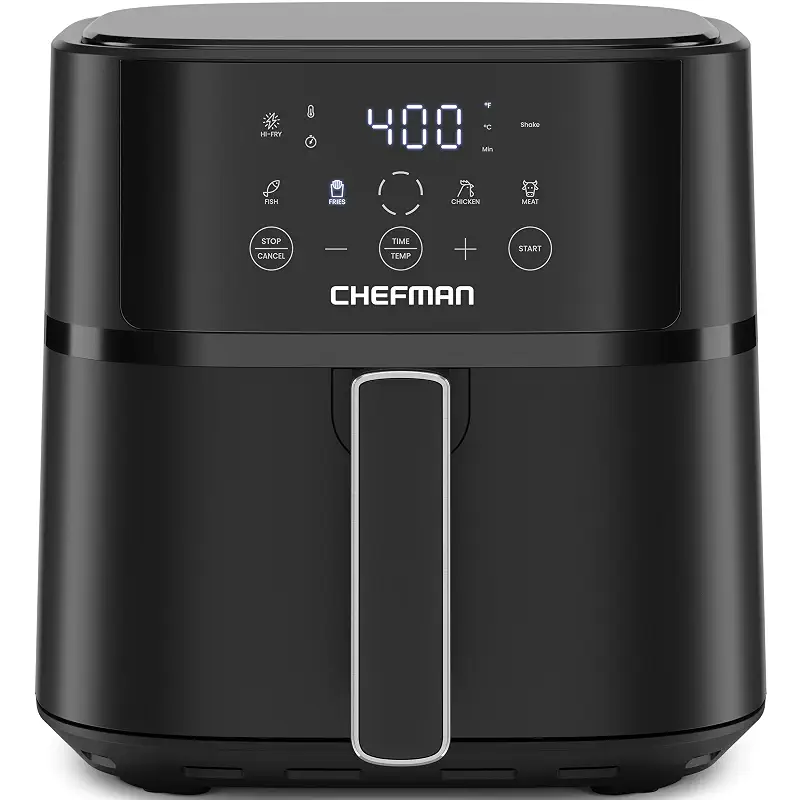
The Chefman Air Fryer proves you don't need premium features or a recognizable brand name to get solid everyday performance. At a budget-friendly entry point, it offers a 6-quart square basket (genuinely spacious) and a Hi-Fry Technology feature that bumps heat to 450°F for the final two minutes of cooking, giving you extra crispness on fries and chicken without the guesswork. The touchscreen display is simple; four presets handle most frozen foods, and you can dial in custom time and temperature when you need it.
Compared to the Cosori TurboBlaze at the top of this list, the Chefman trades the PFAS-free ceramic coating for a standard nonstick basket, and it doesn't include as many cooking functions. But for basic air frying, roasting, and reheating, it's more than adequate. Owners report even cooking, quiet operation, and a useful shake alert that reminds you halfway through to flip or mix your food. The nonstick basket and rack are dishwasher-safe, and cleanup is straightforward.
One thing to manage: there's no dedicated preheat mode; you simply turn it on for a couple of minutes to reach temperature. And temperature settings display in Celsius on some regional models, which takes adjustment if you're used to Fahrenheit. If your budget is tighter and you primarily air-fry rather than explore nine specialty modes, this delivers real value without sacrificing the core function.
Nonstick basket and rack are dishwasher-safe for easy cleanup
Cons
Standard nonstick coating without PFAS-free ceramic upgrade
No dedicated preheat function; manual warm-up required
Key features
1700W power with square 6-quart nonstick basket and removable crisper rack
Hi-Fry Technology boosts to 450°F in final two minutes for enhanced crispness
Touchscreen controls with four preset functions and custom time-and-temperature setting
Shake-alert audio reminder prompts food turning for even browning
Automatic shutoff and safety features protect appliance longevity
How to Choose the Right Air Fryer
Four trade-offs that actually matter when matching a air fryer macy's to your kitchen.
Capacity and Counter Space
Capacity matters more than it looks on the spec sheet. A 5- or 6-quart basket lets you cook for a family in one go; smaller baskets mean more batches. Square baskets pack more food than round ones because corners don't waste space. But larger models take up counter real estate: measure your space before you buy. If counter room is tight, the Ninja Crispi Glass and other compact designs nest or stack for storage. For air fryer capacity and sizing decisions, think about how many people you cook for regularly and whether you meal-prep in batches.
Heating Performance and Temperature Range
The difference between crispy and mediocre comes down to heat. Look for models that reach at least 400°F; above that, you're betting on either specialty functions (like baking or proofing) or rare high-heat searing. More important is consistent heating across the entire basket. Uneven hot spots burn edges while centers stay soft. Owners who report reliable browning praise fryers with multiple fan speeds, thermal-balance engineering, or dual heating elements. A wide temperature range (down to 90°F or so) unlocks functions like dough proofing and low-temperature drying: useful if you plan to cook beyond frozen fries and chicken.
Build Quality and Coating Safety
Nonstick coatings fall into two camps: standard (PTFE-based) and ceramic or PFAS-free. Standard coatings are cheaper and work fine, but they wear over time and shed microscopic particles. PFAS-free ceramic or borosilicate glass coatings cost more but resist wear and avoid forever chemicals. If you use your fryer daily, a ceramic or glass design will feel noticeably more durable after a year of use. The best ceramic air fryer models combine easy cleanup with longevity; glass containers add weight and take up storage but eliminate coating concerns entirely. Stainless-steel and plastic housings should feel solid: flex or creaking suggests corners were cut.
Ease of Cleaning and Maintenance
A fryer that's hard to clean becomes a fryer you avoid using. Drawer-style baskets trap grease in corner seams and between grates; glass containers or removable crisper plates sit flush and slide out. Dishwasher-safe parts are huge: hand-washing nonstick coatings risks scratching and reduces lifespan. Air fryer cleaning and maintenance should be quick; if it takes fifteen minutes to scrub, you'll dread daily use. Splatter builds on interior heating elements over weeks; models with smooth tops are easier to wipe than those with coils or grooves. Check if the interior top is accessible; some designs trap debris where you can't reach.
Features vs. Simplicity
Nine cooking modes sound great until you realize you only use two. Basic models cover air frying, roasting, and reheating: the 80/20 of home cooking. Advanced modes like proofing, dehydrating, and sous-vide-style slow-cooking appeal to adventurous cooks but add cost and complexity. Beginners often do better with four simple preset functions and adjustable time/temperature than with 12 buttons and an overwhelming manual. That said, if you bake regularly or make jerky, the extra functions earn their place. Think about what you'll actually cook, not what sounds impressive on the box.
Frequently asked
Quick answers to the questions readers ask most.
Do I need to preheat an air fryer?
Most modern air fryers heat fast enough that preheating is optional for non-frozen foods. Frozen items benefit from a brief preheat (2–3 minutes) to jump-start crisping. Some models include a preheat function that adjusts timing by temperature; others require manual warm-up. Check your manual. A useful practice: turn on the fryer for a minute or two, let it beep or settle, then load food. The difference in cooking time is usually minimal, but preheating can improve browning consistency on delicate items like seafood.
Can I cook meat to a safe internal temperature in an air fryer?
Yes, if you monitor the internal temperature with a meat thermometer. Air fryers cook the exterior faster than the interior, so chicken or pork can brown beautifully while still undercooked inside. Flip or rotate larger pieces halfway through. For chicken breasts, aim for 165°F; pork, 145°F; ground beef, 160°F. A wireless probe thermometer that alerts you when food reaches target temperature removes guesswork and prevents overcooking. Always let meat rest for a few minutes after cooking before slicing.
What's the difference between air frying and baking in an air fryer?
Air frying uses high, focused heat with fast-moving air to brown and crisp quickly. Baking uses lower, gentler heat and relies on trapped steam or slower Maillard reactions for even browning. Most air fryers default to air-fry mode (400°F+). For delicate items like fish, seafood, or pastries, use a bake or roast mode (350°F or lower) to prevent burning the outside before the inside cooks. Temperature control matters more than the label; if you need gentler heat, dial it down regardless of function name.
Is an air fryer worth it if I already have a convection oven?
Air fryers cook faster and use less counter space, but they're not dramatically different from a good convection oven. The real advantage is speed, preheating is nearly instant, and cooking times are often half that of a full-size oven. If you hate heating a large oven for small meals or live in a hot climate where using the oven warms your kitchen, an air fryer pays for itself in convenience and energy savings. For occasional cooking, a convection oven is fine; for daily use, an air fryer wins on speed and ease.
How do I prevent small foods like fries or shrimp from falling through the basket?
Use square or rectangular paper liners designed for air fryers. They sit flat on the basket bottom and catch small items. Many fryers sell compatible liners, and generic parchment liners from kitchen supply stores work too. Reusable silicone liners are also available. Avoid standard parchment paper, which can blow around; fryer-specific liners have small holes or perforations to allow air circulation. Some owners also use small oven-safe bowls or aluminum foil cups to contain tiny items while still letting air flow underneath.