Kitchen & Dining · Small
Best Air Fryer for Dehydrating: Top Picks for Home Use
Find the best air fryer for dehydrating with low-temp precision. Compare top models with dehydrate functions, capacity, and performance for jerky, chips, herbs.
Affiliate disclosure: As an Amazon Associate I earn from qualifying purchases.
At a glance
1
Best Overall for DehydratingCosori
2
Best for Beginners and Small Batches 3
Best for Medium-Sized Dehydrating Projects 4
Best Premium Option with WindowInstant Pot
5
Best for Versatile Multitasking KitchensChefman
Detailed reviews
The Cosori TurboBlaze stands out because it brings together the temperature control that matters for serious dehydration work. Its 90-degree minimum temperature gives you the gentle, consistent heat that turns fresh herbs, fruit slices, and meat into shelf-stable snacks without cooking or browning them. The five-level fan speed system is a real advantage here: you can dial back airflow for delicate foods, preventing over-drying or uneven moisture removal. Owners consistently praise how evenly it performs across the basket, which makes a measurable difference when you're running a full load of banana chips or chicken for a dog.
The 6-quart capacity is genuinely spacious without dominating counter real estate. You can fit enough herbs on the rack system to justify the time investment, or batch dehydrate jerky strips over a few hours. The ceramic-coated basket cleans effortlessly afterward, and the dishwasher-safe parts are a small mercy after hours of dehydration work. One owner mentioned successfully dehydrating chicken for their dog: a practical example of how the low-temperature range pays off in everyday use.
The one area where dehydration purists might hesitate is the 24-hour maximum timer. Thick-cut jerky or whole fruits occasionally demand longer runs, so you'd need to split very long sessions. That said, most home dehydration projects fit comfortably within that window, and the precision control at lower temperatures compensates for the time limit.
Pros
- 90°F minimum temperature for gentle dehydration
- Five adjustable fan speeds for moisture control
- Large 6-quart capacity for batch dehydrating
Cons
- 24-hour maximum timer may require session splitting
- Larger footprint than compact models
Key features (4)
- Temperature range 90°F–450°F with five-speed fan adjustment
- 6-quart ceramic-coated basket with removable crisper plate
- Dishwasher-safe components for quick cleanup
- Nine cooking functions: air fry, roast, bake, broil, dry, proof, reheat
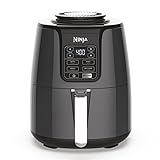
The Ninja Air Fryer keeps dehydration simple without sacrificing capability. Its 105°F floor might sound slightly higher than some competitors, but it's still low enough to dry herbs, thin fruit slices, and small batches of jerky strips without degrading flavor or texture. The dehydrate function uses a combination of low fan speed and lower temperature: a thoughtful design choice that reduces the risk of uneven drying from too much air circulation.
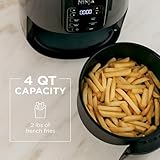
What sets this model apart for beginners is clarity: it has just four functions (air fry, roast, reheat, dehydrate), so you're not lost in a sea of presets. A new user can focus on learning temperature and time without overthinking. The 4-quart capacity is right-sized for a household of two to three people doing occasional dehydration projects. Owners who've made beef jerky in this unit report excellent results, and the ceramic-coated basket is genuinely easy to clean even after long, oily dehydration runs.
Compared to the Cosori TurboBlaze, this model trades some fan-speed customization and capacity for simplicity and a smaller counter footprint. If you live in a tight space or are dipping a toe into dehydration for the first time, the Ninja's straightforward approach and track record of reliability make it an intelligent choice. Where the Cosori excels at fine-tuned control, the Ninja excels at dependable, no-fuss operation.
Pros
- 105°F minimum for reliable low-temperature dehydration
- Simple four-function design, easy to learn
- Ceramic-coated nonstick basket cleans effortlessly
Cons
- 4-quart capacity limits batch size for large projects
- Fixed temperature increments may lack fine-tuning precision
Key features (4)
- Temperature range 105°F–400°F with dedicated dehydrate setting
- 4-quart ceramic-coated nonstick basket and crisper plate
- Dishwasher-safe parts for minimal cleanup
- Rapid air circulation for even dehydration without excessive heat
The Ninja Air Fryer Pro splits the difference between the smaller and the larger Cosori models, making it ideal for households that dehydrate regularly but don't need the 6-quart footprint. Its maximum temperature of 400°F and ability to adjust in 15-degree increments gives you reasonable precision for lower-temperature work, though it doesn't quite match the granular control of the TurboBlaze's 90-degree floor. Still, owners consistently report excellent dehydration results on jerky and fruit chips, suggesting the 105°F practical minimum (accounting for system lag) works well in real-world use.
The five-quart basket represents a meaningful increase in capacity over the without the bulk of the 6-quart Cosori. You can fit a full sheet's worth of jerky strips or several trays of fruit in a single run. Air Crisp Technology uses superheated air circulation that some owners note runs quieter and more evenly than older designs. One reviewer mentioned successfully drying foods without the loud fan noise typical of other models, which matters if your kitchen is an open floor plan.
Where this model asks for compromise: it doesn't have the Cosori's five-speed fan adjustment, so you have less granular control if you're drying very delicate items like fresh basil. But if you're making jerky, veggie chips, or standard fruit leather, that trade-off barely registers. The Pro's sweet spot is the owner who dehydrates weekly but isn't running a commercial-scale operation.
Pros
- Five-quart capacity handles regular batch dehydrating
- Air Crisp Technology with even, quiet circulation
- Nonstick basket simplifies cleanup after long sessions
Cons
- Temperature increments are 15 degrees, less precise than competitor
- No auto-shutoff when basket is opened during cooking
Key features (4)
- Temperature range up to 400°F with 15-degree increment control
- 5-quart capacity basket fitting up to 4 lbs of fries
- Air Crisp Technology for even low-temperature dehydration
- Four functions: air fry, roast, reheat, dehydrate
The Instant Pot Vortex Plus positions itself at the premium end of the market, and that positioning shows in both the engineering and the price. Its 95°F minimum temperature edges out even the Cosori, giving you slightly more headroom for ultra-gentle dehydration of heat-sensitive herbs or delicate fruit slices. The six-quart capacity matches the Cosori, but the Vortex Plus adds a large window: a feature that matters more for dehydration than for air frying. You can check your progress without opening the door and disrupting the moisture-removal cycle, something that cuts guesswork out of long runs.
EvenCrisp Technology uses a dual-heating approach that owners report produces remarkably even results across dense and delicate foods. The stainless-steel exterior and overall fit-and-finish feel noticeably more polished than plastic-heavy competitors. One reviewer who ran multiple test cycles before cooking noted that the initial plastic smell dissipated quickly and never returned: a sign of careful material selection. The build confidence translates to multi-hour dehydration sessions without worry.
The trade-off is cost and some learning curve. The Vortex Plus has more buttons and options than necessary for basic dehydration, and the instructions could be clearer on how to customize settings beyond presets. If you're comparing this to the Ninja Air Fryer Pro, you're paying for the window, stainless finish, and the extra 10 degrees of low-temperature precision: luxuries that matter more if dehydration is a regular weekend project, less so if it's occasional.
Pros
- 95°F minimum for ultra-gentle dehydration
- Large observation window eliminates guesswork mid-session
- Six-quart capacity with stainless-steel finish
Cons
- Higher price point than plastic alternatives
- More preset options create unnecessary complexity for dehydrating
Key features (4)
- Temperature range 95°F–400°F with fine-grain control
- Six-quart capacity with large interior window
- EvenCrisp Technology for consistent low-temperature cooking
- Six functions: air fry, bake, roast, broil, dehydrate, reheat
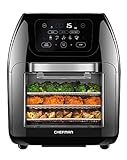
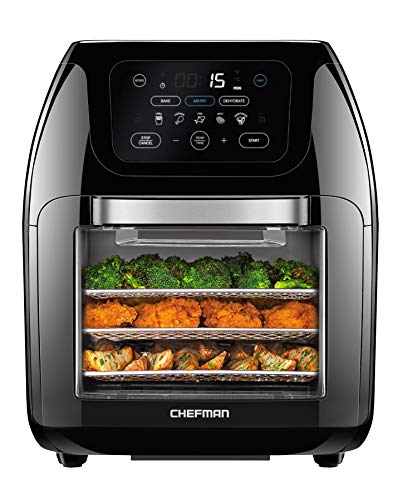
The Chefman Multifunctional offers sheer versatility: air fry, bake, roast, dehydrate, and rotisserie all in a single 10-liter unit. For dehydration specifically, the temperature range tops out at 450°F but dips to a usable low end, and owners report solid results drying jerky and fruit chips across the three mesh racks. The 17 preset options mean you can find dehydrate settings pre-tuned for common projects without constant fiddling. The large viewing window helps you monitor progress without opening the door.
The real draw here is counter space savings if you're juggling multiple cooking needs. One household can roast a whole chicken in the rotisserie, dehydrate jerky on the mesh racks, and bake bread: all from the same appliance. Owners who embrace the multi-function approach and don't use the presets as gospel report exceptional value. That said, some buyers have flagged consistency issues with the touch-screen controls and the door mechanism feeling flimsy after repeated use. The buyer who experienced mid-cooking shutdowns and difficulty turning the unit off raises legitimate safety concerns, though that appears to be an outlier rather than a widespread defect.
Where the Chefman falls short for dedicated dehydration: the three included racks mean managing food placement becomes more complex than single-basket designs, and heat distribution isn't quite as refined as the Instant Pot or Cosori. If dehydration is your primary goal and you have adequate counter space, the Cosori TurboBlaze would deliver better results. But if you're a multitasking cook who dehydrates occasionally alongside other projects, the Chefman's capacity and versatility offer genuine appeal: provided you buy from a seller with reliable returns.
Pros
- Ten-liter capacity with three mesh racks for large batches
- Rotisserie function adds protein-cooking versatility
- 17 presets simplify setup for dehydrating and other functions
Cons
- Touch screen and door durability concerns reported by some users
- Heat distribution less refined than single-basket competitors
Key features (4)
- Temperature range with dehydrate function and 17 touch-screen presets
- 10-liter capacity with three mesh racks and rotisserie spit
- Large interior window for monitoring without opening door
- Five functions: air fry, bake, roast, dehydrate, rotisserie
How to Choose an Air Fryer for Dehydrating
Temperature Range and Low-End Precision
Dehydration requires gentle, consistent heat: ideally starting at 95°F or below. Most standard air fryers max out at 350°F, but dehydration-capable models drop to 90°F–105°F. This lower floor is crucial: herbs and delicate fruit chips scorch quickly above 110°F. Look for models offering 5- or 10-degree temperature increments, which give you fine control. The air fryer dehydrator models we've reviewed all meet this standard, but cheaper alternatives often jump in 25-degree steps, making precision nearly impossible.
Fan Speed and Airflow Control
A key difference between air frying and dehydrating is airflow intensity. When you're crisping fries, high-speed circulation is your friend. When you're drying jerky, too much fan speed unevenly pulls moisture from the exterior, leaving the interior soft. Models with adjustable fan speeds (like the Cosori's five-level system) let you dial back circulation for delicate dehydration work. Single-speed models still work, but they demand longer drying times and closer monitoring to prevent edge-burning.
Basket Capacity and Surface Area
Air fryer capacity matters differently for dehydration than for air frying. A 4-quart basket might hold 2 pounds of fries in a single layer but can handle jerky strips or fruit slices spread across multiple sessions. If you plan to dehydrate regularly, a 5- or 6-quart model with a removable rack system lets you use two layers, effectively doubling your batch size. For the air fryer dehydrator comparison, larger capacity translates to fewer, longer cooking runs instead of many short ones.
Timer and Cooking Duration
Dehydration is a marathon, not a sprint. Jerky runs 4–8 hours; fruit chips take 6–12 hours; herbs dry in 2–4 hours. Your air fryer needs a timer that accommodates these sessions. Most models max out at 24 hours, which works for most home projects. Some high-end dehydrators run longer, but for occasional home use, 24 hours is sufficient. Consider whether the control panel clearly displays remaining time and whether you can adjust it mid-session without restarting.
Build Quality and Ease of Cleaning
Dehydrating produces minimal grease compared to air frying, but long sessions at low heat can bake on residue. Ceramic-coated baskets are gentler on food and much easier to clean than standard nonstick, especially after hours of use. Check whether the basket and racks are dishwasher-safe and whether the control panel and seals resist moisture buildup. A window or light to monitor progress without opening the door helps preserve heat and humidity balance during long runs.
Our picks at a glance
1
Best Overall for DehydratingCosori
2
Best for Beginners and Small Batches 3
Best for Medium-Sized Dehydrating Projects 4
Best Premium Option with WindowInstant Pot
5
Best for Versatile Multitasking KitchensChefman
Frequently asked
Can I use a regular air fryer to dehydrate, or do I need a special model?
Many standard air fryers have a dehydrate setting, but success depends on temperature range and fan control. A model that only drops to 200°F will brown or partially cook most foods. For reliable dehydration, you need 105°F or lower, ideally with adjustable fan speed. All five models we've reviewed meet this threshold. Cheaper air fryers often skip low-temperature capability entirely, so always check the specs before assuming a 'dehydrate' preset will work.
How long does it take to dehydrate jerky or fruit chips?
Beef jerky typically requires 4–8 hours depending on thickness and starting moisture. Fruit chips (thin slices) dry in 6–12 hours. Herbs are quickest, usually 2–4 hours. These times assume consistent temperature (around 160°F for jerky, 135°F for fruit) and adequate airflow. Your first batch is always a learning run: write down times and adjust for your second attempt. The air fryer dehydrating temperature guide covers exact settings by food type, which speeds up trial-and-error.
Is a ceramic coating better than regular nonstick for dehydrating?
Yes. Ceramic coatings withstand hours of low-heat exposure without degrading, and they resist sticking when moisture and natural sugars accumulate. Regular PTFE nonstick can break down over time at lower temperatures and prolonged use. All five models here use ceramic or aluminum bases, which is why they're reliable for multi-hour sessions. Cheaper air fryers sometimes use lower-grade coatings that flake or peel, especially after dehydration work.
Do I need a window to monitor dehydrating progress?
A window helps but isn't essential. It lets you check food without opening the door and losing heat or moisture. Models like the Instant Pot Vortex Plus have windows; others rely on a quick peek at the start and near the end. If you're nervous about your first batch, a window removes guesswork. For regular dehydrators who've dialed in timing, it's a nice-to-have rather than a must-have.
How should I prepare food before dehydrating fruits and vegetables walkthrough?
Prep depends on the food. For jerky, slice meat ¼-inch thick, season, and marinate if desired. For fruit, slice uniformly (¼-inch for chips, thinner for leather) and pat dry. For herbs, strip leaves and discard thick stems. Uniform thickness ensures even drying. Arrange food in a single layer without overlapping; crowding traps moisture. Spray a light coating of oil on savory foods to help browning, but skip oil on delicate herbs. Most failures come from uneven thickness or overcrowding, so prep patience pays off.